Swine Barn Grows With Its Animals
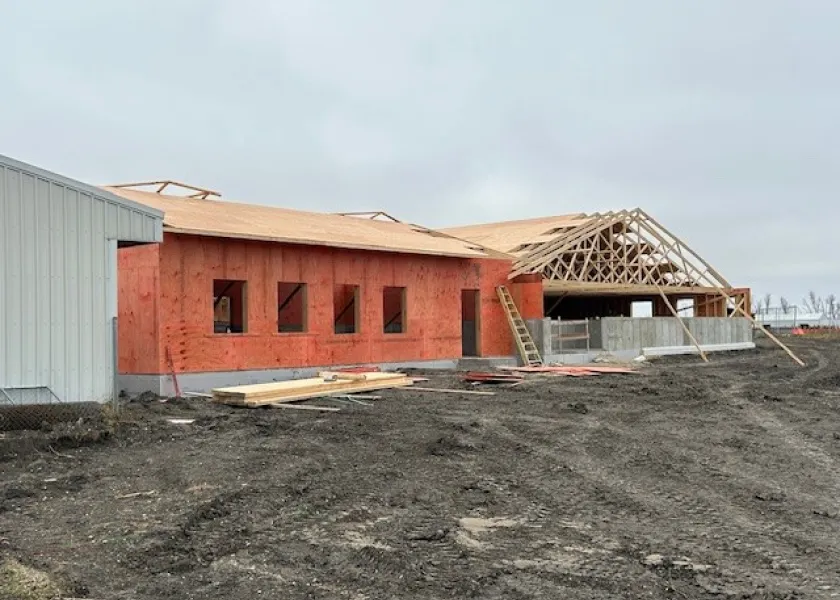
New addition being built to increase capacity and student opportunities
by Darla White Administrative Secretary
The swine industry in North Dakota has a small footprint, er, hoofprint, but the NDSU Swine Unit is doing its best to change that.
The most noticeable indication of that is the construction under way at the barn. Another finishing area is being added that will allow the swine unit to function at full capacity. The current facility, which was built in 1983, contains two farrowing (birthing) rooms. Only one room is used at a time because there’s not enough space for the pigs to reach market weight if both rooms were utilized. The new addition will solve that problem along with making it easier to get the finished pigs to market thanks to a proper loading chute. A classroom is also being built to expand the educational opportunities at the barn.
Megan Kavanagh, the swine unit manager, is excited about the new possibilities. She jumped into the position in August 2024, right as she was finishing her master’s degree from the University of Minnesota. She has a passion for pigs and is eager to share it with others.
“Pigs are smart,” she says. “I like to see their personalities, and the way they’re thinking.” She also appreciates how much can be done with pigs. “The industry is so much larger than it seems,” she says.
Megan and half a dozen student workers take care of the 400 to 500 pigs that are typically at the swine barn. About 75 of them make up the breeding herd -- the sows and boars that stick around for years. The others are the feeder pigs. They grow rapidly and generally are ready for market after five months. Because the unit is a farrow-to-finish operation, students can witness all stages of production in little more than a semester.
Multiple classes visit the barn each semester to get hands-on learning. For example, vet tech students practice blood draws on the pigs.
Students in livestock evaluation assess the breeding hogs. Students in the introductory animal science class learn how to read ear notches. And livestock production students practice handling swine and vaccinating piglets.
Building relationships with undergraduates is a priority for Megan. “Working with students is the highlight of my job,” she says.
Research is also an important mission of the swine barn. Associate Professor Christopher Byrd’s specialty is swine research, so he and his graduate students often have projects going on at the unit. The next one will focus on training sows to have their blood drawn. That one could be interesting, since Megan says the sows have quite a bit of sass and personality.
While there isn’t a swine club at the moment, the barn has a close association with the Saddle and Sirloin Club. The swine unit provides the pigs for the club’s annual Little International. In fact, some lucky pigs at the barn right now will be making their public debut at the 100th Little “I” in February. Megan bred them specifically to be excellent specimens for that historic event.
Megan hopes to invite the public to see the barn’s expansion after construction ends next spring. If all goes well, many more people will see the possibilities of the swine industry and how NDSU is poised to grow -- possibly as fast as its pigs.