19.1 Plant uptake of calcium and the role of calcium in plant nutrition
Plants take up Ca²⁺ primarily using their roots, and then transport it through the xylem cells, which are the same hollow cells that carry the water transpiration stream upwards through the plant. The xylem stream is not an energy controlled 2-way transport. Instead, the rate of the water and solute movement is governed by the pull on the continuous water column, maintained by cohesion and adhesion. Upwards movement occurs based on the difference in water potential between the xylem cells and the air. The stomates in leaves are the exit point for the water as it evaporates into the air, Water is pulled from the area of saturation (the xylem) to the area of less concentration (the air). Along the way, dissolved solutes like Ca²⁺ are shunted into plant cells along the xylem pathway. This absorption into the plant cells, and their substructures such as the mitochondria, are not passive but require energy. During periods of drought when the water uptake from the soil is low, the movement of water and dissolved Ca²⁺ through the xylem is not adequate enough to sustain normal growth and a Ca deficiency can occur. Likewise, in periods of near 100% humid conditions, such as sustained fog or drizzle, the transpiration pull is near zero, which also results in very low flow through the xylem causing stagnation of plant growth. Several days of high humidity can also result in a Ca deficiency.
The role that calcium (Ca²⁺) plays in plant nutrition is complex, and for a more technical explanation of the current understanding and hypotheses of the mechanisms, please see the review by Hepler (2005). Simply put, calcium ions play an important role in the regulation of plant growth and development. Calcium ions act in concert with auxins, gibberellins and other plant hormones to initiate several plant processes, slow them down, or halt them entirely. The protein calmodulin for example, whose name hints to its tight association to calcium, is important in many of the interactions between Ca and different plant hormones. Another very important role calcium plays is in the direct production of microtubules. These muti-tubulin proteins are a main constituent of cell walls and vital to both their shape, and any intercellular transport between them. Ca+2 also strengthens both the cell wall and the subcellular cell wall structures, making them both more rigid and more plastic, both of which are necessary for cell division.
19.2 Calcium deficiency related to cell structure]
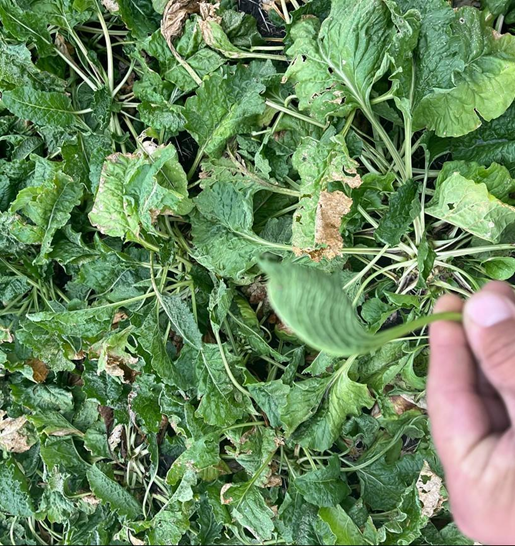
Calcium deficiencies are often seen as the result of undeveloped cell wall structures at the plant growing points, resulting in cell leakage and the ‘stickiness’ of the meristems.
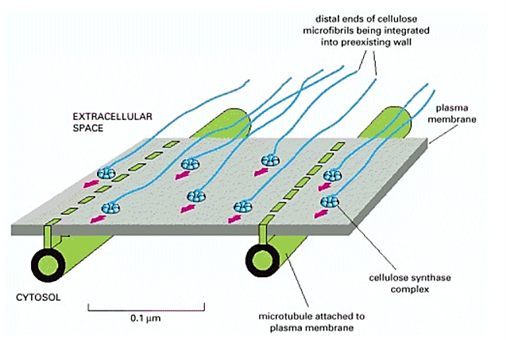
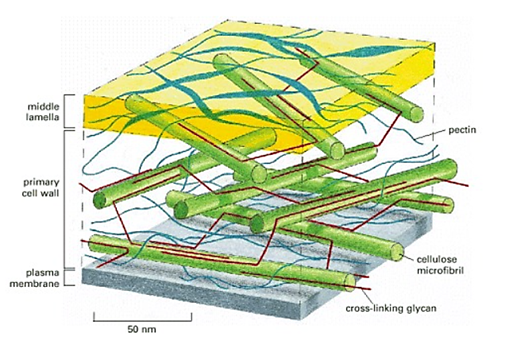
During the construction of the cell wall, cellulose microfibrils are cross-linked at roughly 90-degree angles to each other in multiple layers. Pectin, which is a structural protein, is also included within the layers. Calcium ions (Ca²⁺) cement the pectin to the cellulose, producing a semi-plastic wall, allowing the plant cells to maintain turgidity (due to the osmotic pressure differentials), and stability.
Calcium deficiency can also occur on low pH soils; however, this deficiency is often overshadowed by other issues brought upon by low pH soils such as toxicity from the soluble Al and Mn ions in the soil. Liming with a calcium amendment needs to be applied at sufficient rates to increase the soil pH to adequate levels to overcome a pH-related Ca deficiency. In North Dakota, we have no crops that have specific calcium fertilizer requirements beyond what is required for the remediation of acid soils. In the peanut-growing soils of southeast USA, gypsum (calcium sulfate) is applied due to the unusual Ca requirement of that particular crop. Any gypsum application in North Dakota is confined to the reclamation of sodic soils. A gypsum application can also be done in an effort to apply needed S to the soil, although the solubility of gypsum is low compared to ammonium sulfate.
19.3 References for Calcium crop nutrition
Alberts, B., Johnson, A., Lewis, J., Raff, M., Roberts, K., & Watson, J. D. (2002). The plant cell wall. In Molecular biology of the cell (4th ed.). Garland Science.
Hepler, P. K. (2005). Calcium: A central regulator of plant growth and development. The Plant Cell, 17(8), 2142–2155. https://doi.org/10.1105/tpc.105.032508