Soil is composed of mineral and organic fractions, as well as various pore spaces filled with either air or water. In North Dakota, a typically productive soil—offering good economic and environmental potential—is composed of approximately 50% mineral/organic material and 50% pore space. Of the pore space, about half is filled with water and the other half with air. Figure 2.1 illustrates this idealized soil composition by volume.
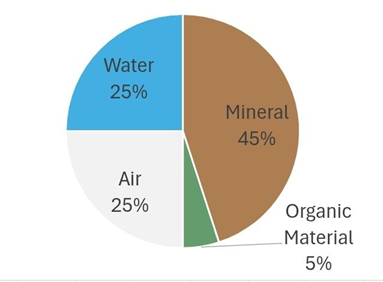
In North Dakota, the solid component of soil (excluding air and water) is typically 92%–99.5% mineral by weight. The remainder consists of organic material, including decomposed and non-decomposed plant residues, microorganisms, and weed seeds.
2.1 Concept of Soil Texture
The Natural Resources Conservation Service (NRCS), formerly known as the Soil Conservation Service (SCS), defines soil particles as sand, silt, or clay. These categories are further divided based on particle size (see Table 2.1). The term “texture” refers to the feel of soil. Soil scientists often use “by-feel” techniques—also called hand texturing—to estimate the texture of a sample. This involves rolling a moist soil sample into a ball, then forming a ribbon between the thumb and forefinger. The ribbon’s length before breaking provides insight into the clay content.
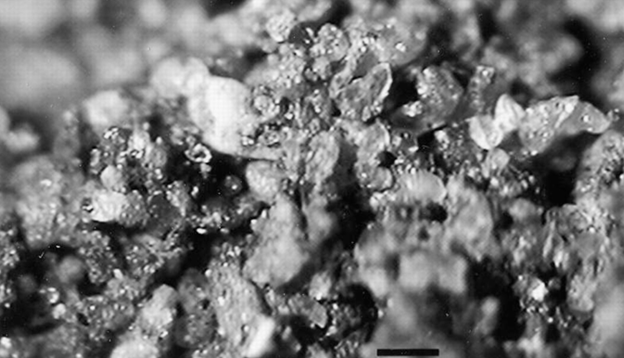
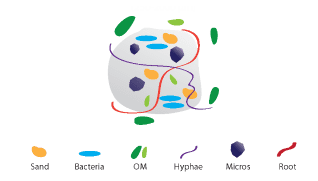
For greater precision, laboratory methods are used to measure particle distribution. The USDA NRCS textural triangle defines the boundaries of soil texture classes such as sandy loam or silty clay loam (Figure 2.2). Soil particles are distributed randomly within the soil matrix and are often bound into aggregates by biological factors like fungal hyphae and plant root exudates (Figure 2.3).
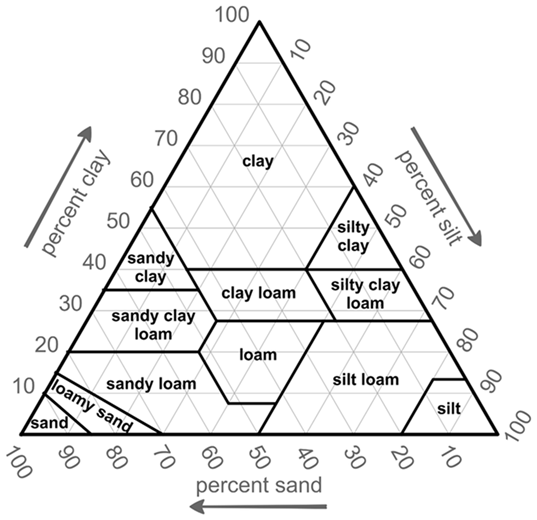
Table 2.1. USDA NRCS definition of sand, silt, and clay particle sizes.{.unnumbered}
| Particle Name | Diameter (mm) |
|---|---|
| Total sand | 2.0 – 0.05 |
| Very coarse sand | 2.0 – 1.0 |
| Coarse sand | 1.0 – 0.5 |
| Medium sand | 0.5 – 0.25 |
| Fine sand | 0.25 – 0.10 |
| Very fine sand | 0.10 – 0.05 |
| Total silt | 0.05 – 0.002 |
| Coarse silt | 0.05 – 0.02 |
| Fine silt | 0.02 – 0.002 |
| Clay | < 0.002 |
2.2 Mineral Composition of Soil Particles
2.2.1 Sand
While sand is often thought to consist mainly of quartz, it can also include feldspars and other weathered rock minerals. Silt is similar in composition but finer and often amorphous (non-crystalline).
2.2.2 Clay
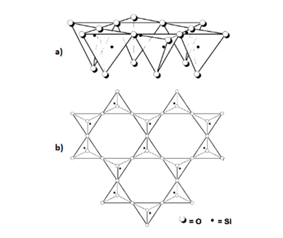
Clay is the smallest particle size category. In North Dakota, clays are typically made up of clay minerals and amorphous components. These minerals form from weathered mica, which has a layered “sandwich” structure of silicon oxide and aluminum hydroxide (Figures 2.4 and 2.5).
As mica weathers, potassium ions (K⁺) leach out, converting the mineral to hydrous mica or illite. Illite maintains a 2:1 structure but with more freedom between sheets, allowing limited shrink–swell behavior. Further leaching results in smectites (e.g., montmorillonite), which expand and contract significantly depending on moisture (Figures 2.6–2.8).
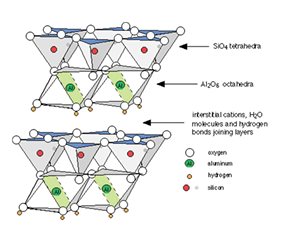
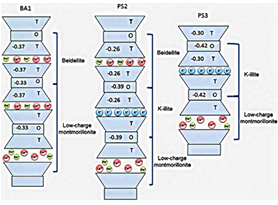
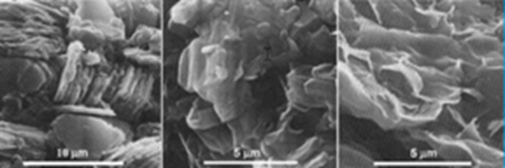
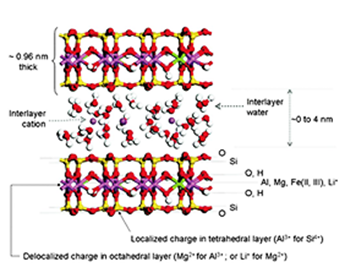
Different clay minerals influence soil properties in unique ways (Franzen & Bu, 2018). Smectites resist compaction due to their shrink–swell capacity. Illites show limited swelling, primarily at the edges, while kaolinites do not swell at all.
2.3 Soil Aggregation
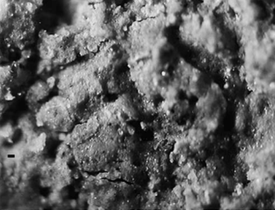
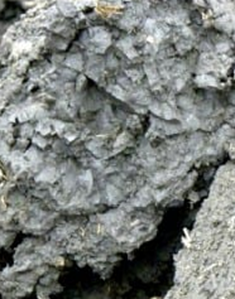
Soil particles form aggregates, which improve water infiltration, root penetration, erosion resistance, and structural resilience. Aggregation also enhances nutrient retention and organic matter stability. Aggregates form through interactions among microorganisms, plant exudates, decomposition products, and clay particles (Figures 2.9–2.11).
Macroaggregates—larger and less stable—include silt, clay, organic material, and living organisms. Microaggregates are more stable and are key to long-term organic matter storage.
2.4 References
- Franzen, D. W., & Bu, H. (2018). North Dakota clay mineralogy impacts crop potassium nutrition and tillage systems. NDSU Extension Publication SF1881, 1–12.
- Guimarães, V., Rodríguez-Castellón, E., Algarra, M., Rocha, F., & Bobos, I. (2016). Kinetics of uranyl ions sorption on heterogeneous smectite structure. Applied Clay Science, 134, 71–82.
- Hopkins, D. G., & Franzen, D. W. (2003). Argillic horizons in stratified drift. Soil Science Society of America Journal, 67(6), 1790–1796.
- Karpiński, B., & Szkodo, M. (2015). Clay minerals and swelling in the oil & gas industry. Advances in Materials Science, 15(1), 37–55.
- Lower, S. (2014). The Earth’s Crust. LibreTexts Geosciences. https://geo.libretexts.org
- Ras, R. H., Umemura, Y., Johnston, C. T., Yamagishi, A., & Schoonheydt, R. A. (2007). Ultrathin hybrid films of clay minerals. Phys. Chem. Chem. Phys., 9(8), 918–932.
- Tovey, N. K. (1971). A selection of scanning electron micrographs of clays. University of Cambridge, Dept. of Engineering.