| Table 21.1. Soybean yield as affected by preplant N rate and oat cover crop | |||||||||
|---|---|---|---|---|---|---|---|---|---|
| Eight Minnesota IDC sites, 2006–2009 | |||||||||
| N applied (lb/ac) | Oats |
Yield (bushels per acre)
|
|||||||
| C06 | YM06 | K07 | YN07 | C08 | R08 | C09 | R09 | ||
| 0 | No | 42.1 | 52.0 | 3.7 | 51.7 | 34.3 | 30.4 | 51 | 42 |
| 100 | No | 28.6 | 32.2 | 0.3 | 46.5 | — | — | — | — |
| 200 | No | 25.3 | 19.1 | 0.1 | 40.2 | — | — | — | — |
| 0 | Yes | 42.5 | 52.4 | 40.2 | 50.7 | 41.7 | 28.1 | 50 | 44 |
| 100 | Yes | 20.5 | 42.6 | 24.5 | 43.4 | — | — | — | — |
| 200 | Yes | 18.9 | 25.9 | 7.2 | 33.7 | — | — | — | — |
| *Headings indicate different sites/years of study (Bloom et al., 2011).* | |||||||||
21.1 Iron in crop nutrition
Iron (Fe) is classified as a micronutrient because of the small amount crops require to grow and reproduce. Regardless of the quantity, Fe is very much an essential nutrient to many plant functions and metabolic pathways. Iron in its oxidized form is present in abundance in North Dakota soils and soil minerals. The Fe present in the earth’s surface constitutes around 5% of its total weight. However, this does not mean it is plant-available. Iron’s availability to plants and crops is restricted by its solubility. For example, in its reduced form, ferrous iron Fe²⁺, is highly soluble and can occur at relatively high concentrations in groundwater under anaerobic conditions. When ferrous Fe (Fe²⁺) is exposed to oxygen it is oxidized to it ferric form (Fe³⁺), a reaction that proceeds forward very quickly, and changes the solubility of the Fe from 10-2 moles per liter (about 0.56 g/liter) to 10-10 moles per liter (0.0000000056 g/liter), meaning Fe³⁺ is about a trillion times less soluble than Fe²⁺.
The majority of Fe taken up by plants is the reduced Fe²⁺ form. Some plants, however, including many grasses, use phytosiderophores that chelate the Fe+3 form and enable its transport into the plant. Various molecules exuded from the plant’s roots can act as phytosiderophores, such as non-protein forming amino acids. Once inside the plant, Fe is translocated via the xylem to the target/deficient plant tissue or organelle. Because Fe only moves through the xylem, it is not readily retranslocated to newer areas of plant growth or deficient tissue, making any signs of an Fe deficiency appearing first in the younger, actively growing tissues. A foliar application of Fe results in its immediate uptake; however, the Fe taken up through the leaf tissue is unable to translocate to newer growth and is only utilized only in the tissues to which it is applied. Therefore, foliar Fe applications are only effective in relieving the symptoms of an Fe deficiency on the tissue that the spray comes in contact with.
One of the roles Fe plays in plants is centered around the production of haem structures and enzymes —including catalase, peroxidase, cytochrome oxidase and several cytochromes. Catalase involves the breakdown of peroxides to its constituents’ water and oxygen H2O2 + H2O2 → 2H2O + O2, and is an important enzyme in chloroplasts acting as the main source of oxygen release from photosynthesis. Peroxidase is present in many processes including the formation of structural lignins from phenols. Another role Fe has in plants is as a key electron acceptor/donor via the electron transfer between Fe²⁺ ⇌ Fe³⁺.
## Iron deficiency chlorosis (IDC)
In green plants, there is a direct positive relationship between overall greenness and the concentration of Fe in the vegetation. Iron is crucial for the biosynthesis of chlorophyll; however, it is not a constituent of the chlorophyll molecule itself. Iron is also part of the photosynthetic chain of reactions that produces chemical energy from light. In North Dakota, symptoms of an Fe deficiency are most commonly evidenced, and easily recognizable as, iron deficiency chlorosis (IDC) in soybean.
In soybean, Fe is mobile in the plant from germination through the first mono-foliate leaf. As the first trifoliate leaf emerges however, Fe becomes immobile in the plant and must be continuously taken up by plant roots to meet demand and avoid deficiency. The soybean strategy for Fe uptake begins by the soybean roots acidifying their immediate surroundings in the rhizosphere. The acidic soil environment is necessary for the Fe-reducing proteins that the soybean root secretes (Mallarino et al., 2001). If the rootzone remains acidic, the soybean-exuded Fe-reducing proteins come in contact with oxidized iron and reduce it to its soluble ferrous iron, making it available to the plant.
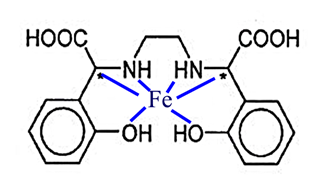
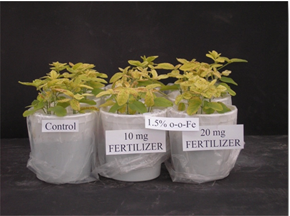
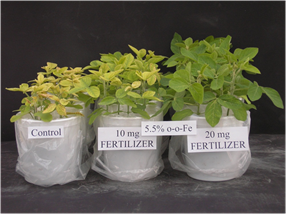
Soil carbonates (CO₃²⁻) are the primary causal agent of IDC (Schmidt, 1999). As the soil becomes wetter, the concentration of dissolved carbonates increases, which exist in equilibrium with the bicarbonate anion (HCO₃⁻) (Franzen & Richardson, 2000). Bicarbonate neutralizes soil acidity by reacting with H⁺. When bicarbonate is present in calcareous soil, it can neutralize the acidified rhizosphere of the soybean plants, counteracting the activity of the secreted Fe-reducing proteins (Zocchi et al., 2007; Bloom & Inskeep, 1986). Iron foliar sprays generally are not very effective in correcting Fe deficiencies. The best application to reduce IDC is ortho-ortho-EDDHA Fe chelate applied with water in-furrow at seeding. The ortho-ortho-EDDHA succeeds in delivering Fe to the plant’s roots early in the season. It also has the added benefit of remaining as an empty chelate in the soil solution post-Fe-delivery, where it can then bind to an additional Fe, and moving through the soil water stream, deliver it to the soybean roots as well (Chatterjee et al., 2017). The ratio of ortho-ortho Fe-EDDHA in relation to ortho-para Fe-EDDHA (Figure 21.1) in an Fe-EDDHA fertilizer is very important. Recent research at NDSU has shown that the response of soybeans to Fe-EDDHA fertilizer is directly proportional to the percentage of ortho-ortho Fe-EDDHA present (Figure 21.2).
An effective IDC prevention strategy does not rely on the application of ortho-ortho-EDDHA alone, but must be built on a comprehensive approach to the condition, for example a grower can start by selecting an IDC-tolerant soybean variety. A recent four-state study led by NDSU found that the highest yields for a soybean field with a mix of soils susceptible and unsusceptible to IDC can be best attained by seeding a high-yielding IDC-susceptible cultivar in non-IDC soils and an IDC-tolerant cultivar in the IDC-susceptible soils (Helms et al., 2010).
Additional NDSU greenhouse experiments have shown that Fe-HBED (Fe-N,N′-bis(2-hydroxybenzyl)ethylenediamine-N,N′-diacetate) resulted in similar Fe uptake and soybean biomass compared with 80% Fe in ortho-ortho-EDDHA. Therefore Fe-HBED has potential to be used as an Fe fertilizer to reduce IDC symptomology. To reduce IDC pressure, soybeans should be seeded in rows wider than 15 inches, as long as the wider row-spacing does not sharply increase weed pressure. Soybeans in densely seeded rows are taller and have less IDC symptoms, compared with the normally seeded fields. Similar reduction in IDC symptoms is seen as soybeans are seeded closer to each other in wider row spacings or higher seeding rates (Goos & Johnson, 2001). The exact mechanism of how a denser stand can limit IDC is not known, yet many growers have seen evidence of it when their planter stops within the field and then leaves a high strip of seeds behind when it resumes planting again. One of the reasons for IDC reduction with a denser seeding rate might be related to reduced soil moisture under the row, or greater root-zone acidity that favors activity of the Fe-reducing soybean root secretions. A three-state study (ND, MN and SD) found that seeding a cover crop of 1 bushel per acre of oats or other easily killed small-grain cover crop, in the soybean field near the date of soybean planting can reduce excess water and take up some of the excess soil nitrate (Figures 21.3 and 21.4; Kaiser et al., 2014). Depending on soil moisture, the oats may be then killed with herbicide early if conditions are dry, or allowed to grow up to the five-leaf stage if the season is wet. The use of an oat cover crop in Minnesota has resulted in as high as 40 bushels per acre more soybeans d, compared to a no inter-crop site during a wet year (Bloom et al., 2011) (Table 21.1).
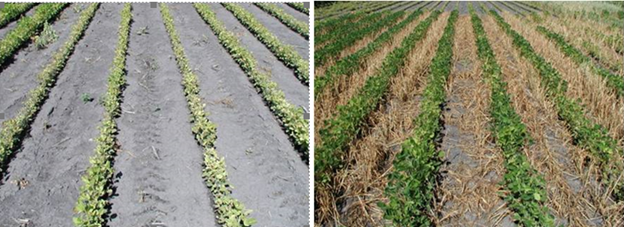
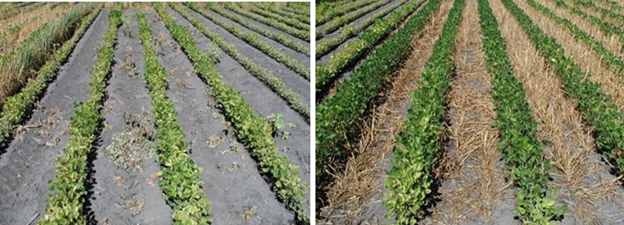
Table 21.1 Soybean yield as affected by preplant N rate and seeding an oat cover crop at eight Minnesota IDC sites, 2006-2009. (Bloom et al., 2011).
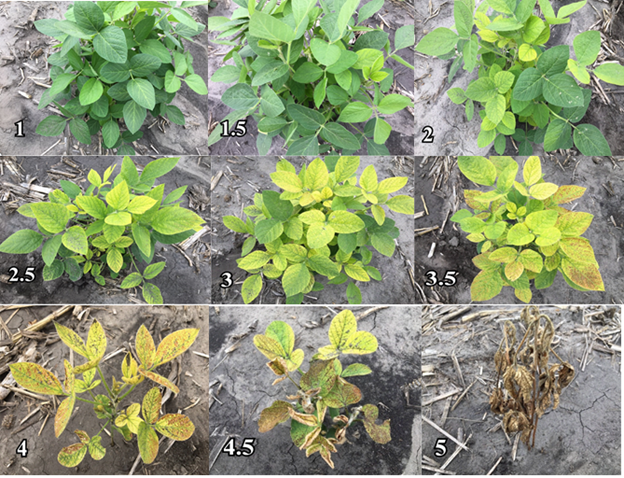
Because soil salinity aggravates and increases the severity of IDC, a comprehensive, rotation-based strategy should be imposed to reduce soil salinity as much as possible. The strategy should include selecting only salinity-tolerant crops; using alfalfa strips to reduce roadside salinity; using alfalfa above saline seeps to reduce the severity of the seep; planting cover crops whenever possible before, during or after cropping to reduce field water table; and installing tile drain, if possible, practical, economical, and socially and/or regulation permissible. A pictorial representation of the IDC ratings for soybeans used by the NDSU soybean breeders and scientists can be found in Figure 21.5. It is possible that in high carbonate, high salt soils, some IDC might also be seen in other crops; however, the extent of the IDC severity in other crops is almost always small compared to serious whole-field issues seen in soybean.
21.2 References for iron nutrition in crops
Bloom, P. R., & Inskeep, W. R. (1986). Factors affecting bicarbonate chemistry and iron chlorosis in soils. Journal of Plant Nutrition, 9(3–7), 215–228.
Bloom, P. R., Rehm, G. W., Lamb, J. A., & Scobbie, A. J. (2011). Soil nitrate is a causal factor in iron deficiency chlorosis in soybean. Soil Science Society of America Journal, 75(6), 2233–2241.
Chatterjee, A., Lovas, S., Rasmussen, H., & Goos, R. J. (2017). Foliar application of iron fertilizers to control iron deficiency chlorosis of soybean. Crop, Forage & Turfgrass Management, 3. https://doi.org/10.2134/cftm2017.05.0037
Franzen, D. W., & Richardson, J. R. (2000). Soil factors affecting iron chlorosis of soybean in the Red River Valley of North Dakota and Minnesota. Journal of Plant Nutrition, 23(1), 67–78.
Goos, R. J., & Johnson, B. (2001). Seed treatment, seeding rate and cultivar effects on iron deficiency chlorosis of soybean. Journal of Plant Nutrition, 24(8), 1255–1268.
Helms, T. C., Scott, R. A., Schapaugh, W. T., Goos, R. J., Franzen, D. W., & Schlegel, A. J. (2010). Soybean iron-deficiency chlorosis tolerance and yield decrease on calcareous soils. Agronomy Journal, 102(2), 492–498.
Kaiser, D. E., Lamb, J. A., Bloom, P. R., & Hernandez, J. A. (2014). Comparison of field management strategies for preventing iron deficiency chlorosis in soybean. Agronomy Journal, 106(6), 1963–1974. https://doi.org/10.2134/agronj2014.0105
Mallarino, A. P., Haq, M. U., Wittry, D., & Bermudez, M. (2001). Variation in soybean response to early season foliar fertilization among and within fields. Agronomy Journal, 93(5), 1220–1226.
Schmidt, W. (1999). Mechanisms and regulation of reduction-based iron uptake in plants. New Phytologist, 141(1), 1–26.
Zocchi, G., De Nisi, P., Dell’Orto, M., Espen, L., & Gallina, P. M. (2007). Iron deficiency differently affects metabolic responses in soybean roots. Journal of Experimental Botany, 58(5), 993–1000.