26.1 Boron nutrition in plants
The main source of boron (B) in North Dakota soils is granite, where traces of tourmaline are typically found. Tourmaline is the most important B-containing mineral, and can be up to 3% B by weight. During phyllosilicate crystal formation, B can substitute for Si in the crystal lattice formation, as part of the isomorphous substitution that is common in clay minerals. Boron in the soil consists of the B(OH)₃ molecule, which is unique in that the hydroxyl (OH) groups do not dissociate with pH change, and also as a non-charged entity. With some of its most common forms in soil lacking a charge, it results in B’s being very susceptible to leaching. As the soil pH increases, B(OH)₃ may acquire an additional OH group, producing B(OH)₄⁻, which can be readily adsorbed by illitic clays minerals. Unlike the cation exchange, this adsorption is a replacement of OH⁻ groups on the clay adsorbing surface with B(OH)₄⁻. Borate is another form of B in the soil that is closely associated with and held by soil organic matter. Soil organic matter is the main source of plant available B across North Dakota. Most B in the soil is unavailable for plant uptake during any given growing season. The soil test for plant available B is the hot-water extraction method (Watson, 2015). However, the hot-water B analysis has only been calibrated for alfalfa in Wisconsin and should not be considered diagnostic in ND.
26.2 Boron deficiency in crops and in North Dakota
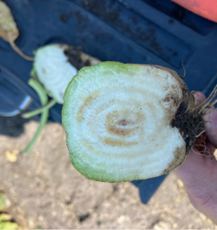
In North Dakota, sunflower and sugar beet are the two most sensitive crops to low soil B levels. In sunflower trials across North Dakota, even at B values as low as 0.2 ppm, there has been no reported yield increase from the application of additional soil applied or foliar B within the past 20 years. Likewise, no yield or sugar concentration increases have been recorded in sugarbeet under normal growing conditions within the same past 20 years of experiments. Physiological B deficiencies in sugarbeet have been recorded, but only during extended drought periods, or in periods of continuously high humidity, fog, drizzle. Since B is moved through the plant via the xylem transpiration pull, any conditions that limit water uptake can also result in B deficiency. A B deficiency in sugarbeet typically result in the death of the growing point, appearing as blackened meristem in the whorl, and then overtime extending out forming darkened regions within the root (Figure 26.1).
Boron plays a key role in the construction of cell walls, and is part of the cross-linked pectin assembly discussed in the previous calcium chapter of this resource. Boron also helps to control many active transport mechanisms through influencing the cell wall and cell membrane proteins and enzymes. Boron is also involved in supporting nitrate reductase activity and indirectly influences many plant processes by supporting both functional cell walls and cell membranes. Boron is considered an immobile nutrient within plants; therefore, a continuous supply of B is required throughout the growing season. The concentration variance of B between deficiency and toxicity is much narrower than other plant nutrients, so care must be taken to not to apply B when not needed, or overapply it, otherwise producers risk B toxicities.
26.3 References for Boron nutrition of North Dakota crops
K. Mengel and E.A. Kirby. 1987. Principles of Plant Nutrition. Chapter 18 pp 559-568. International Potash Institute. Bern, Switzerland.
Watson, M.E., 2015. Chapter 10 Boron, 10.1-10.4 North Central Regional Pub No.221, revised. https://extension.missouri.edu/media/wysiwyg/Extensiondata/Pub/pdf/specialb/sb1001.pdf