At first glance of this title, I can only imagine many of you will either skip this chapter, or at least want to skip it. Don’t be afraid! You need to understand what happens in soil and why.
5.1 Cations and Anions
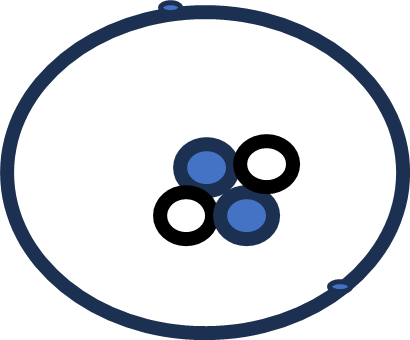
All matter is composed of atoms. Atoms consist of a nucleus with protons (positively charged) and neutrons (that have no charge of attraction), Masson (1921). Protons and neutrons are not single particles but are a combination of sub-particles bound by gluon. They have distinct diameters and weights, these along with the various pressures within the proton and neutron are all studied by atomic physicists. For basic soil chemistry understanding, only the properties of positive charge for protons and neutral charge for neutrons are important. Electrons are very small very fast particles, with a negative charge, by convention, equal to the magnitude of the proton’s positive charge. Therefore, as the electrons orbit the nucleus the overall charge of the atom is zero or neutral, if the number of protons and electrons are equal. If the atom has a greater or lesser number of electrons compared to the nucleus’s proton(s), it results in an electric charge, and is classified as an ion.

5.2 Atoms, Their Organization into the Periodic Table of Elements and Importance of Electron Orbitals
The atomic weight of an element is the sum of the protons and neutrons of an individual atom of that element. Although the electron shells may be more or less than the number of protons ー giving the atom a positive or negative chargeー in nature the number of protons and neutrons never varies.
In 1811, a mole of atoms was defined as the weight of 6.023 × 10²³ atoms. The weight of 1 mole of hydrogen (H) is actually the origin of the weight defined as a gram. The weight of H per mole is defined as 1 gram. The weight of Helium (He) is 4 grams (2 protons, 2 neutrons). So whereas the atomic weight is the total weight of protons and neutrons in an atom, the atomic number is defined by only the number of protons per atom.
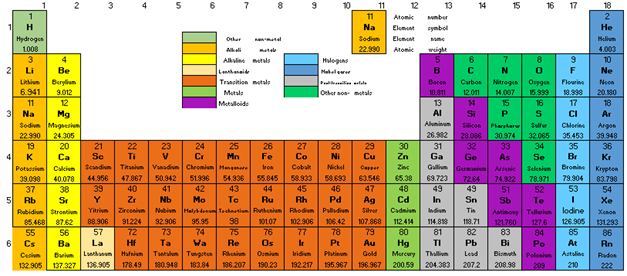
In soil fertility, and any branch of science that refers to atom, a shorthand or abbreviation of the element name is used. The abbreviation is often derived from Latin, not English, so potassium for example is K, which stands for kalium. The following are the elements whose acronym comes from Latin:
- Sodium – Na, from Natrium
- Potassium – K, from Kalium
- Copper – Cu, from Cuprum
- Tin – Sn, from Stannum
- Antimony – Sb, from Stibium
- Tungsten – W, from Wolframite
- Gold – Au, from Aurum
- Mercury – Hg, from Hydrargyum
- Lead – Pb, from Plumbum
5.3 Salts of Strong Acids and Strong Bases and Weak Acids and Weak Bases
In soil, most elements are present in their ionic state due to both the presence of water and their weathering history. Soil solutions have salts of strong acids and salts of weak acids. Salts of strong acids include any compound with a Cl⁻¹ or SO₄⁻² as the anion component. A strong base would be any compound with O⁻² or OH⁻¹, i.e., CaO or KOH.
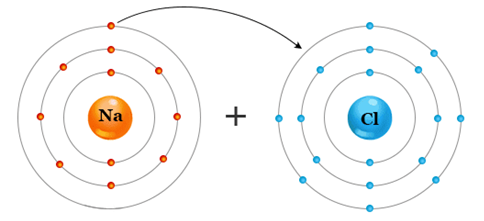
NaCl is fully soluble in water, meaning it completely dissociates. There is no solubility constant to consider compared to the degree of solubility of the salt of a weak acid or a weak base. The electron shell configurations involved in the ionization and association of Na⁺ and Cl⁻ are shown in Figure 5.4.
\[\text{NaCl + H₂O} \rightarrow \text{Na}^+ + \text{Cl}^- \; \text{(aqueous)}\]
5.4 Water Facilitates Solubility of Ions Due to Its Polar Nature
Although water is a neutral compound on paper, where the two H⁺ ions are balanced by the O⁻² ion, the spatial configuration of the molecule in three dimensions results in a positive end where the H⁺ ions are located compared to a negative end where the O⁻² ion is located. The location of positive and negative charge on opposite sides of a molecule results in polarity of the molecule.

Salts of weak acids include phosphates (H₂PO₄⁻¹, HPO₄⁻², PO₄⁻³), carbonates (CO₃⁻²) and acetates (CH₃COO⁻) and the salts of the weak bases include ammonia (NH₃). Solubility of salts of weak acids and bases are very pH dependent on the degree of solubility in water and affect the pH of their solution
Example
NaAc → Na⁺ + Ac⁻¹
Where Ac = CH₃COO
And H₂O + Ac⁻¹ → HAC + OH⁻¹
The dissociation constant (K_b) for the Ac⁻¹ of HAC is:
\[Kb = ([HAC] × [OH⁻¹]) / [Ac⁻¹] = 1.75 × 10⁻⁵\]
5.5 Activity vs. Concentration
In chemistry, activity is the measure of the reactivity of the ion toward other solutes in the solution. In measuring soil pH, the pH meter is actually measuring the H⁺ ion activity and not the actual concentration…
5.6 Oxidation and Reduction of Crop Nutrients in Soil
The definition of oxidation in chemistry is the loss of electrons. The definition of reduction in chemistry is a gain of electrons…
Fe⁺² is a significant ion in the soil solution in aerobic soils with a pH < 5. Its solubility decreases by 1,000 with every 1 unit increase in soil pH.
5.7 Reference for Basic Chemistry
- Masson, O. 1921. XXIV. The constitution of the atoms. The London, Edinburgh, and Dublin Philosophical Magazine and Journal of Science, 41(242):281–285.
- National Center for Biotechnology Information. (n.d.). PubChem periodic table. National Institutes of Health. https://pubchem.ncbi.nlm.nih.gov/periodic-table/PMC
- Priyam Study Centre. (2022, June). Sodium chloride (NaCl): Uses, crystal structure, and properties. https://www.priyamstudycentre.com/2022/06/sodium-chloride.html
- Sparks, D.L., Singh, B., & Siebecker, M.G. (2023). Environmental Soil Chemistry (3rd ed.). Academic Press, Elsevier. https://doi.org/10.1016/B978-0-443-14034-1.X5000-2