7.1 What Cation Exchange and Cation Exchange Capacity Are
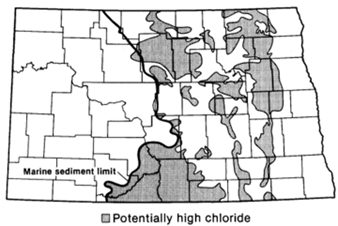
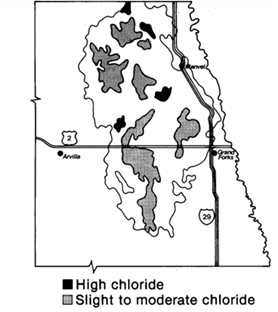
To understand certain chemical processes that contribute to the physical and chemical properties of soil, one needs to have a better understanding of what cation exchange and cation exchange capacity are. A cation is a positively charged ion, with Ca²⁺, Mg²⁺, K⁺, NH₄⁺, Na⁺ and H⁺ as the most abundant cations found in North Dakota soils. An anion is a negatively charged ion, with sulfate (SO₄²⁻), chloride (Cl⁻), nitrate (NO₃⁻), carbonate (CO₃²⁻), bicarbonate (HCO₃⁻) and sulfate are the dominant anions in most North Dakota soils. Chloride specifically is highly present in soils of northeast North Dakota and a few other areas in the state (Figure 7.1, 7.2).
There are two types of cation exchange capacities (CEC) in North Dakota soils:
pH-dependent charge
Permanent charge
The pH-dependent charge is based on organic matter charge sources and clay based charge, while the permanent charge is primarily associated with the structure of specific clay minerals. Soil organic matter contains functional groups such as carboxyl (–COOH), amino (–NH₂), and thiol (–SH) groups. These groups can gain or lose protons (H⁺) depending on the soil pH. At higher pH levels, these groups tend to lose protons, becoming negatively charged (e.g., –COO⁻, –NH⁻, –S⁻), which increases the soil’s capacity to hold positively charged nutrient ions. Conversely, at lower pH levels, these groups are more likely to retain their protons, reducing the number of negative charges available for cation exchange limiting the number of positively charged nutrients the soil can hold. Thus, the cation exchange capacity contributed by organic matter increases as soil pH increases.
Permanent charge is different and as the name implies is an inherent unchangeable property of the soil. Permanent charge is a product of a process called isomorphous substitution, which is when clay minerals crystalize in the original magma of their metamorphic formation. In other words, permanent charge is a natural feature of soil that doesn’t change over time. It forms deep in the Earth when certain minerals (like clay) are created from melted rock. During that process, tiny changes happen in the mineral’s structure that give it a lasting electrical charge.
In the silicon oxide (SiO₂) clay sheet (see clay minerals section), Si, with a +4 charge, has a similar radius to Al, with a +3 charge. Substitution of Si⁺⁴ with Al⁺³ is a common reaction in silicon oxide clay sheets. The switch between a +4 and +3 charged atom results in a negative charge of that clay sheet. (Note the calculation works if you remember that oxygen has a -2 charge.) Similarly, in the aluminum octahedral sheet of clays, Mg⁺² has a similar radius as Al⁺³. It is common for Mg⁺² to substitute for Al⁺³ in the octahedral sheet. The +2 atom replacing a +3 atom results in a net negative charge of the clay sheet.
The common measure of the negative soil charge is the cation exchange capacity, with units of milliequivalents per 100 g of soil (meq/100 g) or centimoles of charge per kg of soil (cmol₊/kg). Note that one meq/100 g is equal to one cmol₊/kg.
Not all cations interact with the surface of the clay particles the same, some are held more tightly to the surface than others, these cations in direct association with the clay surface are called, in chemistry, the Stern layer. Others stay slightly farther away but are still attracted to the clay and not free to move through the soil. This outer layer is called the Gouy layer or Gouy-Chapman layer. Other cations stay slightly farther away from the clay surface, but are still attracted to the clay particle, unable to move freely throughout the soil due to its pull. This layer is defined, in chemistry, as the Gouy layer or Gouy-Chapman layer. The cations held onto or by the clay particles’ negative charge can be exchanged with other cations in the soil solution. A Ca²⁺, for example, may take the place of two H⁺ as long as the total charge across all of the negatively charged sites on the clay particle are balanced, this is referred to as cation exchange.
7.2 Methods for Cation Exchange and Caption Exchange Capacity Determination
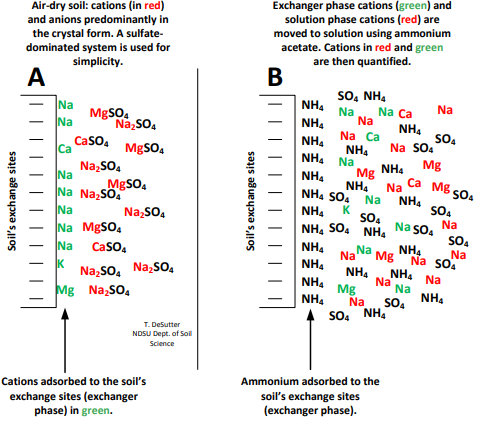
The CEC of a soil can be determined by one of two methods. The principle method, that works for most soils, is referred to as the 1N method. The 1N stands for 1 normal, or one mole method. A mole is a gram equivalent weight of Avogadro’s number (6.0221408 × 10²³) of atoms in 1 liter of water. The 1N ammonium acetate method is strictly defined in the NCERA-13 publication “Recommended Chemical Soil Test Procedures for the North Central Region” (Warncke & Brown, 1998). In soil with no free lime and with very low soluble salts, the 1N ammonium acetate method results in extraction of the cations, held onto the negative exchange sites of the clay particles in the soil sample by “bumping off”, replacing, or exchanging them with ammonium, with the newly freed cations being measured in the solution. When 1N ammonium acetate is added in equivalent molar quantities, and the method is properly followed, the resulting measurement closely approximates the actual CEC of the soil sample (see Figure 7.3 for reference).
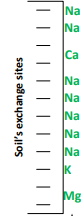
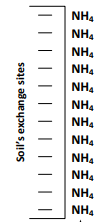
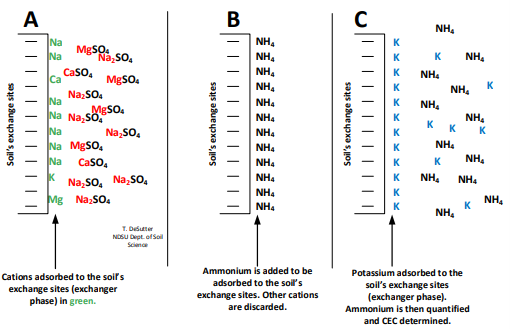
When soluble salts and/or free lime are present in the soil in high amounts, the simple 1N ammonium acetate extraction overestimates the real CEC of the soil (Figure 7.4). The reason being that the soil test method also extracts calcium from the naturally occurring soil mineral calcium carbonate, which is not held on cation exchange sites. Therefore in these soils to measure the real CEC, the method is to take the soil sample and mix it with 1N ammonium acetate or 1N sodium acetate, the mixture is then filtered, and the filtrate is discarded. The ammonium (or sodium) replaces all the ammonium- or sodium-saturated soil is then mixed with KCl solution, the potassium “bumps off” all of the held on ammonium or sodium and they are analyzed in the resulting filtrate (Figure 7.5). This method eliminates non-CEC-related cations present in the original soil (EPA; Chapman, 1965).
7.3 References for Cation Exchange and Cation Exchange Capacity
- Bluemle, J. P. (1971). Depth to bedrock map (Misc. Map No. 13). North Dakota Geological Survey.
- Chapman, H. D. (1965). Cation-exchange capacity. In C. A. Black (Ed.), Methods of soil analysis. Part 2: Chemical and microbiological properties (pp. 891–900). American Society of Agronomy.
- Richardson, J. L., Fanning, C., & Goos, R. J. (1988). Chloride distribution in North Dakota soils (NDSU Extension Publication SF-946). North Dakota State University Extension, Fargo, ND.
- U.S. Environmental Protection Agency. (n.d.). Method 9081: Cation-exchange capacity of soils (sodium acetate). https://www.epa.gov/sites/default/files/2015-12/documents/9081.pdf
- Warncke, D., & Brown, J. R. (1998). Potassium and other basic cations (Rev. January 1998). In Recommended chemical soil test procedures for the North Central Region (North Central Regional Research Publication No. 221, Section 7). University of Missouri Extension. https://extension.missouri.edu/media/wysiwyg/Extensiondata/Pub/pdf/specialb/sb1001.pdf