9.1 Soil Health Definitions
A healthy soil supports an active biological community, both micro and macro; minimizes soil and nutrient loss due to wind and water erosion; minimizes the need for supplemental crop nutrient additions; supports soil aggregate development that aids in trafficability of field equipment; and sustains productivity and environmental services over time. The definition from the USDA NRCS, which is a dominant supporter of soil health practices in the U.S., states, > “Soil health is defined as the continued capacity of soil to function as a vital living ecosystem that sustains plants, animals, and humans. Healthy soil gives us clean air and water, bountiful crops and forests, diverse wildlife and beautiful landscapes” (2024).
9.2 General Guidelines to Improve Soil Health
According to the Soil Health Division of USDA NRCS, there are five essential functions of a healthy soil: - Regulate water flow on and within the soil - Sustain plant and animal life - Filter and buffer potential pollutants - Cycle nutrients - Provide physical stability and support
To achieve these five functions, the USDA NRCS focuses on four principles: - Maximize the presence of living roots - Minimize soil disturbance - Maximize soil cover - Maximize biodiversity
To maximize the presence of living roots in North Dakota, a farmer should consider at least three crops in a rotation. Since about 2010, corn and soybean rotated or alone have been attractive due to crop price and input costs, as well as their ease of management. However, planting a cover crop after either corn or soybean in North Dakota is nearly impossible. Research has shown that in a crop rotation of corn, soybean and a small grain crop the best opportunity to establish a cover crop is after the small grain harvest. About one-third of the time, interseeding the cover crop into standing corn and soybean is unsuccessful with no stand of cover crop establishing at all. The rest of the time, growth of a cover crop following harvest results in spring cover crop biomass less than 1,000 pounds per acre in most trials after either corn or soybean.
Cover crops that are established following a small grain, particularly barley and spring wheat, take up leftover nitrogen (N) from the soil and provide a cover for the soil protecting it from erosion. Seeding forage radish into a small grain mix has also proved successful; turnips however, have not been as successful because they can overwinter and become a harvest problem in the subsequent crop. Seeding an annual legume, such as field pea or faba bean with a small grain, has not resulted in any additional N for the subsequent crop. The N uptaken by the cover crop minimizes the possibility of nitrate pollution; but often times, this N will not released to the subsequent crop, therefore it should not be included in a previous crop N credit for the following year. It is likely that the N taken up by the cover crop will be released at some time in the future; however, the release will probably be seen in the residual nitrate soil test for subsequent years.
Minimizing soil disturbance ensures that the microorganism habitat is preserved, thereby increasing their activity and ability to multiply and thrive, while simultaneously reducing water and wind erosion. Wind erosion is by far the major degrader of soils in North Dakota; however, water erosion can also be devastating to local soils on account of the frequency of heavy summer thunderstorms (Figure 9.1).
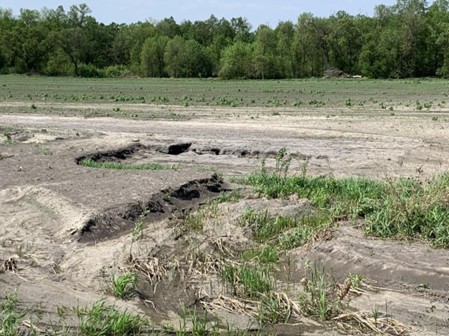
Maximizing soil cover may be related to minimizing soil disturbance, but it is also intertwined with crop rotation and crop choice. Not tilling a soybean-after-soybean rotation may sometimes reduce wind/water erosion, but the residue left by a soybean crop is minimal. Soybean is cut as low as required in North Dakota due to low podding habit, especially in a year of poor yield or in areas affected severely by iron deficiency chlorosis and/or high salinity. Tilling these low-residue fields may make little difference on erosion potential. However, in a true healthy crop rotation, leaving residue encourages greater water infiltration, thereby reducing water erosion potential while also greatly reducing the risk of wind erosion due to standing residue and the thin mulch resulting from a no-till management system.
The benefits of rotation are largely understood by agronomists in the context of minimizing disease, insects and, to some degree, weed severity. Many studies have shown that the microorganisms found in the soil community are directly associated, and result from the crops grown, and that any changes in the crop changes the microorganism composition of the community. Changes to the crop rotations order or crops, does not completely change the soil community, but the balance between different organisms can differ. The general belief is that greater diversity in the crops grown in rotation, increases the range of microorganism species in the soil and the current theory and understanding is that more types of microorganisms the greater the benefits. If this is true, then expanding from a corn-soybean rotation to a corn-soybean-small grain rotation or a four- or five-crop rotation can prove beneficial to farmers. Depending on crop price and input costs however, this may or may not be true. Inserting cover crops between crops has been helpful in some areas of the U.S. where winters are not as severe as they are in North Dakota. In North Dakota however, it has been difficult (and arguably even impossible) to grow a cover crop after long-season crops like corn and soybean. Even interseeding cover crops, although not detrimental to yield in experiments to date, does not produce sufficient dry matter (less than 1,000 pounds per acre) resulting in no more than slight benefit. By growing a third crop, a short-season crop such as barley or spring wheat with corn and soybean rotations, there is ample time in most years to produce thousands of pounds of dry matter and introduce crop diversity resulting in shifts of microorganisms and possibly expanding the microorganism species to be helpful in increasing farmer profits.
9.3 Measurements of Soil Health
9.3.1 Physical Tests of Soil Health
An oft-quoted phrase from farmers who have worked hard to develop healthier soils is “I know it when I see it”. Healthy soils have good aggregation and are teeming with soil biology. The aggregates are strong enough to resist traffic compaction but crumble easily and allow water and roots to pass through with minimal energy. Aggregate stability is therefore a good measure of overall soil health (Rieke et al., 2022).
Any measure of soil health should begin with benchmark values in a field. Various aggregate stability tests can be performed. They include the Cornell aggregate stability test, the Woods End lab test and wet-sieving methods, among others. The most important point is to use the same test each time to track trends in soil health from the start to where the soil goes over time.
There also are several measures of soil health biology. Despite some questions that have arisen regarding different measures, the following tests may still provide some beneficial information on crop nutrient needs. However, there is still a lot of controversy regarding their use to benchmark and track changes in soil health over time.
9.3.2 Examples of Soil Health Biological Tests (Karlen et al., 2021)
- Phospholipid Fatty Acid (PLFA) test: Phospholipids are polar–nonpolar fatty acids utilized by plants in the formation of their plant cell membranes. These membranes serve to both keep things out, or keep things inside of the cell (and other intracellular compartments within the cell). Specific configurations of fatty acids are characteristic of some genera of microorganisms and may act as a signature or fingerprint to aid in identification. A number of commercial laboratories offer PLFA soil analyses. Utilize the same laboratory each time, as the genetic markers used by one lab to separate out groups of PLFAs differ between labs. There is no current standard.
- Earthfort Soil Food Web Biology test: a PFLA test but utilizes microscopy to determine relative abundance between groups and also distinguishes between active bacteria/fungi and inactive.
- Cornell Comprehensive Assessment of Soil Health (CCASH): is a commercial test that measures then rates 12 soil attributes, combining them to produce a quality score (out of 100 possible points). CCASH specifically evaluates four biological soil properties, four physical soil properties and four chemical soil properties. The biological properties are organic matter, active carbon, protein and respiration. The physical properties are aggregate stability, available water-holding capacity, surface hardness and subsurface hardness. The chemical properties are soil pH, available phosphorus, available potassium and available micronutrients.
- Haney test: measures respiration. It also provides measurements of N, P and K, and seeks to estimate nutrient availability in a growing season. The Haney test utilizes water extractable organic C and N, which presumably are forms readily used by soil microbes. The Haney tool provides a Soil Health Calculation, which combines the extractable organic C and N with soil respiration. In addition, the calculation estimates supplemental N requirements. One recent evaluation of the test in eight Midwest states including North Dakota, found a poor relationship between the Haney test results and best N rate (Yost et al., 2018).
- Permanganate oxidizable carbon (PoxC) soil test: this test measures the change in active carbon in a soil, which can be related to soil nutrient cycling. PoxC is strongly related to soil organic matter; however, its measure can change over time with successive sampling of benchmark areas. This test can aid in explaining the soil health differences between soils of similar organic matter but under different management strategies.
- Solvita field test: is a proprietary method of measuring respiration within soil. The results may indicate the rate of organic matter respiration, thereby estimating N release.
- CO₂ burst method: indicates respiration by microbes acting on organic matter. The Solvita field respiration test and the CO₂ burst method have not been shown to consistently predict soil N status and in-season N rate requirement.
9.4 References for Soil Health
- Karlen, D. L., Stott, D. E., & Mikha, M. M. (Eds.). (2021). Soil health series: Volume 2—Laboratory methods for soil health analysis. https://doi.org/10.1002/9780891189831
- Natural Resources Conservation Service. (2024). Soil health. U.S. Department of Agriculture. https://www.nrcs.usda.gov/conservation-basics/natural-resource-concerns/soils/soil-health
- Rieke, E. L., Bagnall, D. K., Morgan, C. L. S., Flynn, K. D., Howe, J. A., Greub, K. L. H., Mac Bean, G., Cappellazzi, S. B., Cope, M., Liptzin, D., Norris, C. E., Tracy, P. W., Aberle, E., Ashworth, A., Tavarez, O. B., Bary, A. I., Baumhardt, R. L., Gracia, A. B., Brainard, D. C., … Honeycutt, C. W. (2022). Evaluation of aggregate stability methods for soil health. Geoderma, 428, 116156. https://doi.org/10.1016/j.geoderma.2022.116156
- Yost, M. A., Veum, K. S., Kitchen, N. R., Sawyer, J. E., Camberato, J. J., Carter, P. R., Ferguson, R. B., Fernández, F. G., Franzen, D. W., Laboski, C. A., & Nafziger, E. D. (2018). Evaluation of the Haney Soil Health Tool for corn nitrogen recommendations across eight Midwest states. Journal of Soil and Water Conservation, 73(5), 587–592. https://doi.org/10.2489/jswc.73.5.587