10.1 A Brief History of Tillage
Records of humans tilling the earth, or just tillage in general, date back to 5,000 years ago, with the earliest evidence of tillage originating in Mesopotamia, Egypt, China and India. Plowing the soil and loosening the soil surface to better enable the sowing of seeds into the cracks was (and still is) a primary reason for tillage practices. Killing weeds and minimizing their competition with the desired crop being planted was (and still is) another benefit of plowing and tillage of the soil.
The development of the moldboard plow was not a one-time event, but instead an evolution born out of necessity. Early tillage activities were done primarily plowing using a stout wooden implement projection pulled by people, and then later with animals. As far back as the warring states period of Ancient China (400-200 BCE) the Chinese were using a cast iron plow (Temple, 1986). They improved the design, up through the Han and Sun dynasties. The advanced Chinese plow, by the 13th century was of cast iron, with the plow share shaped like a V, and two attached arms arching away like gull wings. The blade would carve into the ground and the curved arms would turn the earth away flipping it over, this design significantly reduced friction. In Europe the Gauls, Romans, Anglo-Saxons, and the Dutch modified and enhanced the plow by twisting and shaping the wooden shape to lift and turn the soil.
In Europe initially there was no standard shape of these early moldboard plows. The plows were made locally and with as hard a wood as was available, and shaped through steaming, and then attached to a metal framework. The subsequent wooden plow was then attached to a metal framework to enable it to be pulled. By the mid-1600s in the Netherlands, by what seems to be introduction from China combined with gradual enhancements, the Dutch plow design proliferated throughout Europe (Temple, 1986). Several others further improved upon the design of the plow and manufacturing and casting of plows began to take shape in the 1700’s. Thomas Jefferson, while ambassador to France in the late 1700s, made notes of French moldboards. Applying his knowledge of mathematics, he designed what he considered to be the perfect moldboard plow, which would easily slice through sod, lifting and turning the soil with minimal effort (Martin & Stanton, 1988). He put his design to work on his plantation in Virginia when he returned, and in 1814 he cast his plow design in iron. The iron plow became the standard plow in America until John Lane and others from Illinois invented the steel plow in 1833. Later John Deere was the first to begin mass producing the steel moldboard plow in 1837 and that launched the company into prominence as a farm machinery supplier that continues to the present day (Landers, 2015).
The seed drill originally developed in China in the 2nd century, was introduced to the western world in Italy around the middle of the 16th century. In England, Jethro Tull, a farmer and scientist, invented his own seed drill in 1701 (L.B. Sayre, 2010; Tull, 1731). After inventing his seed drill, Jethro Tull began to work to instill in farmers the importance of thorough and repeated tillage in order to enable the successful use of the seed drill, especially since its use combined with tillage eliminated the need for a hoe. He maintained that amending the soil with manure was not required since tilling the soil and reducing the soil to smaller particles released the substances required by plants. Chemistry as we know it was not still not developed at that time.
10.2 Reasons for Tillage Today
The primary reason for tillage today is to prepare a seedbed that allows seed to be placed at a depth required to enable both access to continuous moisture from the soil and also still allows the leaves to emerge. Placement of seed at random depths results in uneven emergence, which can lead to problems with the critical timings of pesticide applications, field operations, and harvest. Maximum crop yield is only achieved when crop plants emerge the same day, at the ideal even spacing required for the specific crop.
In addition, tillage kills small weeds; and with the options for weed control continuing to dwindle because of increased resistance to several chemical groups of herbicides, new weeds emerging, and the reluctance of chemical companies to develop new herbicides due to an increase in EPA scrutiny and legal liabilities, tillage may be a good option. Tillage can greatly reduce the first flush of weeds, although most weed species will continue to germinate after the tillage depending on environmental conditions, including shading, competition with other plants, moisture and temperature.
10.3 Types of Tillage
Tillage can be categorized by the degree of soil disturbance: clean tillage, conservation tillage and no tillage.
10.3.1 Clean tillage
Clean tillage, or deep tillage, can be performed using several implements, including a plow. The plow might be configured to leave a small amount of residue behind, but generally farmers who plow do so to bury all residue as a form of residue control. The buried residue is quickly decomposed, so that planting is not impeded or the root balls from corn do not interfere with spring tillage and subsequent crop harvest.
10.3.1.1 Moldboard plow
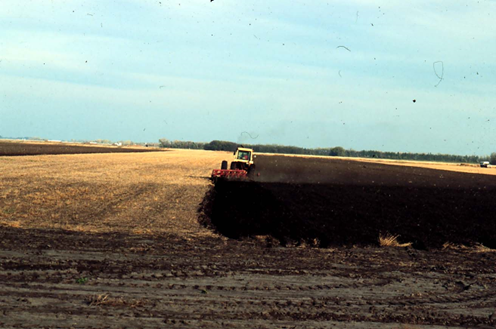
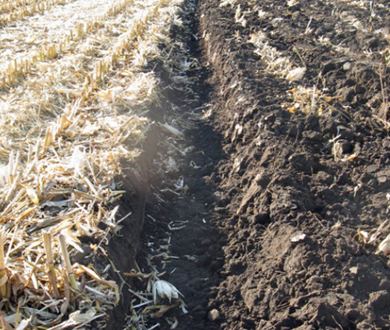
The moldboard plow (Figures 10.1; 10.2) has the ability to turn over soil usually from an 8- to 12-inch depth, although specialty plows are made for severe sodic soil reclamation to invert soil to 4 feet.
10.3.1.2 Disk Ripper
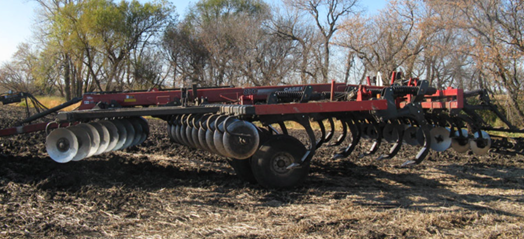
A disk ripper does not invert the soil like a plow, but instead cracks and lifts the soil, if soil moisture conditions are favorable, to break up compaction layers that might exist deeper than plow layers. Common depths of operations are 10 to 18 inches. The tools use one or more of a combination of shallow disks, shallow depth leading shanks and then deeper, larger width shanks (Figure 10.3).
10.3.1.3 Deep Ripper or Deep Zone Tiller
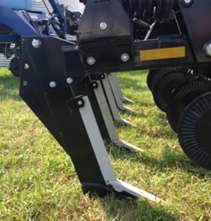
These implements have shanks to a depth of 15 to 20 inches, with shanks spaced about 30 inches apart (Figure 10.4). They crack and open soil with compaction issues at very deep depths. Deep rippers with straight shanks just cut the soil, while curved shanks bring deeper soil to the surface. Use of curved shanks requires several field trips with shallow depth, and finishing implements are generally required to smooth the soil after these tools are used.
10.3.2 Conservation Tillage
Conservation tillage is defined as any tillage system that leaves at least 30% soil surface residue coverage after planting. Conservation tillage tools break up soil and partially inverts it while leaving some residue on the surface to reduce wind and water erosion.
10.3.2.1 Chisel plow
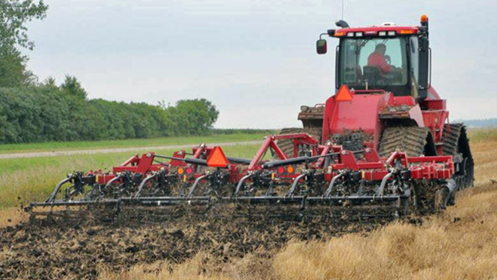
A chisel plow is an implement, usually with curved shanks, used to lift soil to help alleviate shallow compaction and bury some or all of the residue, depending on shank attachments (Figure 10.5). Chisel plow shank points, whether shovels, straight points or sweeps, produce varying degrees of soil disturbance as well as the amount of crop residue remaining at the surface for erosion control. Fields are normally chisel plowed in the fall and then followed by one or more spring tillage passes using a field cultivator or shallow disk to prepare the final seedbed. Leaving at least 30% residue cover at the soil surface at planting reduces erosion by as much as 65% compared to a bare soil surface. To achieve 30% residue cover in the spring, 45% to 50% of residue needs to be left over after chisel plowing in the fall. Twisted shovels cover more residue so straight shovels and shanks are preferred for residue conservation.
10.3.2.2 Disk strip-till
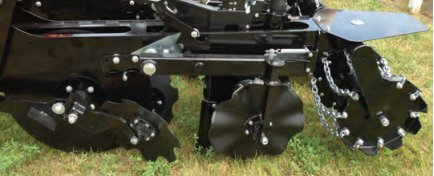
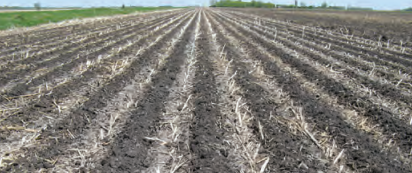
Disk strip tillage utilizes a coulter to cut residue and two aggressive disks to till soil to a depth of 4 to 6 inches in about half the width of a row over the area where a crop will be seeded the next spring (Figure 10.6). The advantage of disk strip tillage is that it prepares a seedbed similar to what a disk till pass would do but leaves standing residue between to catch snow and reduce wind erosion.
10.3.3 Shallow Tillage (1 to 4 inches in depth)
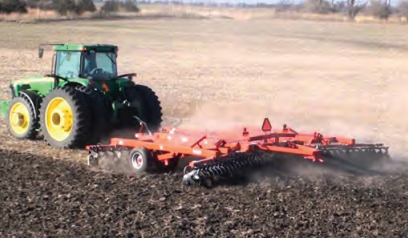
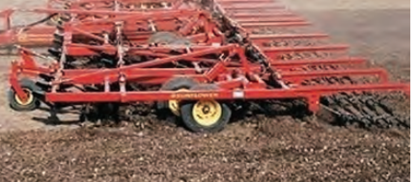
The most common shallow tillage tools in North Dakota are the tandem disk and the field cultivator. A tandem disk uses offset disks to cut residue, sizing it so that subsequent tools, such as a planter, more easily slide between the residue pieces (Figure 10.8). The disks also pulverize the soil into smaller particles that are more easily smoothed prior to planting. The field cultivator finishes preparing a seedbed for planting (Figure 10.9). The type of harrow used at the rear of a field cultivator or disk is important to level the soil to achieve the seedbed quality required. Either can be used as a first-pass implement to smooth the field in the spring for seedbed preparation or as the first tillage pass to incorporate preplant herbicide, which typically requires two passes to provide the most even and effective weed control.
10.3.4 Vertical Tillage
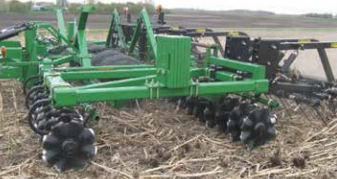
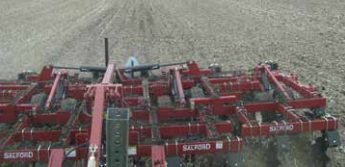
Vertical tillage tools have become popular due to their ability to smooth the soil surface without entering too deeply into the soil, usually no more than 2 inches. In the spring, soil can be very wet a few inches under the soil surface, and, if worked too wet, the soil condition may be poor for planting. In a drier year, deeper tillage can help to dry soil to the depth of tillage, leaving the seeding zone too dry for germination. Vertical tillage reduces the erosion risk, when compared to a field that has been tilled with a disk or field cultivator. However, the risk of wind erosion from vertical tillage is still greater than erosion risk than leaving residue untouched.
10.3.5 No-Till Management Systems
No-till management means that no tillage (or very light residue and soil disturbance) is used to prepare the seedbed for planting. There are three main types of no-till: classic no-till, shank strip-till and shallow one-pass seeding.
10.3.5.1 Classic no-till
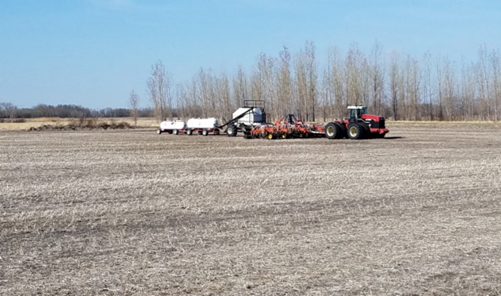
Seeding into a classic no-till field requires a coulter in front of the seed drill to allow for seeding into the previous crop residue; with no other residue-disturbing tools used in the growing season. A classic no-till system may include a preplant or side-dress thin shank to apply anhydrous ammonia or a previous pass through the field with an air seeder with spikes to apply urea and other fertilizer inputs.
10.3.5.2 Shank strip-till
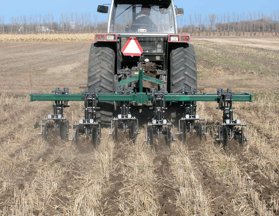
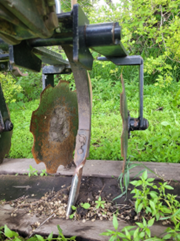
Commercial strip tillage implements can be expensive (Figure 10.13). However, quite a few farmers with engineering and welding skills have produced excellent shank-style strip tillage implements from materials at hand (Figure 10.14). For each row, a coulter leads the strip-till train, then residue managers move the residue to the sides, clearing the desired band width, usually 7-12 inches in width, where next year’s crop will then be seeded directly in the center of the band. Next, comes the shank; It may be made with one or more fertilizer tubes in the back, allowing for the fertilizer(s) to be placed at a certain depth and distance in order to still maintain adequate separation between the fertilizer band and the seed to avoid injuring the seed/seedling the following spring. Anhydrous placement should be at least 3 inches deeper than the spring seeding depth, usually about 6 to 8 inches deep. Other fertilizer can be placed closer but at least 2 inches of separation between the fertilizer band and the seeding depth is considered adequate and ideal. Then, a pair of disks catch the soil tilled by the shank to form a berm about 2 inches high at the peak, which will mellow and smooth by spring planting. If the soil tends to produce clods, growers may often attach a rolling baskets or chains behind to smooth out the berm and break up larger soil units.
10.3.5.3 Shallow one-pass seeding
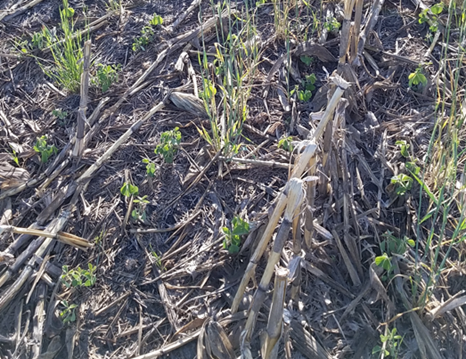
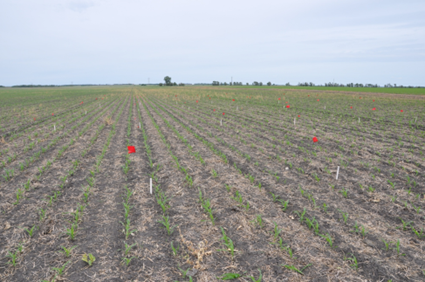
Some growers are uncomfortable leaving crop residue completely covering the soil surface and worry that this thick layer of crop residue may interfere with the ability of a planting implement to place seed at the correct depth and maintain the down pressure necessary for good seed to soil contact. In this case they may employ a management system named shallow one-pass seeding. The shallow one-pass tillage system leaves residue on the soil surface (Figure 10.16) until planting. The seeder has a front gang or two of narrow shovel points that stirs the soil with residue only in the top couple inches, then the seeder places the seed and packs the soil back around the seed for good contact. In N rate trials, the N credits and other biological indicators are similar in shallow one-pass seeded soils as in classic no-till (Franzen et al., 2019).
10.4 References for Tillage
- DeJong-Hughes, J., & Daigh, A. (2021). Upper Midwest Tillage Guide (2nd ed.). University of Minnesota. Retrieved from https://hdl.handle.net/11299/263302 (Images used with permission)
- Franzen, D. W., Inglett, P., & Gasch, C. K. (2019). Asymbiotic nitrogen fixation is greater in soils with long-term no-till versus conventional tillage. Soil Science Society of America Journal, 83(4), 1148–1152. https://doi.org/10.2134/sssaj2018.12.0482
- Landers, J. (2015, February 19). Did John Deere’s invention spark a revolution or an environmental disaster? Smithsonian Magazine. https://www.smithsonianmag.com/smithsonian-institution/did-john-deeres-best-invention-spark-revolution-or-environmental-disaster-180957080/
- Martin, R. L., & Stanton, L. C. (1988). Moldboard plow. In Thomas Jefferson Encyclopedia. Monticello. https://www.monticello.org/research-education/thomas-jefferson-encyclopedia/moldboard-plow/
- Sayre, L. B. (2010). The pre-history of soil science: Jethro Tull, the invention of the seed drill, and the foundations of modern agriculture. Physics and Chemistry of the Earth, 35(15–18), 851–859. https://doi.org/10.1016/j.pce.2010.07.034
- Temple, R. K. G. (1986). The genius of China: 3,000 years of science, discovery and invention. Simon and Schuster.
- Tull, J. (1731). The new horse-houghing husbandry: or An essay on the principles of tillage and vegetation. London, England.