Bison Spotlight: Barney Geddes, Plant Pathology, Microbiology and Biotechnology
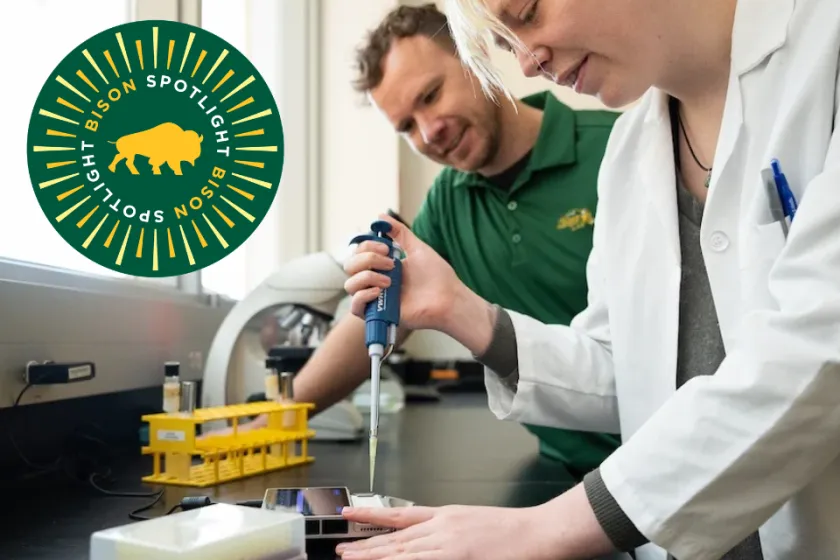
From helping North Dakota farmers improve crop production to developing technologies that could benefit growers around the world, Barney Geddes and his team at North Dakota State University are pursuing innovative ways to make agriculture more productive, resilient and sustainable.
As an assistant professor of plant systems microbial ecology, the Richard and Linda Offerdahl Professor and leader of the Geddes Lab, Geddes focuses on agricultural microbiology, studying beneficial microbes that help crops acquire nutrients, withstand environmental challenges and improve growth.
“We work on beneficial microbes,” Geddes said. “You can think of it like probiotics for the crop. Unlike others in my department who work on pathogens and how to prevent them, we look at the microbes that are good for crops.”
The lab's work centers on three major areas: improving existing microbial technologies for North Dakota farmers, developing solutions for smallholder farmers internationally and pursuing a long-term research goal often described as the "holy grail" of agricultural biotechnology.
Helping North Dakota farmers today
Geddes Lab's primary research efforts focus on rhizobia, naturally occurring bacteria that form partnerships with legumes such as soybeans, dry beans and alfalfa. Within specialized structures on legume roots, the bacteria convert nitrogen from the atmosphere into a form that plants can use for growth.
“They basically make fertilizer inside of the plant cells,” Geddes said. “It's probably the model of symbiosis in all of biology because we do understand it quite well and it's really impactful.”
The process provides a sustainable source of plant nutrition while reducing reliance on conventional fertilizers, which can be costly to produce, vulnerable to global market disruptions and can have adverse environmental impacts.
Geddes' research aims to improve microbial products already available to farmers. While crop genetics have seen decades of innovation, many of the microbes used in commercial inoculants were originally isolated in the 1950s.
“Within our crops, there's been this intense focus on the plant from an optimizing biology standpoint — through breeding, for example,” Geddes said. “But the microbe has largely been overlooked. So, we're trying to optimize the biology of the microbes to improve those technologies.”
The lab is studying how North Dakota microbes can be optimized for local growing conditions, helping farmers increase yields and improve crop resilience.
Agricultural impact beyond North Dakota
While much of the lab's work is rooted in the region, Geddes is equally focused on solving agricultural challenges on a global scale. One major initiative aims to help smallholder farmers in Africa gain access to affordable crop nutrition thanks to a major funding award he recently received.
In many African farming regions, producers cannot reliably access commercial fertilizer or afford its cost. Microbial technologies could offer a lower-cost alternative capable of boosting crop productivity.
“In Africa, the real challenge is that fertilizers are either too expensive for smallholder producers, or they can't even access them," Geddes said. “It's actually providing access to technology.”
The project seeks to create a single microbial inoculant capable of supporting multiple crops at once, an important consideration for small farms that often grow several crops within a few acres.
For Geddes, the international work and the North Dakota-based research are deeply connected.
"There's a lot of synergy,” he said. “The things that we learn as we focused on Africa can still lead to understandings that help us figure out how to better develop technologies for local farmers.”
That relationship works both ways. The lab's extensive research on microbes in North Dakota helps guide the development of technologies that may ultimately benefit growers in other parts of the world.
“We've done tons and tons of work in North Dakota understanding our beneficial microbes,” Geddes said. “Those understandings help guide us toward how to better build new technologies.”
Pursuing the holy grail
The lab's most ambitious work is supported through philanthropy from Richard and Linda Offerdahl. Geddes describes the project as one of the biggest challenges in agricultural science.
Researchers are exploring whether the nitrogen-fixing relationship currently found in legumes can someday be transferred to cereal crops such as wheat, corn and other grains.
“Cereals cannot do this. But if they could, it would dramatically reduce our reliance on chemical fertilizers in agricultural production,” Geddes said.
The potential implications are enormous. Because cereal crops account for a significant portion of global food production, enabling them to access nitrogen through natural biological processes could transform agriculture worldwide.
“These are the moonshot, transformative advances, where we’re trying to do really, really big but risky and difficult things,” he said.
Growing agricultural innovation at NDSU
Geddes said NDSU provides an ideal environment for pursuing all three research areas because of the university's strong agricultural connections and North Dakota's diverse crop production systems.
“The reason that I chose to come to NDSU was that I wanted to be in an ag-connected institution,” Geddes said. “I wanted to feel closely connected to the farming system.”
Raised on a small farm in Manitoba near the North Dakota border, Geddes remains motivated by the opportunity to help farmers, whether they are working fields in the Northern Plains or on small farms halfway around the world.
“It's exciting to think about the technologies we work on and where they have this scope for immense impact,” he said. “It can contribute to these real global issues, like the food supply.”
NDSU Marketing and Communications
Source: Barney Geddes
Writer: Paul Teeple
Photos: Justin Eiler, NDSU