
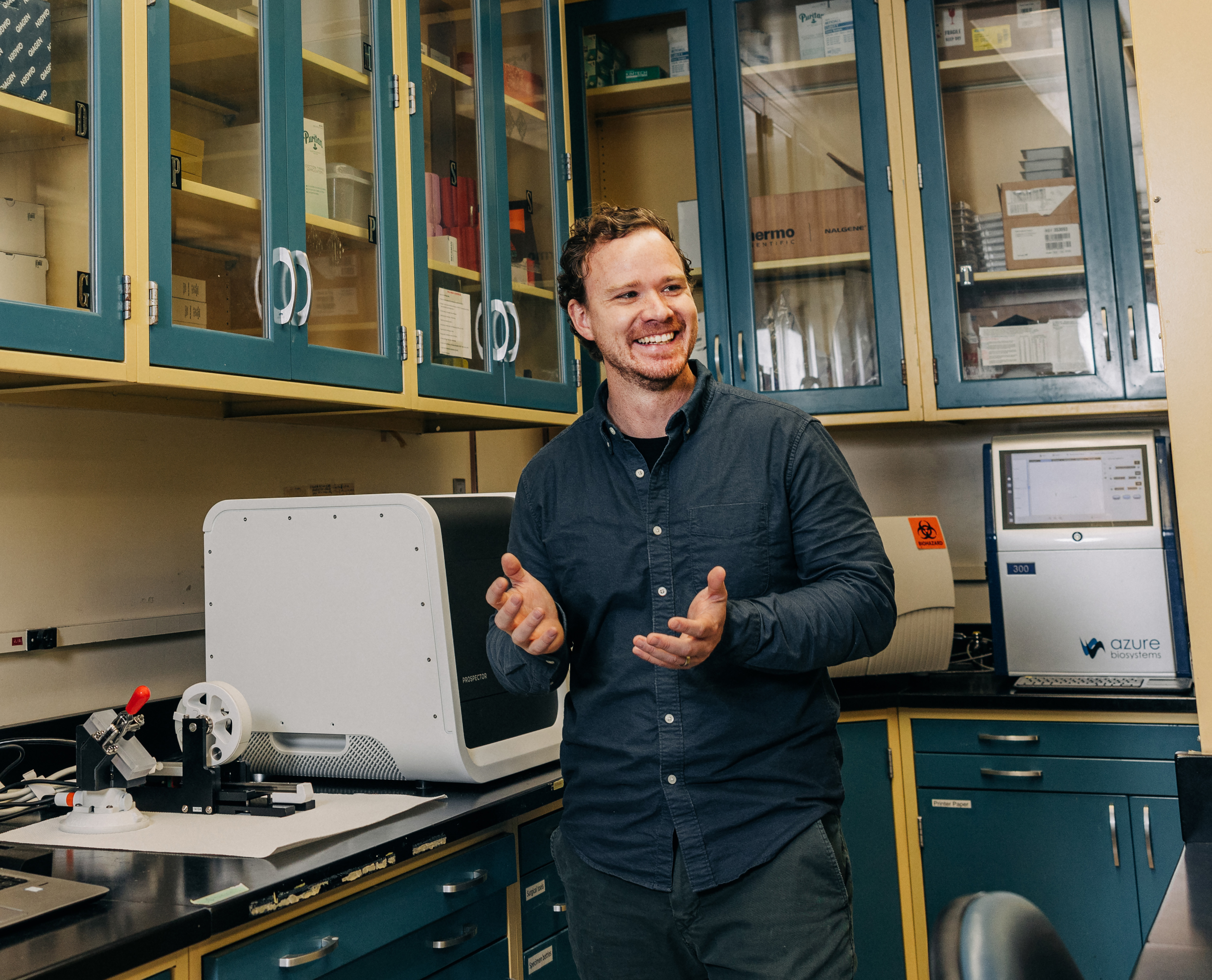
Geddes research team working to maximize symbiotic nitrogen fixation in crops
North Dakota State University assistant professor and Richard and Linda Offerdahl Faculty Fellow Barney Geddes and his team are working to improve how crops naturally get nitrogen by better understanding how helpful soil bacteria (rhizobia) and legumes work together.
The aim is to boost symbiotic nitrogen fixation, thereby decreasing the use of chemical nitrogen fertilizers on cropland in North Dakota and elsewhere.
The National Science Foundation and USDA have funded the more basic research, says Geddes. The project has also received funding support for translational research from the Richard and Linda Offerdahl Faculty Fellowship, the North Dakota Soybean Council, the Foundation for Food and Agriculture Research, and the Northern Pulse Growers Association.
“The overall goal of the research is to maximize symbiotic nitrogen fixation in agriculture to reduce the need for environmentally and economically costly chemical nitrogen fertilizers,” says Geddes. “While we continue fundamental research to understand what makes the symbiosis work, we now also do a lot more translational work, helping farmers understand what's going on in their fields and improving the microbial products available to them.”
"The research by Dr. Geddes is critical to improving our understanding of the symbiosis between plants and the soil microbial community,” says Greg Lardy, Joe and Norma Peltier Vice President for Agriculture at NDSU. “His work has the potential to reduce reliance on nitrogen fertilizers and, ultimately, improve global food security. Dr. Geddes was hired through the Agribiome initiative funded by the North Dakota State Legislature in the 2019-2021 session."
The initiative was developed as a priority by the State Board of Agricultural Research and Education (SBARE).
Geddes’s interest in sustainable agriculture began as he grew up on a small farm in southern Manitoba, Canada, where regenerative agriculture was emphasized to reduce chemical inputs. That led him to pursue his Ph.D. at the University of Manitoba, where he began studying microorganisms, and he has been studying them ever since.
Much of Geddes’s work focuses on root nodule symbiosis, a process in which rhizobia convert atmospheric nitrogen into a usable form for legume crops within specialized root organs.
Rhizobium is a nitrogen-fixing bacterium common in soil, especially in the root nodules of leguminous plants (e.g., beans, peas, soybeans, lentils, peanuts).
“A fundamental aspect of our research is trying to understand the genetics that make up rhizobium populations in agricultural fields and how that impacts the efficiency of symbiosis in legume crops,” says Geddes.
Symbiosis in crops refers to cooperative relationships between plants and microorganisms — primarily bacteria and fungi — where both partners benefit.
“We continue fundamental research into understanding what makes the symbiosis work. We also now do a lot more translational work, working towards helping farmers understand what's going on in their fields and to improve the microbial products available for their use,” says Geddes.
Lilac Agriculture, Inc., was created to license the technology from Geddes’s research program. Lilac Agriculture is a high-tech company partnering with pulse seed companies to advance a new generation of crop inoculants. The initial rollout will focus on lentils, with ongoing efforts to use advanced genomic tools to improve microbial performance and expand into other crops in the future.
The goal of Lilac is to offer products that use microbes to improve soil.
“A key to having the impact I desired from our program involved getting elite rhizobia we identify into farmers' hands as products,” says Geddes.
“I explored partnerships with existing companies, but in the end, the most tangible solution seemed to be to spin off my own in collaboration with several ag industry veterans who shared my philosophy about gaps and challenges in the rhizobium inoculant market,” adds Geddes.
Geddes’s research looks at why naturally occurring rhizobia in soils often outcompete added, more effective strains. Even though these native strains are good at forming root nodules, they don’t fix nitrogen as well, which reduces crop benefits. By studying large collections of rhizobia from farm fields, researchers have identified the genes behind this issue and found a few standout strains that are both competitive and highly efficient.
“Our goal is to identify and develop elite rhizobia that are both highly competitive and efficient nitrogen fixers,” says Gayathri Senanayake, an NDSU Ph.D. student working in the Geddes lab on the research. “In the long term, this could lead to tailored inoculants specially adapted to North Dakota soils and crop varieties, enabling plants to meet their nitrogen needs naturally while enriching the soil for future crops and hopefully making it no cost for nitrogen fertilizers for farmers."
“These represent an opportunity to improve the biology that underlies rhizobium inoculant technology for farmers,” says Geddes.
With North Dakota among the leaders in pulse crop yields, the research aligns well with NDSU’s land-grant mission and research.
“North Dakota is a leader in pulse production nationally, including in dry beans, peas, lentils and chickpeas, while soybean production is also rapidly expanding in the region,” says Geddes. “We have some of the highest diversity of legume crops of any state in the U.S., and they have become integral to our agricultural system. Maximizing nitrogen fixation on the farm and harnessing this as a key benefit of growing legumes has a direct impact on North Dakota agriculture.”
FOR MORE INFORMATION:
