
NDSU teams with Bayer to prepare the next generation of scientists
Preparing the next generation of agricultural scientists requires more than classroom learning. To be successful, students need real-world insight and soft skills to thrive in today’s research environment. That’s why North Dakota State University is collaborating with Bayer Crop Science to offer the B4U Mentorship Program to students. The program is designed to support students through high-impact, industry-based mentorship.
NDSU launched its inaugural B4U cohort in 2025. Nine NDSU students and one student from South Dakota State University participated in one-on-one virtual mentoring sessions with Bayer experts, gaining personalized career guidance and exposure to real-world innovation.
“The growth, collaboration and inspiration that emerged through this program are a testament to the power of mentorship and the strength of academia-industry partnerships,” says Ana Heilman-Morales, program co-organizer and NDSU director of agricultural data analytics.
Mentors focused on helping students develop soft skills — attributes related to interaction, collaboration and communication in the workplace. Heilman-Morales emphasizes that these skills are paramount in a research environment.
After NDSU partnered with Bayer to host the inaugural NDSU Hackathon in 2024, Heilman-Morales looked to collaborate on a mentorship program to help students build confidence and competency in the workplace, regardless of their specific career path.
“We are committed to equipping the next generation of scientists and leaders with the essential tools they need to thrive and make a lasting impact,” says Magan Lewis, project co-lead organizer from Bayer.
Abbeah Navasca is a Ph.D. candidate in NDSU’s Department of Plant Pathology, Microbiology, and Biotechnology. Her main goal for the yearlong program was to get a “360-degree exposure to agriculture, academia, the industry and its growers.” She says B4U did just that.
Her assigned mentor was Connie Davis, a corn breeder and product development scientist at Bayer. Davis connected Navasca with other plant pathologists at Bayer and shared her career experiences.
“In addition to sharing about her years of experience, she had advice for me in terms of self-advocacy and work-life balance,” says Navasca.
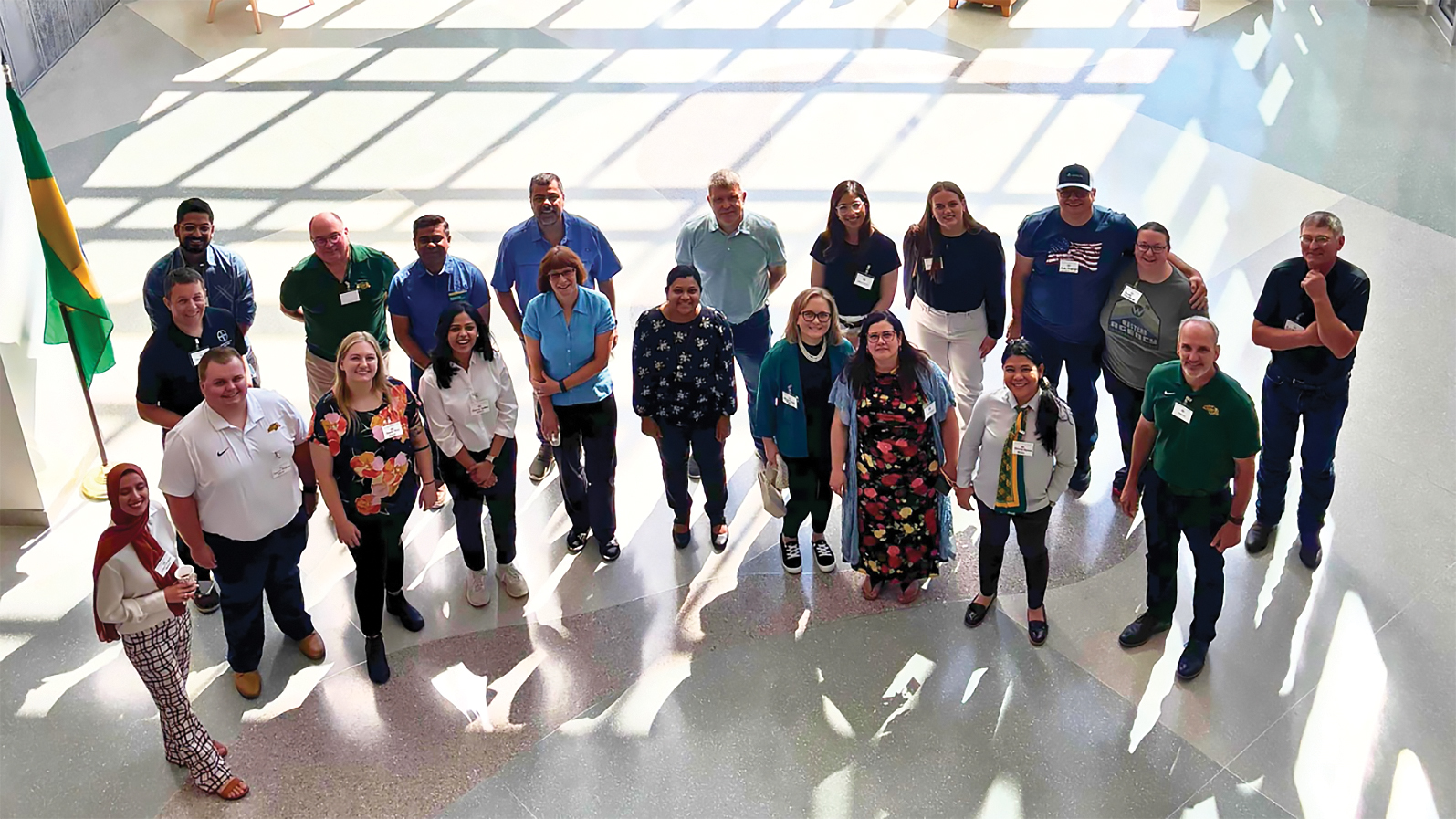
In June, the B4U at NDSU team visited Bayer Crop Science in Ankeny, Iowa. This was the first trip to offer a firsthand view of operational scale and innovation in action, such as at Bayer’s genotyping laboratory and seed center.
Davis travelled to Iowa to meet Navasca for the first time in person, and Navasca says Davis making the trip was meaningful and supportive.
Cameron Matthews is a Ph.D. candidate in NDSU’s Department of Plant Sciences. His love for genetics led him to his current role in the barley breeding program.
His interest in the Bayer mentorship program stemmed from his desire to work in the private sector. He had heard about the program at other universities and was eager to see how it could shape his own career path.
Matthews’ mentor, Tom Jury, is the head of North American field testing at Bayer. Together, the two focused on leadership skills, team management and achieving program goals. They explored technical aspects such as efficiency and resource distribution in large-scale operations.
Throughout 2025, Matthews took on a leadership role in his research fellowship, so his meetings with Jury focused on effective leading, facilitating and uniting a team toward a common goal. Navigating differing approaches was relevant to his lab experience, and he was drawn to Jury’s experience working his way up to senior management at Bayer.
In July, NDSU held a Bayer growers meeting at the Peltier Complex on campus — a meeting Navasca describes as “really linking industry, academia and the growers.”
“We’re all doing research in the agriculture sector and trying to make positive impacts on farmers’ lives,” says Matthews, “but a lot of students don’t have a strong personal connection to farms.”
Matthews says meeting with producers helped students gain a real-world perspective on their work, and he was happy to see Jury made the trip up as well.
In October, the group took a trip to St. Louis, Missouri, to Bayer’s global headquarters. There, students experienced Bayer’s innovation culture, networked with scientists and executives, and participated in leadership and communication development workshops.
Matthews’ advice to the next class of mentees?
“Jump headfirst into the program, and embrace the opportunities presented.”
Matthews and Navasca agree that, in addition to sharing a bond with their Bayer counterparts, the mentees had a good time connecting and learning from one another, especially during their travel.
Heilman-Morales feels confident that these students “were able to see themselves in the industry … to see how this can be their future.”
With the second annual cohort launching in February, another round of students will have the opportunity to learn from industry leaders and begin to see how they can contribute to the future of agriculture.
For more information contact Ana Maria Heilman-Morales
