Dakota Gardener: Lessons learned this past year
By Joe Zeleznik, Forester
NDSU Extension
Today, I saw a red squirrel run along our deck and bury an acorn in one of the flowerpots. This happens every year, and invariably we see some oak seedlings coming up in spring among the zinnias, cosmos and other plants.
A few days ago, though, my wife saw a squirrel running up a Scotch pine tree outside of her sewing room, carrying a large disk in its mouth. She called me over, and we watched the squirrel continue its labors several times. What was going on?
Following a quick internet search, we both started laughing. Apparently, red squirrels sometimes cache mushrooms in conifer trees. The mushrooms provide them with nutritious food over the lean months of winter.
Who knew?!
Every day I learn something new about trees in North Dakota. Here are some lessons learned this past year.
- Round-leaved dogwood (scientific name Cornus rugosa) was found in North Dakota for the first time. Nathan Rokke (Grand Forks County Soil Conservation District) and Tyler Janke (Minnesota Department of Natural Resources) were exploring in the Pembina Gorge and found this species on several north-facing slopes. In some places, the shrubs formed thickets that were hard to walk through.
- A single stand of limber pine (scientific name Pinus flexilis) was found in the North Dakota Badlands in the late 1940s. In 2026, colleagues with the USDA Forest Service in Dickinson found more limber pine trees in a remote area near Marmarth. Cool!
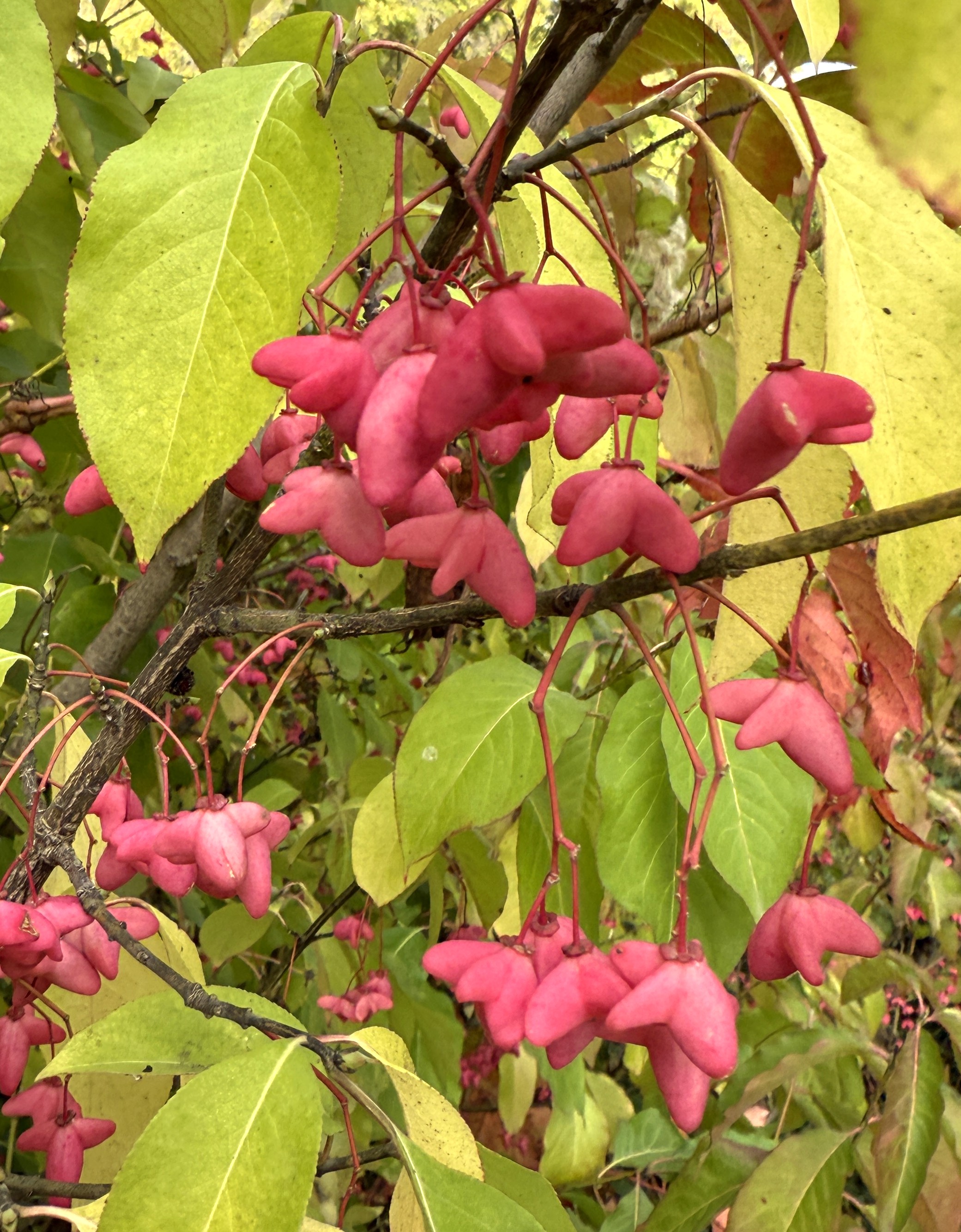
- Eastern wahoo (scientific name Euonymus atropurpureus) is a shrub that’s native to the eastern U.S. In North Dakota, it’s pretty rare and found only along the Sheyenne River, in a 20-mile stretch southwest of Kindred. I finally got to see this unique plant this past autumn while canoeing down the river. Eastern wahoo is sometimes known as “burning bush,” and it has beautiful pink fruit in the fall, with bright red seeds inside the capsules.
- Creeping Oregon grape (scientific name Mahonia repens) is a low shrub that rarely reaches 2 feet tall and sometimes is prostrate along the ground. It’s been confirmed in North Dakota in only two locations in Bowman and Slope counties. I got to see this one for the first time in 2026 as well.
Okay, those last two aren’t trees. But they are woody plants!
Unfortunately, my daily lessons sometimes are about pests that damage or even kill trees.
- Pine wilt disease was confirmed in North Dakota in August of this year. This disease will impact Scotch pine, Austrian pine and possibly mugo pine. The disease has been spreading northwards in the Great Plains for decades and was finally confirmed here. The disease is pretty complex and involves a nematode, a sawyer beetle and a fungus. Drought conditions of the past several years have helped pine wilt spread. Fortunately, our native ponderosa pine very rarely suffers from pine wilt.
- Emerald ash borer (EAB) was found in three new locations in 2026, including Bismarck and Prosper (in rural Cass County). The insect was confirmed in Fargo this year as well, but that was a bit anticlimactic – EAB had already been found in neighboring Moorhead, Minnesota, back in 2023.
- Elm zigzag sawfly (EZS) is a relatively new pest in North America. It was first found in Quebec in 2020 and has been spreading in the eastern and midwestern U.S. ever since then. We haven’t found it in North Dakota yet (thank goodness!), but I did see it in Perham, Minnesota, this year. The females sometimes lay their eggs in the wheel wells of cars and trucks, which then help spread the insect incredibly long distances. Perham is about an hour drive from Fargo.
Every day I learn something new. Sometimes it’s good news, and sometimes it’s bad news.
What have you learned today?
NDSU Agriculture Communication – Nov. 17, 2026
Source: Joe Zeleznik, 701-231-8143, joseph.zeleznik@ndsu.edu
Editor: Dominic Erickson, 701-231-5546, dominic.erickson@ndsu.edu