
Take steps to prevent combine fires during sunflower harvest
Sunflower harvest is ramping up across North Dakota, as weather and soil conditions have been mostly dry, allowing producers to harvest crops quickly. However, dry, low-humidity conditions increase the risk of combine fires, especially during sunflower harvest.
In 2026, North Dakota is expected to harvest an estimated 591,000 acres of sunflowers, an 18% increase in sunflower acres in the state compared to 2025, according to the National Agricultural Statistics Service. Warm, dry weather has allowed the harvest to progress quickly, but it also increases the risk of combine fires.
“Mix warm, dry harvest conditions with high wind speeds, and you have a recipe for fires, especially when combining sunflowers,” says Angie Johnson, North Dakota State University Extension farm and ranch safety specialist.
Producers can monitor current wind speeds, temperatures and humidity values, which are updated live every five minutes at https://ndawn.info/.
“The high wind speeds and the large amount of extremely dry plant material in our fields and grasslands create perfect conditions for fire when provided with an ignition source, such as the hot exhaust from the combine’s turbocharger or exhaust manifold,” says Johnson. “These components can reach temperatures of over 1,000 degrees Fahrenheit. Additionally, electrical malfunctions in the plastic wiring harnesses on the combine can also create electrical shorts or arcs, which can also start a fire.”
Combine fires can occur at any time with any crop in the right conditions. Sunflowers, however, pose a greater risk because of the large volume of dust and particulate they produce while being harvested, says Johnson.
Research from South Dakota State University shows that the white portion inside the stalk, known as the pith, breaks down into tiny, high-surface-area particles that easily get sucked into the fan as it pulls air through the radiator to cool the engine. That pith dust and particulate easily stick to the engine and exhaust components and can ignite when in contact with the turbocharger and exhaust system.
“Believe it or not, there was a time when producers made the decision to quit raising sunflowers because of the constant fire risk and complete combine losses that took place because of combine fires due to sunflowers,” says Johnson.
Johnson shares the following tips for reducing the risk of combine fires while harvesting sunflowers:
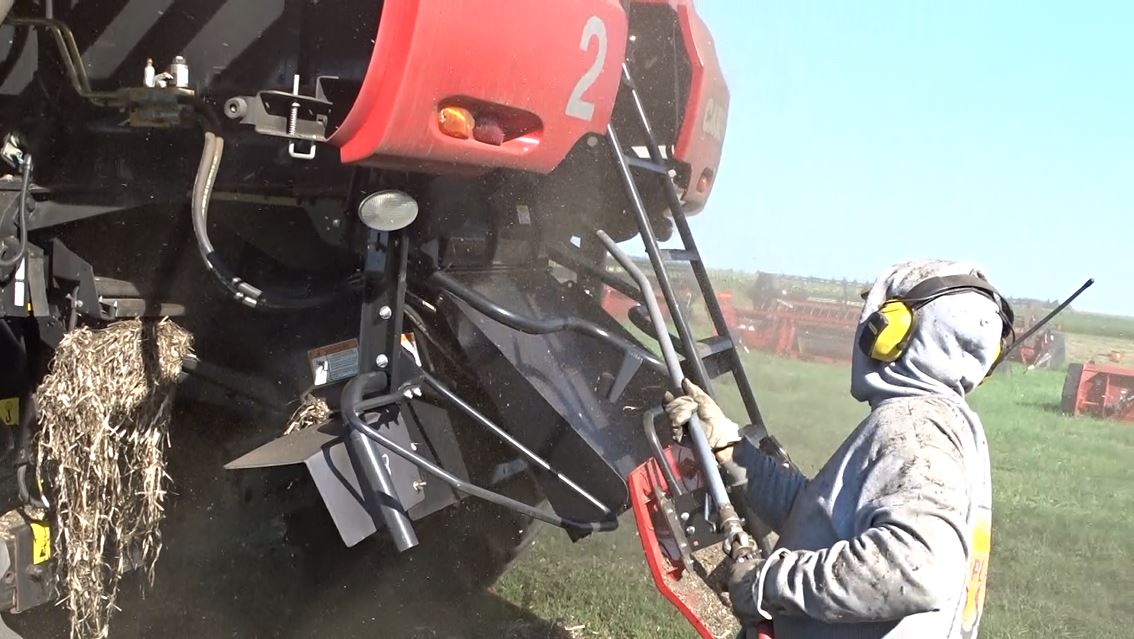
- Take time to walk around the combine before the start of each day during harvest season. Use an air compressor or leaf blower every day when the machine is off and cooled down to remove dirt, dust, chaff and other plant residue; always wear hearing, eye and respiratory protection, such as an N95 mask, when doing so.
- Take time to service the machine daily, based on the combine’s operator manual. Grease and lubricate bearings and chains, and continue to look for areas that have excessive wear or damage.
- Watch for wiring issues. Take time to glance through the wiring systems to see where wires appear unrestrained or damaged from rubbing or contact with moving parts.
- Monitor gauges and warning signs. If you notice increased fuel consumption, loss of hydraulic pressure, fuses that regularly fail or “blow out,” or higher-than-normal temperature gauge readings, stop and determine the cause, as these are serious warning signs that something is malfunctioning.
- Use an infrared thermometer. Warm up the combine before taking it to the field, and use an infrared thermometer to determine the operating temperature of your combine’s bearings. If the thermometer measures a bearing’s temperature that is much higher than others, it is time to replace that bearing, as it may be worn or damaged.
- Install an air intake kit. An air intake kit allows clean air above the combine’s “dust cloud” to enter the combine’s air intake screen, rather than dusty, dirt-filled air produced by harvesting.
- Avoid combining during fire danger conditions. Keep an eye on relative humidity values and wind speeds. As hard as it is to shut down for the day when conditions are favorable for harvesting, shutting down when relative humidity is low and/or when conditions are windy could prevent a fire. Find out if the area is in a fire danger zone by visiting https://ndresponse.gov/burn-ban-restrictions-fire-danger-maps.
- Always allow equipment to cool down before parking it inside a shed for the night. Also, make it a safety practice to shut off equipment and allow it to cool before refueling.
- Carry fire extinguishers. Ideally, you should have two 20-pound, charged fire extinguishers on your combine. Have them ready and operational and review with workers how to use them when needed.
- Have a water truck in the field. If possible, bring a filled, ready-to-use water truck in the event of a fire.
- Create a soil perimeter. If harvesting during high-wind and high-temperature conditions, make a tillage pass around the perimeter of the field to prevent a fire from spreading.
- Strategically park harvest equipment. While harvesting a field, park semis, trucks, pickups, tractors, grain carts and other equipment in a location with minimal vegetation. Hot exhaust from these vehicles can ignite dry grass in the ditch.
“Overall, good machine maintenance, cleaning and monitoring can help reduce the incidence of combine fires during crop harvest,” says Johnson. “Combines and crops are replaceable – you are not.”
For more information on crop harvest fire prevention, visit ndsu.ag/sunflower-dust26.
For more NDSU Extension guidance, including a crop harvest fire prevention checklist, visit ndsu.ag/harvest-fire-26.
NDSU Agriculture Communication – Oct. 9, 2026
Source: Angie Johnson, 701-231-1873, angela.b.johnson@ndsu.edu
Editor: Dominic Erickson, 701-231-5546, dominic.erickson@ndsu.edu
