
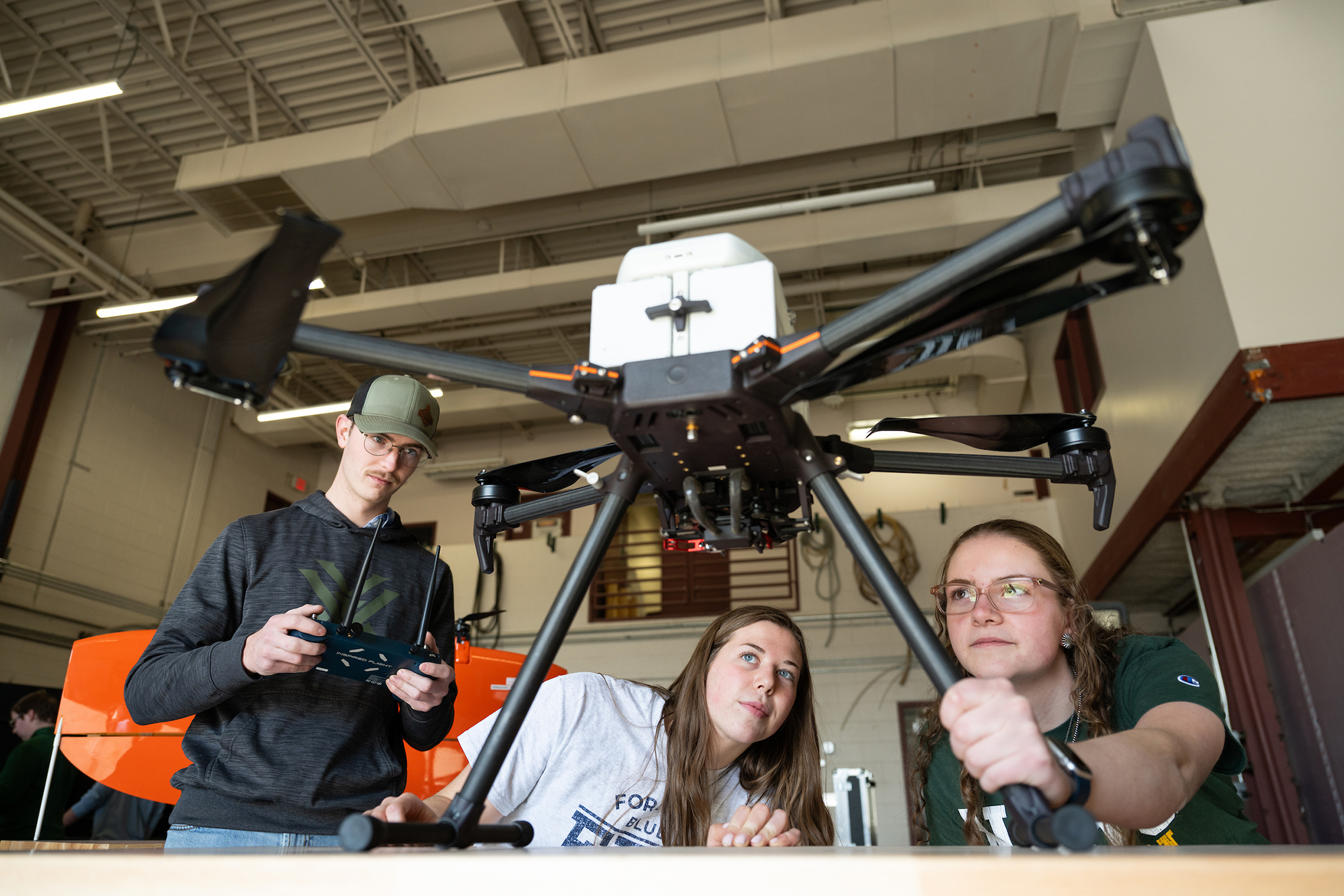
NDSU research seeks to address AgTech workforce needs
What will the agriculture technology workforce look like in North Dakota in the next five years? Ten years? And will there be enough workers to meet those demands?
NDSU is researching ways to determine what those labor needs will be with the intent of developing and implementing a curriculum that will train students to be ready for those careers. NDSU is also seeking to attract more students to the AgTech field and prepare those individuals to be industry-ready upon graduation, thereby helping to meet the workforce needs.
A team led by Adam Marx, NDSU associate professor of agricultural education, and Brooke Thiel, NDSU assistant professor of agricultural education, is working to collect data from college students to determine their interests in AgTech and the reasons behind their choice of major or career path.
“The number of kids growing up on farms and in rural communities is decreasing,” says Thiel. “We know that one of the predictors of career interest in agriculture is exposure to the industry, either through parents, family members or close friends. As youth become more removed from agriculture, we anticipate fewer young people will naturally develop an awareness of careers in agriculture. Thus, it is becoming more important to explore what young people know about agriculture across North Dakota and how that knowledge and awareness may influence their career decision-making.”
The research is part of the Food, Energy and Water Security initiative at NDSU, which is supported by USDA-ARS funding. The FEWS initiative addresses many key issues facing food, energy and water resources today, strongly emphasizing technology and research.
Marx stated that the team is conducting a systematic review of the literature related to young adults’ career decision-making.
“We will pilot a study with current college students in agricultural majors to better understand the things that impacted their decisions to choose their career paths,” says Marx. “This work will additionally help inform how we help connect people to the diverse agricultural careers we have in North Dakota and beyond, in hopes of helping to fill the industry’s demand for an engaged workforce.”
The team explored the actual ag-sector employment demand in North Dakota with the help of Job Service North Dakota reports and prospectus. Analysis of the data showed the scope of agricultural careers reported was narrower than the actual scope of careers available within agriculture. For example, within the JSND, which is aligned with federal job classifications, many careers are mainly on-farm and farm labor positions.
“We decided to align a deeper review of agriculture-related careers with content areas we see in the College of Agriculture, Food Systems, and Natural Resources here at NDSU,” says Marx. “What that ultimately revealed is what we believe to be a more accurate picture of agricultural career demand in the coming decade, which accounts for blue- and white-collar fields extending from education to engineering and finance to field work.”
“The intent is to use the survey data to guide the development of experiences that would lead young adults to consider careers in agriculture,” says Thiel. Determining the future needs of North Dakota’s agricultural workforce involves conducting national agricultural literacy surveys among high school students. Agricultural literacy refers to the knowledge and understanding of food, its production and processing, and the vital role of agriculture in our daily lives and economy.
“To meet the agricultural workforce needs in North Dakota, we need to be recruiting and training employees from all walks of life. However, retaining the youth from North Dakota in the agricultural industry should be a top priority for our state. Hopefully, by encouraging young people to prepare for and enter careers in agriculture, the state and industry can flourish.”
