

A Century of Innovation: NDSU Crop Breeding Continues to Influence Regional Agriculture
The year 2026 marks the 100th anniversary of the Ceres spring wheat variety, which was the first spring wheat bred and released at the North Dakota Agricultural Experiment Station.
L.R. Waldron developed Ceres, which stands as a landmark variety, playing a pivotal role in early 20th-century rust resistance and bridging the gap between early-susceptible wheats and modern disease-resistant varieties. Ceres was known for its high yields and stability in addition to its rust resistance. By 1935, Ceres had been grown on 50% of North Dakota’s spring acreage.
Spring wheat (with more than 60 varieties released since 1892) is one of several crops in which NDSU’s crop breeding programs have made a mark on agriculture. There are 12 active breeding programs at NDSU, which have bred and released 353 crop varieties.
"Public investment in agricultural research is one of the highest-return investments the state can make,” says Frank Casey, associate director of the North Dakota Agricultural Experiment Station. “Studies show every dollar returns about $40 in direct economic impact over the life of that investment — an internal rate of return of 28.4%. Our breeding programs are a textbook example, turning public funding into varieties that drive yield, resilience and farm profitability for decades."
"Public plant breeding is among agriculture's highest-return on investments, delivering higher yields, disease resistance and quality to farmers,” says Rich Horsley, head of NDSU’s Department of Plant Sciences, who also oversees the barley breeding program at the university. “When L.R. Waldron released Ceres wheat in 1926, its yield and rust resistance made it a dominant spring wheat and established a genetic foundation that still shapes wheat breeding today.”
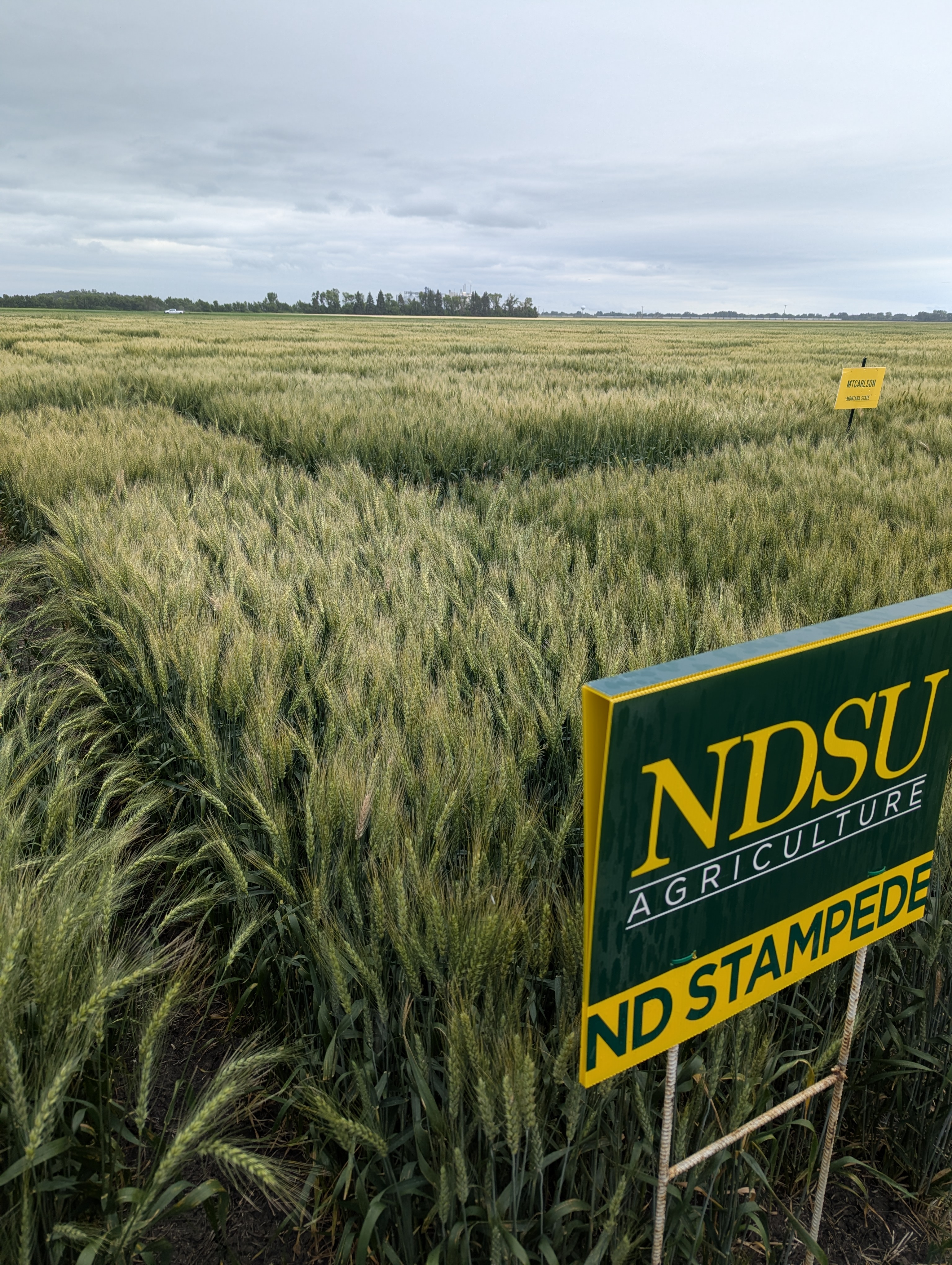
The most recent spring wheat variety released by NDSU was ND Blockade in 2025. Another variety, ND Stampede, is in its second year of production in the state and has high yield, high protein and good end-use quality and was sold by 75 seed associates this spring.
A variety must have four to six years of yield testing before a release is considered. Andrew Green, Richard Frohberg Endowed Associate Professor of wheat breeding, says a variety can be released in as little as seven years, but it usually takes nine.
“My goal is to continue to push yield and end-use quality simultaneously, while working to solve emerging disease and agronomic issues to make wheat profitable for farmers,” says Green. “We are also working on several unique traits that may present a direct value-added option for wheat growers. Our economic and national security interests rely on successful domestic crop production, and North Dakota is a big part of that as one of the top two states annually in wheat production.”
Elias M. Elias, University Distinguished Professor, is the durum wheat breeder at NDSU. Since he joined NDSU in 1990, 19 varieties have been released, with the most commonly grown being ND Riveland, which was on 48% of the durum wheat acreage in North Dakota in 2025.
Elias says it can take 10-12 years of research before releasing a durum wheat variety. Since the durum wheat breeding program began in 1929, 63 varieties have been released.
“Varieties developed by this program continue to be the leading cultivars grown in North Dakota, with several also widely grown in Montana,” says Elias.
NDSU’s program remains the largest public durum breeding program in the U.S. With North Dakota accounting for more than half of U.S. durum wheat production and consumer demand for pasta increasing, the program’s impact is strong.
“During the past five years, NDSU-developed cultivars were grown on more than 91% of the durum acreage in North Dakota,” says Elias. “Over the same period, North Dakota accounted for 56.2% of U.S. durum wheat production, generating approximately $1.6 billion in direct economic value for North Dakota producers.”
Henry L. Bolley bred the first wilt-resistant flax variety in 1908, one of 34 flax varieties bred at NDSU. The new Bolley Agricultural Laboratory, which will house NDSU’s plant breeding programs, will open this summer.
Md. Mukhlesur Rahman, NDSU plant science professor, has served as NDSU’s current flax breeder since 2017. The crop is important to North Dakota, which leads the nation in flaxseed production.
Developing a new flax variety and releasing it to the public can take 12-14 years, says Rahman. NDSU is releasing two new flax varieties that have demonstrated higher yield potential in trials. Flaxseed contains a high level of omega-3 fatty acids, an essential nutrient for humans.
“Awareness of the health benefits of flaxseed consumption is increasing, and we are optimistic that flax acreage in North Dakota will continue to expand in the coming years,” says Rahman.
North Dakota is one of the leading barley-producing states in the nation, and public barley breeding at NDSU has a direct economic impact on the state. In 2024, barley generated more than $122 million in farm-gate value across 370,000 acres. NDSU’s breeding program has helped drive that success, as ND Genesis barley, released in 2015, accounted for 14.1% of the state’s acreage.
“Public barley breeding at NDSU has a direct economic impact on the state,” says Horsley, who oversees NDSU’s barley breeding program.
NDSU’s breeding programs have set a standard that directly impacts the state’s farm economy.
“NDSU's crop breeding programs are unmatched in scale, impact and legacy,” says Horsley. “Our 10 active programs — the most at any single university site in the nation —develop varieties that improve yield, resilience and quality for North Dakota farmers, strengthening farm profitability, rural communities and the state's agricultural economy. Advances in genomics, AI and predictive breeding will further accelerate our efforts to develop new varieties.”
FOR MORE INFORMATION


