
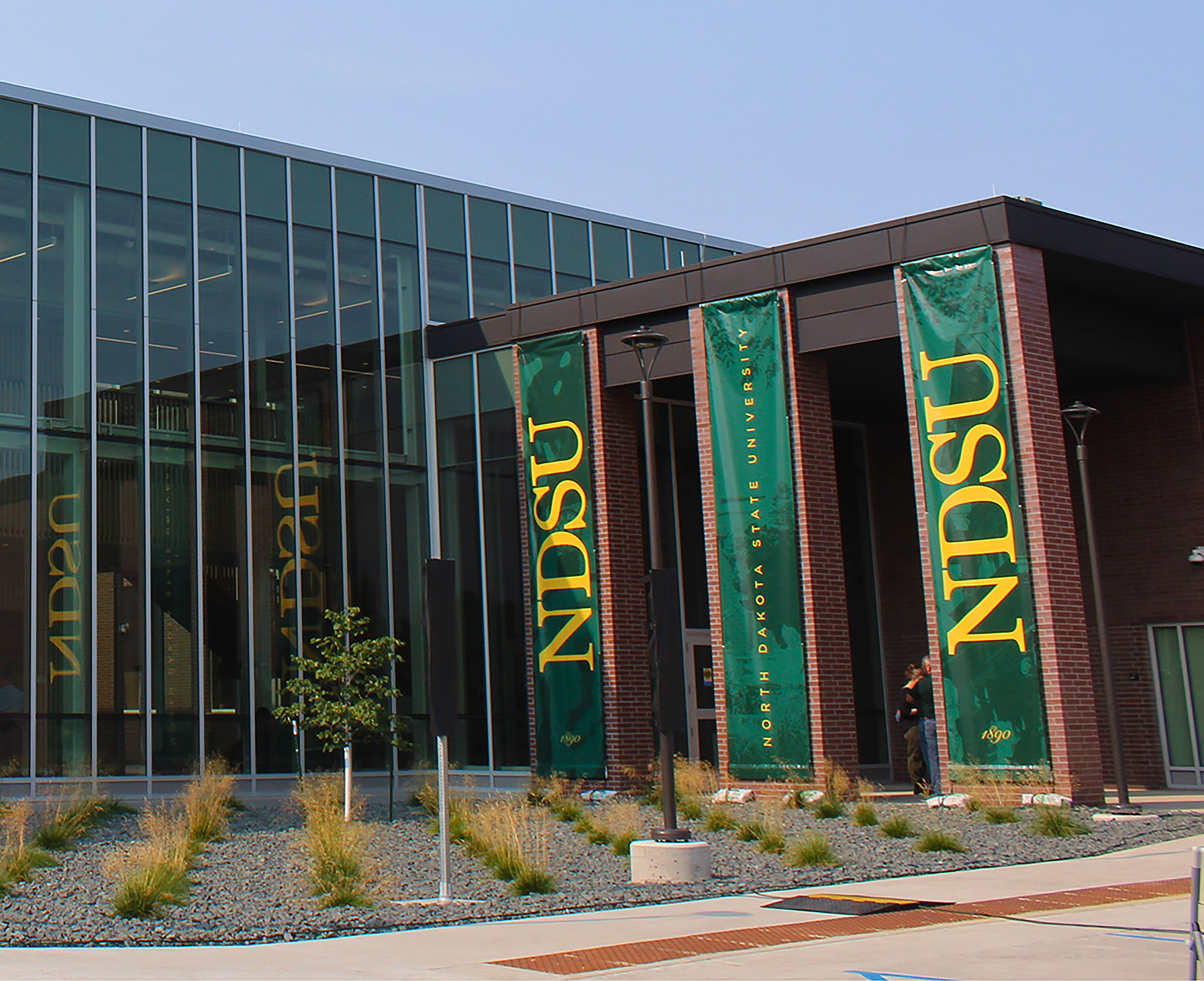
New Bolley Ag Lab strengthens NDSU’s position as a leader in agricultural research
The Bolley Agricultural Laboratory is a 170,000-square-foot facility, but its impact on NDSU’s research capabilities will extend far beyond its doors across the state of North Dakota.
The state-of-the-art facility held its grand opening in August, further solidifying NDSU’s standing as a premier land-grant research university in the United States.
“Bolley is the largest investment in agricultural research infrastructure in NDSU’s history, and it puts our field-oriented research programs in a facility that matches the quality of the people working in it,” says Frank Casey, associate director of the North Dakota Agricultural Experiment Station. “Land-grant peers across the country compete for the same faculty, graduate students, and federal and industry dollars we do. A building like this tells them North Dakota is serious about agricultural research that is producer-focused, and it helps us recruit and keep the scientists who will solve the next generation of problems they face.”
The building is named after Henry L. Bolley, the first plant pathologist at NDSU. He also served as the state’s seed commissioner from 1909 to 1929 and was the founder and coach of the university’s football team.
The Bolley Agricultural Laboratory brings many of NDSU’s research programs under one roof – including plant pathology, plant breeding, weed science, agronomy, soil science and horticulture – and right next to the research plots.
“That proximity matters as it fosters collaborations, bringing interdisciplinary approaches to solve producer challenges,” says Casey. “A breeder, a pathologist and a soil scientist can now share equipment, data and ideas. That kind of collaboration is how we move from individual projects to integrated solutions for North Dakota’s land and commodities.”
“For many programs, the ability to operate in the same facility as breeding, agronomy, soil science, etc., increases collaboration and transdisciplinary research to better serve North Dakota growers,” says Julie Pasche, professor and the Neil C. Gudmestad Endowed Chair of Potato Pathology.
Among the new additions are modern specialized labs and almost 30,000 square feet of greenhouse space with much-improved environmental control. Also included are dedicated seed-drying and processing areas, as well as cooler and storage areas.
“The new building puts us in a better position to make advancements faster, especially when it comes to modernization, because we have so much easy access to new growth chambers and new greenhouses,” says Carrie Dottey, NDSU assistant professor and lead soybean breeder.
Many of those breeding and pathology programs were scattered in different buildings across campus.
“Those support spaces are the backbone of our research, ensuring we have a one-foot-in-the-field approach to our science,” says Casey. “They let us handle more lines, more samples and more seasons of material with better quality control.”
They also set up shared equipment and a recharge model so that high-end instrumentation is available across programs.
Pasche, who oversees the potato pathology program at NDSU, says the Bolley Lab will help the team conduct research that simulates the real-world situations growers face.
“The new facility modernizes our research efforts, specifically with postharvest operations of grading and storage,” says Pasche.
“Most notably, it allows us to conduct potato storage research using modern facilities equivalent to those used by growers,” adds Pasche. “We can mimic real-world scenarios, making our results relevant to growers.”
For Dottey’s soybean breeding program, the new facility will improve logistical efficiency. Her team handles thousands of individual seed lots, plants and harvests thousands of research lots, processes seed and collects data.
“There are a lot of steps where organization, space and the ability to move efficiently from one part of the process to another really matter,” says Dottey.
“Having a facility designed around those workflows will make us much more efficient. Instead of constantly adapting our research to the limitations of the space we have, we’ll create a space designed to support the research. It is extremely efficient to have our large working space and greenhouse/growth chambers, cold room and regular storage, plus all the additional rooms we need, all within one building.”
The NDSU research programs will utilize the modern amenities and tools of the Bolley Agricultural Laboratory, but the results of that work will impact the whole state.
“This facility belongs to the whole Agricultural Experiment Station,” says Casey. “The discoveries made in Bolley will be tested across the state and delivered to farmers. It is a Fargo building with a statewide mission.”
The Bolley Agricultural Laboratory was made possible by a transformative $87 million investment from the North Dakota Legislature in 2023, complemented by additional philanthropic support.


