
Prairie Fare: Inspiration from nature’s paintbrush and a chance to win a calendar
The beautiful foliage of fall inspires long walks and drives to admire the changing colors. In fact, some of my friends make trips to northeastern states to see nature’s paintings featuring red, orange, yellow and even purple hues.
The pigments in leaves are the same ones found naturally in fruits and vegetables. I am not advocating climbing a tree and munching on colorful leaves, though.
Let’s be motivated by our changing seasons to take a closer look at our food choices.
We are all advised to consume more fruits and vegetables, according to current and previous Dietary Guidelines for Americans. On average, we need three servings of vegetables and two servings of fruit, according to the recent guidance. That’s about 3 ½ to 5 cups of fruit and vegetables in total, depending on our needs.
Eating more fruits and vegetables as part of an overall healthy diet may reduce our risk of some types of cancer, Type 2 diabetes, high blood pressure and strokes. Since fruits and vegetables are particularly high in water, they are also low in calories. They provide the fiber that we all need.
How colorful is your daily plate when it comes to fruits and vegetables? Think about what you ate yesterday or on average.
Did you have any red fruits and vegetables? Many are naturally colored by lycopene pigments, which are especially high in tomatoes, watermelon and pink grapefruit.
Lycopene pigments have been studied for their potential health benefits, including decreasing the risk of prostate cancer. If you like tomato-based spaghetti sauce, that’s a good thing, as lycopene pigments are absorbed better in cooked form with some fat present.
Anthocyanins are the red or blue pigments that serve as natural antioxidants. They help protect our cells from damage. Red apples, red or purple cabbage, red or purple grapes, and cherries are among the foods colored by anthocyanin pigments.
Did you include some orange and gold vegetables and fruits? Most are colored by pigments called carotenoids. For example, beta-carotene in sweet potatoes, squash and carrots is converted by our body to vitamin A. This vitamin promotes healthy vision and skin.
Did you leave room for green vegetables on your plate or in your bowl? Spinach, green peppers, peas and cucumber are high in lutein. This pigment works with zeaxanthin in corn, red peppers and other vegetables and fruits to promote eye health.
You do not have to remember all these pigment names, but focus on enjoying a colorful diet. Visit www.ag.ndsu.edu/fieldtofork for more information.
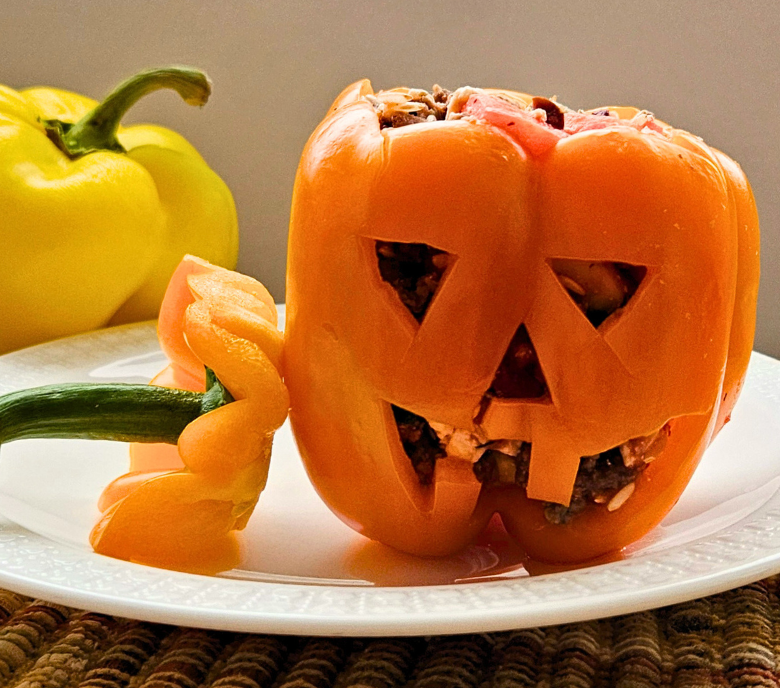
Here’s a recipe that was very popular with our taste-testers, and it is featured in our 2027 Field to Fork calendar. My creative students carved the peppers to look like jack-o’-lanterns, but they work just as well without carving.
If you would like an opportunity to win our colorful calendar in drawings for at least 25 calendars, fill out a form at bit.ly/PFare-26 by Nov. 15. I will make sure these are shipped in 2026 so you are ready to launch the new year.
If the form does not work for you, email me at julie.gardenrobinson@ndsu.edu with “Calendar Drawing” as the subject line. Be sure to include your complete mailing address, where you read the column and a topic idea for a future Prairie Fare column.
Slow Cooker Greek Stuffed Peppers
8 whole bell peppers, tops and cores removed
¾ pound lean ground beef (or pulled pork)
1 medium white onion, chopped (about 1 cup)
3 garlic cloves, finely chopped (3 teaspoons)
1 large zucchini, diced (2-3 cups)
3-4 Roma tomatoes, diced (2 cups)
1 cup brown rice, cooked
⅔ cup feta cheese
⅓ cup Kalamata olives, chopped
For sauce
14 ounces unsalted tomato puree
½ teaspoon oregano
½ teaspoon onion powder
½ teaspoon garlic powder
½ teaspoon salt
¼ teaspoon pepper
½ teaspoon basil
½ teaspoon dill
Cook the rice as directed on the package. In a frying pan, brown the ground beef. Drain excess grease and add beef to a large bowl. Mix in onion, garlic, zucchini, Roma tomatoes, brown rice, Kalamata olives and feta cheese. In a medium bowl, mix together tomato puree, oregano, onion powder, garlic powder, salt, pepper, basil and dill. Add half the sauce to the beef mixture, then place it into the cut peppers. Add the remaining sauce to the bottom of a crockpot, then add the stuffed peppers. Cook on low for 5 to 6 hours or high for 2 to 3 hours.
Optional substitutions: mozzarella cheese for feta cheese, black olives for kalamata olives
Makes eight servings. One pepper has 280 calories, 12 grams (g) fat, 17 g protein, 26 g carbohydrates, 6 g fiber and 430 milligrams sodium.
(Julie Garden-Robinson, Ph.D., R.D., L.R.D., is a North Dakota State University Extension food and nutrition specialist and professor in the Department of Health, Nutrition and Exercise Sciences.)
NDSU Agriculture Communication – Oct. 15, 2026
Source: Julie Garden-Robinson, 701-231-7187, julie.garden-robinson@ndsu.edu
Editor: Dominic Erickson, 701-231-5546, dominic.erickson@ndsu.edu