
Integrated Pest Management of Alfalfa Weevil in North Dakota
(E1676, Revised March 2026)Identification and biology of the alfalfa weevil is discussed. When and how to scout, and use of economic thresholds for making management decisions. Integrated Pest Management (IPM) strategies are discussed including biological control, cultural control and insecticidal control.
Contact your county NDSU Extension office to request a printed copy.
NDSU staff can order copies online (login required).
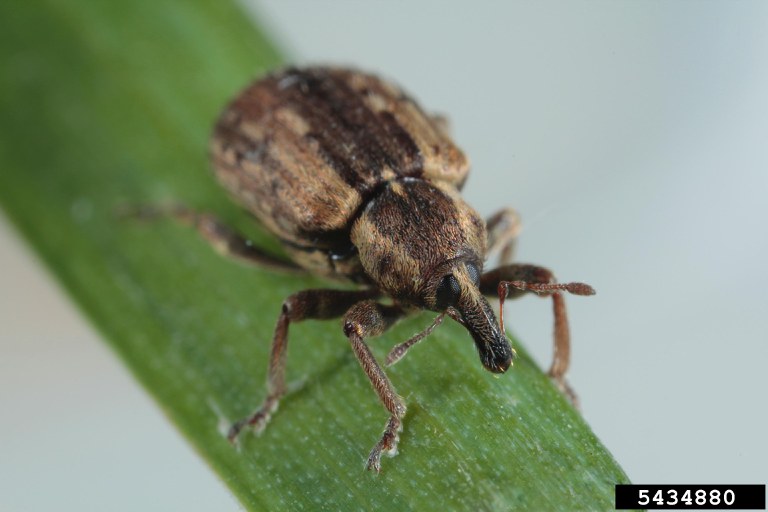
The alfalfa weevil, Hypera postica (Gyllenhal) (Coleoptera:Curculionidae), is found throughout the U.S. and is the major insect pest of alfalfa in North Dakota.
Loss of plant biomass, especially leaf tissue, can be severe. Leaf feeding by alfalfa weevil also reduces the nutritional quality and digestibility of alfalfa. Depending on the year, yield loss due to alfalfa weevil can approach 100%, especially under drought.
Identification
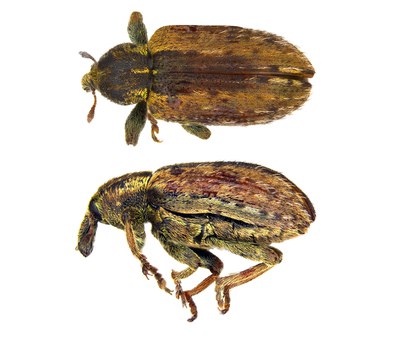
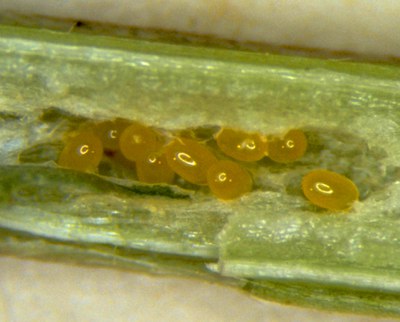
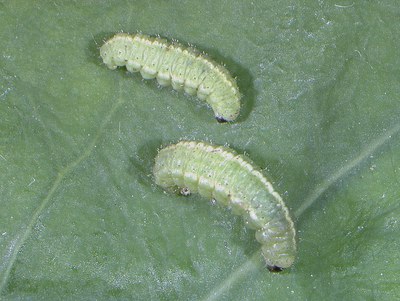
Adults (Figure 1) are about 5 millimeters (mm) long (¼ inch), with elbowed, clubbed antennae and a blunt snout. Adults are brown with short, somewhat thick golden hairs over the body and a distinctive brown stripe longitudinally along the center of the back. Newly deposited eggs (Figure 2) are cream colored, and eggs that are about to hatch are olive brown, with the black head capsule of the developing larva visible. Mature larvae (Figure 3) are about 8 mm long (almost ½ inch) and have a black head capsule and a wrinkled green body with a white stripe running lengthwise along the top. Younger larvae are similar in appearance but smaller.
Life Cycle (Fig. 4)

Alfalfa weevil has one complete generation per year in North Dakota. Adults become active from May through June, and females lay eggs in alfalfa stems. Eggs hatch in one to two weeks. Larvae emerge from the stem and begin feeding on the growing tips of the alfalfa plants. Larvae pass through four growth stages (instars) before reaching maturity.
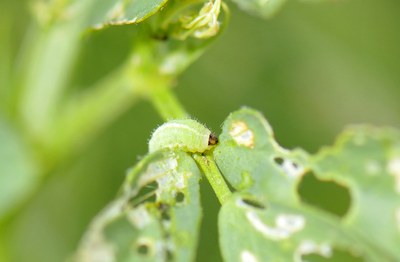
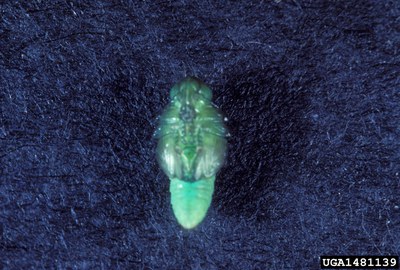
Larvae continue to feed on tender leaf tissue as they grow (Figure 5). Mature larvae feed for two to three weeks before pupating (Figure 6). Pupation takes place in small, silken cocoons that are spun near the base of the plant. Adults emerge after one to two weeks. Adults feed on the alfalfa for two to three weeks before leaving for sheltered areas and entering a summer dormancy period (aestivation).
Some adults may move back to alfalfa in the fall and lay eggs, but these eggs usually do not overwinter successfully in North Dakota. However, during exceptionally mild winters such as we experienced during the winter of 2011-12, winter egg survival may lead to spring larval emergence and damage occurring earlier than normal the following spring. These adults will overwinter in shelterbelts outside the alfalfa field and then continue their life cycle the following year.
Alfalfa weevil development is temperature-dependent, and degree-day models have been used to forecast its life stages. The following degree-day model has been adopted by university Extension specialists in our region (e.g., the University of Wisconsin and the University of Illinois) and was derived from the model developed by Harcourt (1981) for alfalfa weevil in southern Ontario (Table 1).
For most years, degree days toward alfalfa weevil development do not begin to accumulate before March 1. Be sure to check the weekly NDSU Extension “Crop & Pest Report” (https://www.ndsu.edu/agriculture/ag-hub/ag-topics/crop-production/crop-pest-report) during the growing season for statewide alfalfa weevil degree day maps. Or you can generate your own by visiting the NDAWN website at https://ndawn.ndsu.nodak.edu/. Go to “Applications,” select “Insect Degree Days” and choose “Maps.” March 1 is used as the start date; select 48 F as the base temperature, then click “Submit” to generate the map. You can also generate accumulated degree day tables for individual weather stations.
| Life Stage | DD Required to Complete Life Stage | Accumulated DD | Typical Feeding Activity |
|---|---|---|---|
| Egg hatch begins | 300 | 300 | |
| 1st instar development | 71 | 371 | Light |
| 2nd instar development | 67 | 438 | Light |
| 3rd instar development | 66 | 504 | Heavy |
| 4th instar development | 91 | 595 | Heavy |
| Pupation | 219 | 814 | |
| Adult emergence | -- | >814 |
Plant Injury
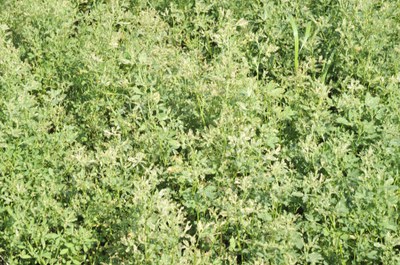
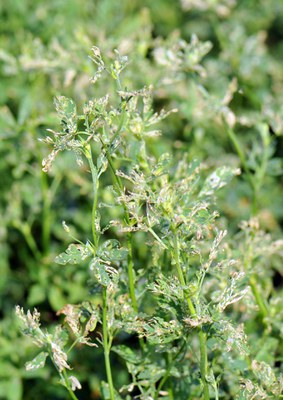
Initial feeding injury by first-instar larvae appears as pinholes in the terminal leaves. As plants and larvae grow, feeding injury will progress across the leaves, with leaves becoming skeletonized as injury becomes more severe (Figs. 7 and 8). Typically, third- and fourth-instar larvae cause the most feeding injury on foliage. Plant growth up to the first cutting is usually most affected by feeding injury. However, crown injury to regrowth can become significant, particularly under windrows where larvae take shelter after the first cutting.
When and How to Scout
Integrating the degree-day model into your alfalfa weevil management program is essential. Accumulated degree days will give you a time to begin scouting, when larval feeding damage might occur and when control action might be necessary.
Scouting should begin immediately after egg hatch, and fields should be scouted weekly up through the first cutting. Fields should be scouted in a “W” pattern or by selecting random sites in the field, with a minimum of five sampling sites per field. Larger fields should have more sampling sites. Be sure your sampling pattern is representative of the entire field. Don’t scout only along the edges or in small areas.
Using a system of aerial imagery of your field, global positioning system (GPS) coordinates (available in Google Earth), and a handheld GPS unit will allow you to set up your scouting routes and locate sampling sites before you scout.
For sampling before the first cutting, you will need sharp pruning shears; a clean, white 5-gallon bucket; a hand lens; a yardstick for measuring plant height; and a pencil, paper and a calculator.
At each sampling site in the field, select a minimum of 30 stems and cut them off at the base. Invert the cut stems into the 5-gallon pail and vigorously beat the plants in the pail to dislodge the larvae. First-instar larvae feeding in rolled leaf tips won’t dislodge easily, so be sure to examine leaf tips for larvae.
Count and record 1) the number of stems sampled, 2) the total number of larvae counted, and 3) the height of the alfalfa at the sampling sites. Repeat this procedure for all sampling sites within the field. When finished, total the number of larvae found and divide by the total number of stems sampled to calculate an average number of larvae per stem for the entire field (Figure 9). Also, calculate average plant height for the field.
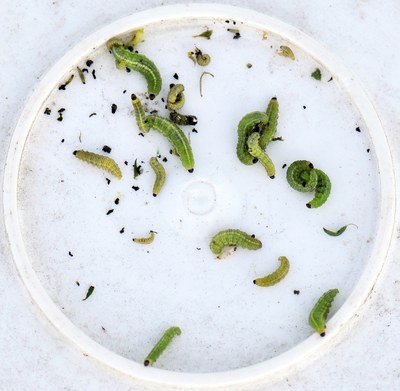
An alternative, though less accurate, scouting method is to visually estimate defoliation at each field sampling site, using the same field scouting pattern described above. Defoliation estimates should be recorded as percent defoliation, and an average should be calculated for the entire field. Keep in mind that this method, while time-efficient, can lead to overestimation or underestimation of actual damage, and estimates can vary significantly among different observers.
We do not recommend using sweep nets for sampling because results are often highly variable and inaccurate. Sweep nets can be used to determine the presence/absence of alfalfa weevil adults and larvae in a field at or before typical egg hatch (300 DD). After alfalfa weevil has been detected, the stem sampling method should be used.
Economic Threshold and Management Decisions
Several factors must be considered when making alfalfa weevil management decisions. Plant height, estimated yield, crop market value, management costs and plant injury based on the number of larvae per stem must be considered. Studies conducted in Kentucky, Nebraska, New York and Utah have demonstrated that the level of plant damage per insect varies by geographic area.
The following economic threshold table is based on simulated third- and fourth-instar larvae damage levels observed in a two-year study conducted in Nebraska in 1990 and 1991 (Peterson et al. 1993) and has been adapted for North Dakota. Threshold numbers in Table 2 are the average number of larvae per stem sampled in the field using the 30-stem sampling method described above. These economic thresholds apply prior to the first cutting only.
Table 2. Recommended economic thresholds for third- and fourth-instar alfalfa weevil larvae in North Dakota prior to the first cutting.
| Plant Growth Stage (Height) | Treatment Cost | Crop Value ($/ton) | Management Decision | ||||||||
|---|---|---|---|---|---|---|---|---|---|---|---|
| $50 | $75 | $100 | $125 | $150 | $175 | $200 | $225 | $250 | |||
| Number of Alfalfa Weevil Larvae per Stem | |||||||||||
| 50% bud or greater | Cut early | ||||||||||
| Early bud (>20 inches) | $7/acre | 4.0 | 2.7 | 2.0 | 1.6 | 1.3 | 1.2 | 1.0 | 0.9 | 0.8 | Cut early, or use a short PHI/PGI product |
| $8/acre | 4.6 | 3.1 | 2.3 | 1.8 | 1.5 | 1.3 | 1.2 | 1.0 | 0.9 | ||
| $9/acre | 5.2 | 3.5 | 2.6 | 2.1 | 1.7 | 1.5 | 1.3 | 1.2 | 1.0 | ||
| $10/acre | 5.8 | 3.8 | 2.9 | 2.3 | 1.9 | 1.6 | 1.4 | 1.3 | 1.2 | ||
| $11/acre | 6.3 | 4.2 | 3.2 | 2.5 | 2.1 | 1.8 | 1.6 | 1.4 | 1.3 | ||
| $12/acre | 6.9 | 4.6 | 3.5 | 2.8 | 2.3 | 2.0 | 1.7 | 1.5 | 1.4 | ||
| $13/acre | 7.5 | 5.0 | 3.7 | 3.0 | 2.5 | 2.1 | 1.9 | 1.7 | 1.5 | ||
| $14/acre | 8.1 | 5.4 | 4.0 | 3.2 | 2.7 | 2.3 | 2.0 | 1.8 | 1.6 | ||
| $15/acre | 8.6 | 5.8 | 4.3 | 3.5 | 2.9 | 2.5 | 2.2 | 1.9 | 1.7 | ||
| $16/acre | 9.2 | 6.1 | 4.6 | 3.7 | 3.1 | 2.6 | 2.3 | 2.0 | 1.8 | ||
| Late vegetative (16 to 20 inches) | $7/acre | 3.8 | 2.4 | 1.8 | 1.4 | 1.1 | 0.9 | 0.8 | 0.7 | 0.6 | Use a short to mid-PHI/PGI product |
| $8/acre | 4.4 | 2.8 | 2.1 | 1.6 | 1.3 | 1.1 | 0.9 | 0.8 | 0.7 | ||
| $9/acre | 4.9 | 3.2 | 2.4 | 1.8 | 1.5 | 1.2 | 1.1 | 0.9 | 0.8 | ||
| $10/acre | 5.5 | 3.6 | 2.6 | 2.1 | 1.7 | 1.4 | 1.2 | 1.0 | 0.9 | ||
| $11/acre | 6.1 | 4.0 | 2.9 | 2.3 | 1.9 | 1.6 | 1.3 | 1.2 | 1.0 | ||
| $12/acre | 6.7 | 4.4 | 3.2 | 2.5 | 2.1 | 1.7 | 1.5 | 1.3 | 1.1 | ||
| $13/acre | 7.2 | 4.8 | 3.5 | 2.8 | 2.3 | 1.9 | 1.6 | 1.4 | 1.3 | ||
| $14/acre | 7.8 | 5.1 | 3.8 | 3.0 | 2.4 | 2.1 | 1.8 | 1.6 | 1.4 | ||
| $15/acre | 8.4 | 5.5 | 4.1 | 3.2 | 2.6 | 2.2 | 1.9 | 1.7 | 1.5 | ||
| $16/acre | 9.0 | 5.9 | 4.4 | 3.4 | 2.8 | 2.4 | 2.1 | 1.8 | 1.6 | ||
| Midvegetative (10 to 15 inches) | $7/acre | 3.6 | 2.2 | 1.5 | 1.1 | 0.9 | 0.7 | 0.5 | 0.4 | 0.3 | Use a long-residual product |
| $8/acre | 4.1 | 2.6 | 1.8 | 1.4 | 1.1 | 0.8 | 0.7 | 0.5 | 0.4 | ||
| $9/acre | 4.7 | 3.0 | 2.1 | 1.6 | 1.2 | 1.0 | 0.8 | 0.7 | 0.6 | ||
| $10/acre | 5.3 | 3.4 | 2.4 | 1.8 | 1.4 | 1.2 | 1.0 | 0.8 | 0.7 | ||
| $11/acre | 5.9 | 3.7 | 2.7 | 2.1 | 1.6 | 1.3 | 1.1 | 0.9 | 0.8 | ||
| $12/acre | 6.4 | 4.1 | 3.0 | 2.3 | 1.8 | 1.5 | 1.2 | 1.1 | 0.9 | ||
| $13/acre | 7.0 | 4.5 | 3.3 | 2.5 | 2.0 | 1.7 | 1.4 | 1.2 | 1.0 | ||
| $14/acre | 7.6 | 4.9 | 3.6 | 2.7 | 2.2 | 1.8 | 1.5 | 1.3 | 1.1 | ||
| $15/acre | 8.2 | 5.3 | 3.8 | 3.0 | 2.4 | 2.0 | 1.7 | 1.4 | 1.2 | ||
| $16/acre | 8.7 | 5.7 | 4.1 | 3.2 | 2.6 | 2.2 | 1.8 | 1.6 | 1.4 | ||
After the first cutting has been harvested, be sure to scout for larvae under the windrows. Larvae that escaped the first cutting tend to move under the windrows for shelter and feed there (Figure 10).
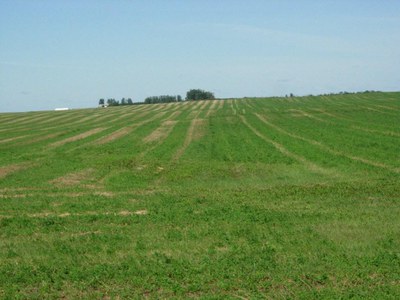
Check regrowth for larval feeding. If eight or more larvae per square foot are found or regrowth is delayed due to feeding, treatment is recommended.
If using the visual percent defoliation method, treatment is recommended when the average percent defoliation across the entire field reaches 30%. Keep in mind that this threshold is less accurate than the threshold based on larval counts and does not take into account forage value or insecticide application costs.
Selected References
Bryan, M.D., R.J. Dysart and T.L. Burger. 1993. Releases of introduced parasites of the alfalfa weevil in the United States, pp. 1-203. USDA-APHIS Series, Miscellaneous Publications No. 1504.
Cook, K.A., S.T. Ratcliffe, M.E. Grey and K.L. Steffey. 2004. Alfalfa Weevil.
http://ipm.illinois.edu/fieldcrops/insects/alfalfa_weevil/ University of Illinois Extension.
Danielson, S., T. Hunt and K. Jarvi. Managing the Alfalfa Weevil. 2006. University of Nebraska-Lincoln Extension, Institute of Natural Resources publication G1208 (revised).
Giles, K., J.J. Obrycki, M. Rice, L. Pedigo and S. Barnhart. 1999. Integrated Pest Management of Alfalfa Insects in the Upper Midwest. Leopold Center for Sustainable Agriculture, Publication
IPM-58. Iowa State University, Ames.
Harcourt, D.G. 1981. A thermal summation model for predicting seasonal occurrence of the alfalfa weevil, Hypera postica (Coleoptera: Curculionidae), in southern Ontario. The Canadian Entomologist 113: 601-605.
Peterson, R.K.D., S.D. Danielson and L.G. Higley. 1993. Yield responses of alfalfa to simulated alfalfa weevil injury and development of economic injury levels. Agronomy Journal 85: 595-601.
Peterson, R.K.D., and S.J. Meyer. 1995. Relating degree-day accumulations to calendar dates: alfalfa weevil (Coleoptera: Curculionidae) egg hatch in the north central United States. Environmental Entomology 24: 1404-1407.
Radcliffe, E.B., and K.L. Flanders. 1998. Biological control of alfalfa weevil in North America. Integrated Pest Management Reviews 3: 225-242.
Rand, T. 2013. Host density drives spatial variation in parasitism of the alfalfa weevil, Hypera postica, across dryland and irrigated alfalfa cropping systems. Environmental Entomology 42: 116-122.
Rodbell, E.A., C.G. Caron, S.I. Rondon, M.U. Masood and K.W. Wanner. 2024. Alfalfa weevils (Coleoptera: Curculionidae) in the western United States are resistant to multiple type II pyrethroid insecticides. Journal of Economic Entomology 117: 208-292.