Grazing with Virtual Fence
(AS2293, June 2026)Virtual fencing systems are tools that utilize digital fence boundaries with global positioning system (GPS)-enabled collars or ear tags to manage the movement of grazing animals. This technology can aid in grazing management by helping remotely implement adaptable and flexible intensive grazing practices. The flexibility provided by virtual fencing can also be used to reach environmental and conservation goals, while reducing labor.
Contact your county NDSU Extension office to request a printed copy.
NDSU staff can order copies online (login required).
❚ What it is and How it Works
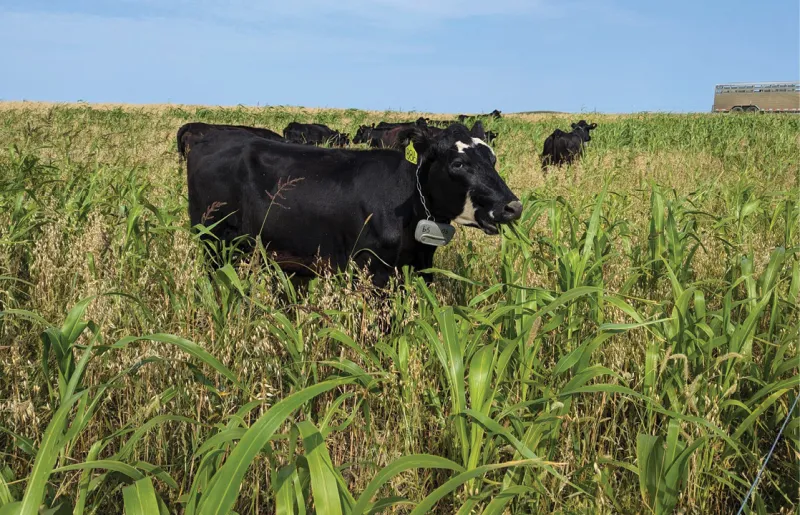
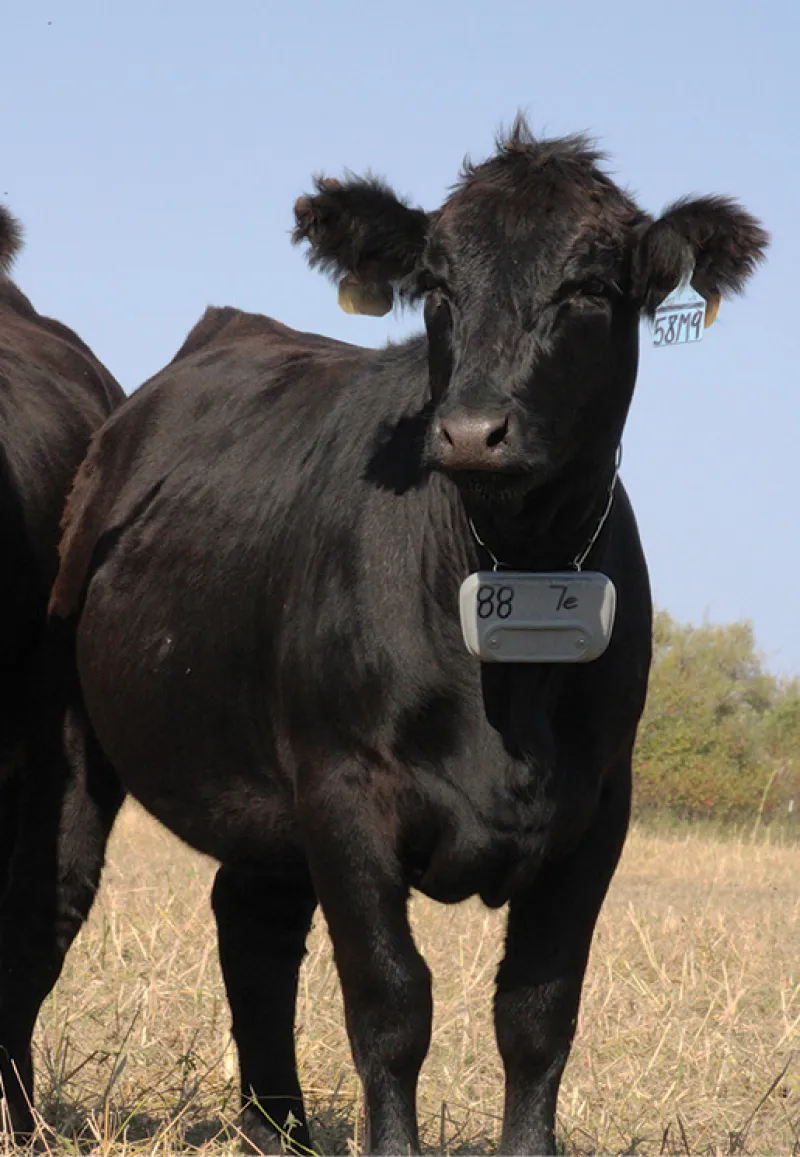
Virtual fencing systems are tools that utilize digital fence boundaries with global positioning system (GPS)-enabled collars or ear tags to manage the movement of grazing animals. While design and connectivity can vary by vendor, virtual fencing systems work through the same principles. A GPS-enabled device is fitted to livestock, often as a collar. This collar communicates the livestock position to an online management platform either via a tower or cellular service. These platforms are used to create virtual fences, contain animals (in or out of designated areas) and even move animals (with assisted move features).
Virtual fence devices are often worn as collars on livestock. All vendors provide collars designed for cattle, while some vendors offer separate collars for small ruminants. It is not recommended to fit virtual fencing collars to calves (general consideration: under 500 lb) due to calves’ growth requiring frequent adjustments to fit. When fitted to yearlings, these devices will require adjustment during the grazing season to maintain optimal fit. The devices are powered by batteries, which may be recharged by built-in solar panels or replaced as needed.
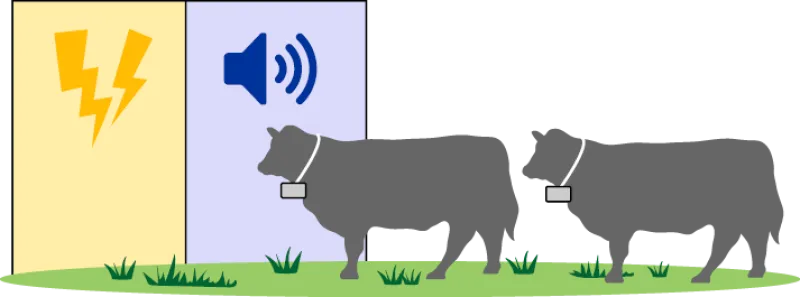
Virtual fence devices utilize GPS to determine the position of the livestock and administer various cues to manage them. Management cues include auditory tones and electrical cues. All cues are designed to be safe and provide effective stimuli. The energy equivalent for the electric cue is equivalent to a 6-to 8-volt electric fence, depending on the manufacturer and livestock class. Auditory and electrical cues are only administered when an animal enters or approaches the set boundaries. An auditory cue warns the animal that it is approaching a boundary. If the animal continues towards or past the boundary, an electrical cue (or in combination with the auditory cue) is administered to deter further movement past the boundary. These cues are direction-sensitive and will not activate as animals move back into the desired area. Additionally, electrical cues are limited for animal welfare and deactivated if a cue threshold is met.
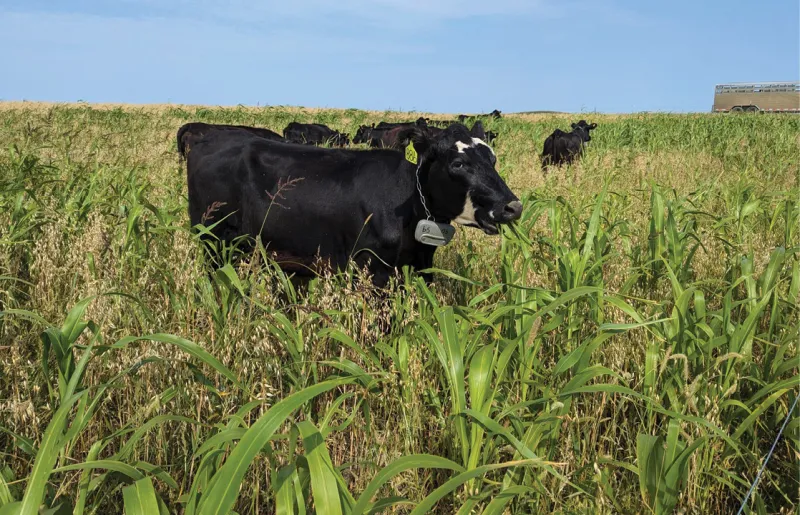
Livestock require training to effectively respond to virtual fence cues. The training period is used to teach animals to associate the auditory and electrical cues with physical fences. During the training period, a smaller, fenced area is required to ensure animals interact with virtual fence boundaries often enough to learn the cues. During the initial phase, the virtual fence boundary should overlay (or be close in proximity to) the existing physical fences to positively reinforce livestock responses to the cues when interacting with virtual fencing boundaries. Subsequently, the virtual fence boundaries are moved away from the physical fences to encourage learning of the cues. Once livestock are trained, virtual fencing is just as effective as electrical fencing options, ranging from 80%-99% effectiveness, depending on the grazing strategy and class of livestock. Ongoing research at North Dakota State University and the University of Nebraska — Lincoln has observed up to 99% effective containment when strip-grazing annual forages.
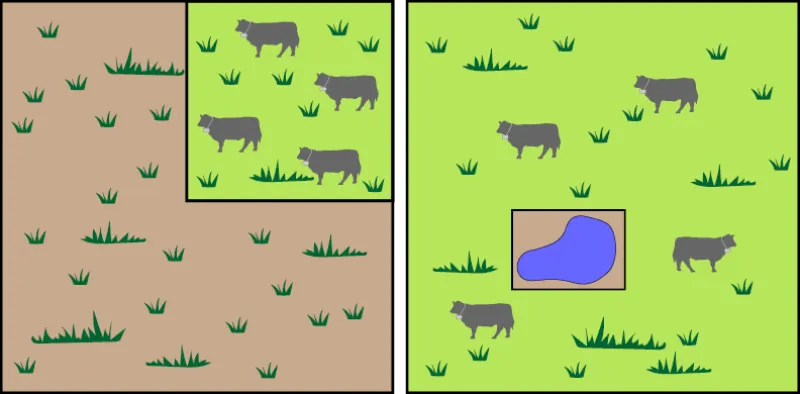
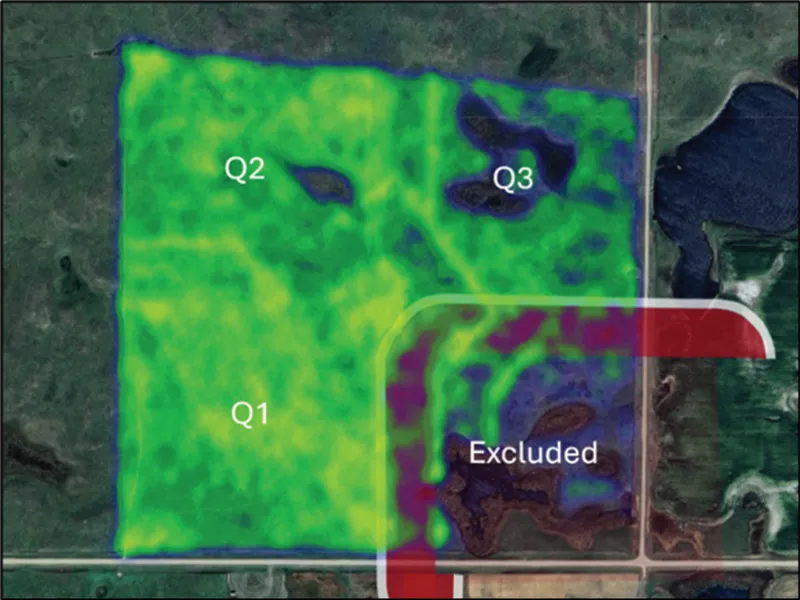
Virtual fences can be designed based on the management goals for each pasture. Most commonly, virtual fencing programs offer three types of fencing: inclusion zones, exclusion zones and movement fences. Inclusion zones are used to confine livestock within a set boundary, fencing them in. Inclusion zones are best used for creating grazing allotments under different intensive grazing practices. Exclusion zones are used to prevent livestock from entering an area by fencing them out. Exclusion zones are useful for protecting sensitive areas, such as riparian areas or wetlands. Movement fences slowly push a boundary in one direction. Movement fences are helpful in moving cattle to new paddocks or towards corrals. Using the correct virtual fence function is important, as virtual fences are one-way only: they provide stimuli as livestock approach the boundary of the restricted area, but not when animals return to the designated grazing area.
All virtual fence systems have a website-based or mobile app where managers can outline fences on their property, view animal location and check the status of their devices. Virtual fencing devices communicate either through satellite connectivity, cellular connectivity or long-range wide-area network (LoRaWAN) tower. Satellite- and cellular-enabled devices communicate directly with the platform and do not require a separate base station with an antenna to transmit data. While smartphones need strong 5G/LTE coverage for calls and texts, virtual fence devices can operate on lower-bandwidth networks such as 3G or 4G because they transmit only tiny bits of data. That means they often stay connected in places where phone service might fail.
Cellular connectivity may be limited or unavailable in some areas. This issue can be overcome with LoRaWAN-enabled devices as well as direct satellite collars. LoRaWAN-enabled devices communicate via radio to a base station placed near the grazing area, then transmit the collar data via cellular connection. These base stations can aid in connectivity in areas with poor cellular signal. In principle, a LoRaWAN tower can easily cover a 2- to 3-mile radius, assuming flat terrain with no major obstacles; additional obstacles and terrain changes correspondingly reduce the tower’s coverage. Direct-to-satellite is the most recent form of virtual fence communication. These devices forgo cellular communication altogether and utilize satellite networks to communicate between the management program and collars. Satellite devices are able to communicate in the most remote and extensive areas where cellular signals have been challenging and investment in towers can be cost-prohibitive; however, communication may slow down under heavy tree cover or other obstructions to the sky.
❚ Benefits to Producers
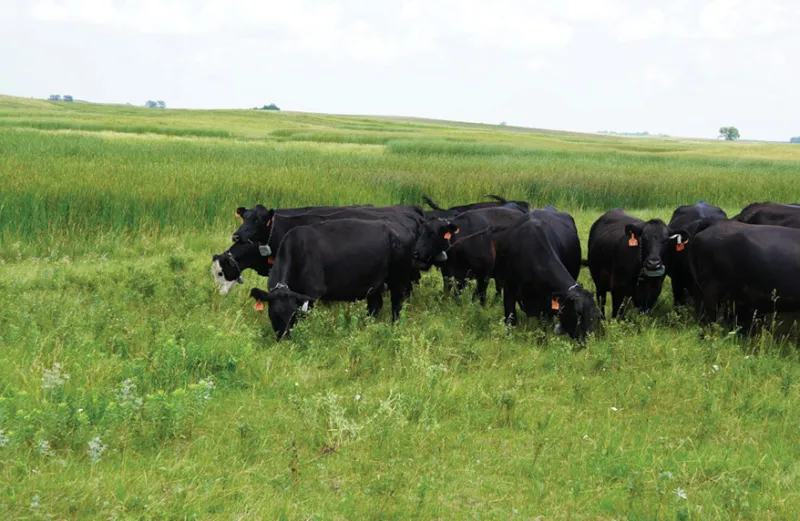
Virtual fencing offers a flexible method of implementing intensive grazing practices. By replacing the interior cross-fencing on rangelands, virtual fencing allows rotational and patch-grazing practices without the need for physical fencing. With the ability to move cattle with only a few clicks, grazing practices become more adaptable to current conditions. Virtual fencing can also be useful on public or rented grazing lands with reduced fencing infrastructure.
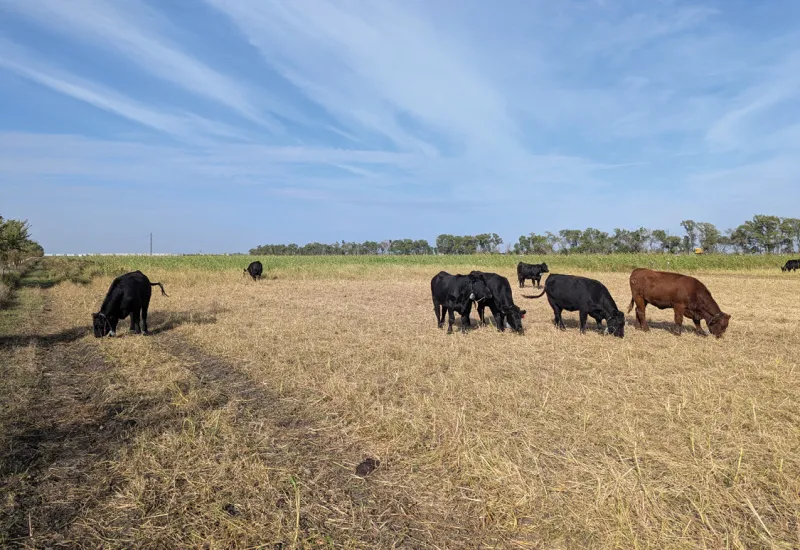
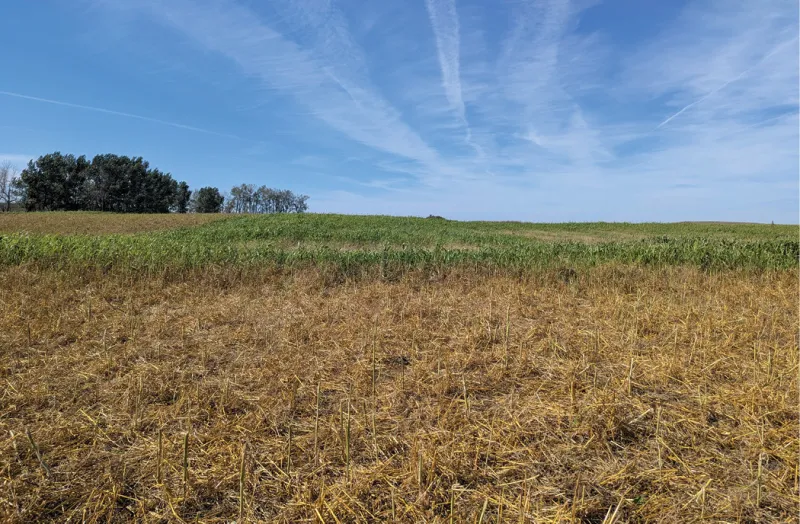
Outside of rangelands, virtual fencing can be useful for alternative grazing strategies where fencing is labor-intensive or otherwise difficult to implement. Research at NDSU and UNL found that within annual forage systems, virtual fencing is just as effective as conventional polywire fencing under strip-grazing practices. These uses can be further expanded into crop residue or bale-grazing scenarios, where constructing fences may be difficult or not feasible.
In addition to physically managing livestock, virtual fencing technologies provide more data to ranchers on their herds’ grazing behavior. Point data and heat maps are available features in management software that can be used to determine where animals spend the most time and identify movement patterns within a pasture. Additionally, heat maps and other visualizations can aid in pasture management decisions, such as identifying preferred water sources or areas where livestock congregate. While this data can help visualize animal distribution, note that areas of high livestock activity may not always equate to higher rates of forage utilization. Point data can also help identify the exact location of an animal or herd during round-up.
❚ Summary
Virtual fencing is a new and fast-growing management tool available to livestock producers. This technology can aid in grazing management by helping remotely implement adaptable and flexible intensive grazing practices. The flexibility provided by virtual fencing can also be used to reach environmental and conservation goals while reducing labor. As with many new technologies, it is important to determine how virtual fencing can impact your operation.