
Interpreting the NDSU Soil Test Analysis for Managing Turfgrass
(H1824, Revised April 2023)This publication teaches homeowners and golf course personnel how to take a soil sample and interpret the soil test results to grow and maintain a healthy lawn. Subjects include soil pH, soluble salts, and nitrogen, phosphorus, and potassium recommendations. Select micronutrients are also covered.
Soil Sample Preparation
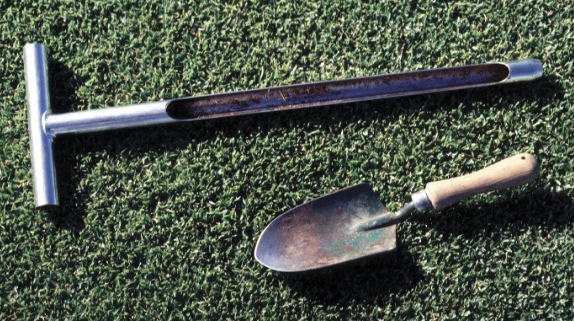

To prepare a soil sample for testing, take cores (subsamples) from the upper 4 to 6 inches of soil, excluding the thatch layer. We recommend that
homeowners take 7 to 10 random cores from each area to be tested. A separate set of cores would be submitted for the front yard as opposed to the backyard. For larger areas, professional turfgrass managers should take 15 to 20 cores per area.
Providing numerous cores from across the entire area is important because the composite soil sample will truly represent that area. In addition, it will provide enough soil to the laboratory to perform the requested tests and ensure accurate test results. Avoid collecting from unrepresentative areas such as dog urine spots and fertilizer spills.
You can use a core sampler or a hand trowel (Figure 1). Be sure to remove the thatch layer to avoid an inaccurate high organic matter reading (Figure 2). Place the cores or trowel samples in a clean bucket and thoroughly mix together. Send at least 1 pint of the mixed soil sample from each area to be tested. You can send soil samples in a plastic or paper bag or in sample bags provided by the lab.
Reference Sources
Carrow, R.N., and R. Duncan. 2011. Best management practices for saline and sodic turfgrass soils: Assessment and reclamation. p. 79. CRC Press, Boca Raton, Fla.
Carrow, R.N., D.V. Waddington and P.E. Rieke. 2001a. Turfgrass soil fertility and chemical problems. p. 251. Wiley, Hoboken, N.J.
Carrow, R.N., D.V. Waddington and P.E. Rieke. 2001b. Turfgrass soil fertility and chemical problems. pp. 354-355. Wiley, Hoboken, N.J.
Carrow, R.N., D.V. Waddington and P.E. Rieke. 2001c. Turfgrass soil fertility and chemical problems. p. 253. Wiley, Hoboken, N.J.
Carrow, R.N., D.V. Waddington and P.E. Rieke. 2001d. Turfgrass soil fertility and chemical problems. p. 251. Wiley, Hoboken, N.J.
Carrow, R.N., D.V. Waddington and P.E. Rieke. 2001e. Turfgrass soil fertility and chemical problems. p. 242. Wiley, Hoboken, N.J.
Christians, N.E. 2011. Fundamentals of turfgrass management. p. 163. Wiley, Hoboken, N.J.
Fagerness, M., S. Keeley and D. Whitney. 1998. A guide to turfgrass nutrient recommendations. Kansas State University Cooperative Extension bulletin MF-2311.
National Atmospheric Deposition Program. 2016. https://nadp.slh.wisc.edu/
Rosen, C.J., P.M. Bierman, and R.D. Eliason. 2008. University of Minnesota Extension. https://conservancy.umn.edu/handle/11299/49265
Soltanpour, P.N., and R.H. Follett. 2007. Soil test explanation. Colorado State University Cooperative Extension Service. http://extension.colostate.edu/topic-areas/ agriculture/soil-test-explanation-0-502/


Published with support from the NDSU Extension Master Gardener program.
