
Precutting Potato Seed Tubers
(PS2296, April 2026)When the tubers are pre-cut, the best healing conditions are 52-55 F, 95-99 % relative humidity, and plenty of oxygen from fresh air. The length of time to completely heal is 7-21 days depending on the variety and healing conditions. Cutting potato seed and the healing period can be managed to influence the dormancy of the seed potatoes and can influence the number of stems and resulting tubers per acre. When you take your seed to the field to plant, manage seed temperature to be at least as warm as soil temperature to avoid condensation on the seed. Ideally, seed and soil should be the same temperature at planting.
Every spring brings many questions about precutting and fresh-cutting potato seed tubers. This article explains the differences between precutting and fresh-cutting potato seed, as well as good management practices for working with seed potato tubers.
When a tuber is cut or damaged, water loss and the risk of infection by bacterial and fungal pathogens are increased. The tuber must heal by developing protective layers of new cells; otherwise, it will rot. Different terms can be used to describe the cutting and healing of potato tubers. Suberization and wound healing are the same process: the formation of a suberin layer over the damaged skin. To define some of the terms used henceforth: fresh-cut is seed that is cut and planted within a day or two; precut seed is cut and piled, allowing it to heal for several days.
The purpose of the potato tuber skin is to retard moisture loss and protect the tuber from pathogen invasion. When seed tubers are planted with a wet or not fully healed cut surface (Figure 1), pathogen entry can be easy. This could occur because of poor handling of the seed (breaking the skin) or incomplete suberization of the cut seed. In some cases, when sprouts are long and get broken off from seed tuber pieces, an entry point for disease is created. In hot environments, the wound left from a broken sprout can lead to bacterial soft rot in as little as four days.
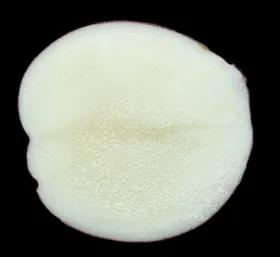
Cutting seed introduces an injury that must heal, or the seed piece will not survive. If cutting and planting immediately, seed tubers can heal in the soil if conditions are favorable for wound healing. The challenge is controlling the environment in the soil for the time required for suberization. Ideal soil conditions are when soil moisture is 60%-65% and the temperature is 50-60 degrees Fahrenheit. Skin will take approximately twice as long to heal when temperatures are 45 degrees Fahrenheit compared to 52 degrees Fahrenheit and even longer at cooler temperatures (Table 1). Tubers will heal faster at warmer temperatures, but there is a higher risk of pathogen development, especially bacterial soft rot. Precutting seed before planting could be considered a form of insurance from the seed getting too wet and rotting after planting.
| Table 1. Approximate number of days to achieve different wound healing stages (adopted from Pringle, et al., 2009). | ||||
| Temperature °F | Light suberization | Complete suberization | Start of periderm formation | Two layers of periderm formed |
| 37-41 | 7-14 | 21-42 | 28 | 28-63 |
| 50 | 4 | 7-14 | 7-14 | 9-16 |
| 68 | 1-2 | 3-6 | 3-5 | 5-7 |
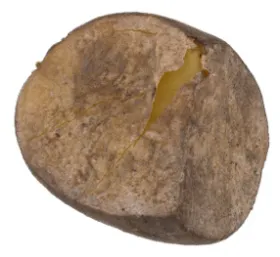
Precutting seed has advantages and drawbacks compared to fresh-cut seed. Precut seed has been reported to emerge earlier, have more vigorous early growth, a higher plant population, more uniform emergence, healthier plants and improved yield (Table 2) compared to fresh-cut seed. However, precutting seed is costly and can increase the risk of pathogen entry and breakdown if it is not properly stored and suberized. Additionally, pointed corners resulting from cutting are more susceptible to damage when handling precut seed, creating new wounds (Figure 2).
| Table 2. Shepody stand and US #1 yield from precut and fresh-cut seed in Michigan (adopted from Chase et al., 1989). | ||||
| Treatment | Stand (%) 1986 | Stand (%) 1987 | US #1 yield (cwt/a) 1986 | US #1 yield (cwt/a) 1987 |
| Pre-cut | 97 a | 96 a | 414 a | 208 a |
| Fresh-cut | 90 b | 80 b | 375 b | 171 b |
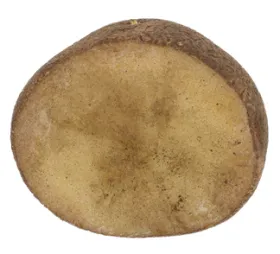
How does tuber skin heal? This process can be simplified into two stages. First, suberin, a hydrophobic waxy material, is formed within hours to prevent water loss. The establishment of the suberin layer will prevent bacterial soft rot entry in approximately three days. Second, the phellogen layer, or periderm, forms. In general, cutting and suberizing in good storage conditions will take about seven to 21 days for a wound periderm to form. This periderm or new skin is as effective as the original skin at protecting the seed piece. However, it takes roughly 14 to 21 days for sufficient periderm to form and prevent Fusarium dry rot.
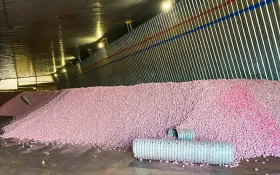
Ideal conditions for suberization of cut seed include 95%-99% relative humidity (with no free water), seed tuber temperature of 52-60 degrees Fahrenheit and abundant oxygen to prevent carbon dioxide accumulation. If these conditions are not met, the risk of seed piece decay increases. Free water on the cut surface promotes bacterial diseases. It is a challenge to maintain adequate airflow, temperature and humidity if the height of cut seed piles exceeds 10 feet (Figure 3).
If insufficient humidity is present in the bin or soil during wound healing, a layer of dry, dead cells may cover the cut surface and could be mistaken for a suberized layer. The resulting seed will feel dry to the touch, but when planted, it has a high risk of seed piece decay because it is not healed. An easy test is to apply gentle pressure across the surface with your thumb. A layer of dead cells will usually come off, while a suberized layer remains in place.
Well-managed suberized cut seed can be successfully held like whole seed. The question of how long and at what temperature to hold the pile is important. This will depend on planting schedule, variety, storage duration and physiological seed age. Cultivars that tend to have a lower stem and tuber count or that are physiologically young can be stored at 52-55 degrees Fahrenheit for one to three weeks. This has been demonstrated to help overcome dormancy challenges and leads to more uniform sprouting and emergence. A seed treatment can be applied prior to piling and suberization, but avoid dust treatments containing talc compounds that can absorb moisture and interfere with suberization. A liquid seed treatment can be used with ultralow volumes that dry quickly so they do not interfere with wound healing.
Other cultivars that tend to have too many stems or tubers or that are physiologically old can be suberized for a shorter time, approximately three to 14 days, and then planted. If planting is delayed, well-healed seed can be cooled to 45 degrees Fahrenheit to prevent excessive sprouting. Potato cultivars that have long dormancy may need an extra five to seven days of storage conditioning. Understanding the genetic tendencies of the cultivar and the physiological age of the seed is important when determining the time required for suberization.
Seed temperature should match soil temperature when planting. If this is not possible, it is recommended to keep seed and soil temperatures within 10 degrees Fahrenheit of each other. Ideal soil temperature for planting is 50-55 degrees Fahrenheit. Cold seed pieces promote condensation. A film of condensed moisture around the tuber from condensation or saturated soils at 50 degrees Fahrenheit for six hours will favor the development of soft rot (Burton and Wiggington, 1970).
In summary, plant disease-free seed and handle seed potatoes as little as possible to prevent damage. When the tubers are precut, the best healing conditions are 52-55 degrees Fahrenheit, 95%-99% relative humidity and plenty of oxygen from fresh air. The length of time to completely heal is seven to 21 days, depending on the variety and healing conditions. Cutting potato seed and the healing period can be managed to influence the seed potatoes’ dormancy and the number of stems and resulting tubers per acre. When taking seed to the field to plant, keep the seed temperature at least as warm as the soil to avoid condensation on the seed. Ideally, seed and soil should be the same temperature at planting.
These are general principles developed through the study of different potato varieties. Getting to know the varieties on your farm and experimenting with them will help determine the best way to cut and suberize seed potato tubers. When planting a new variety, take time to determine how to best suberize the seed, as there can be tremendous differences among varieties.
References
Burton, W. G., & Wigginton, M. J. (1970). The effect of a film of water upon the oxygen status of a potato tuber. Potato Research, 13(3), 180-186.
Chase, R. W., Silva, G. H., & Kitchen, R. B. (1989). Pre-cutting of seed potatoes. American Potato Journal, 66(11), 723-729
Pringle, B., Pringle, R., Bishop, C., & Clayton, R. (2009). Potatoes postharvest. CABI.
