Title

Root-lesion Nematodes in Potato

(A2286 January 2026)
File
Summary

This publication discusses root-lesion nematodes and their effect in potatoes. Root-lesion nematodes can cause emergence problems, infect tubers, and reduce economic returns for potato growers. Sampling fields and treatment plans are discussed.

Lead Author
Lead Author:
Dinesh Poudel Graduate Student, NDSU
Other Authors

Guiping Yan Associate Professor and Plant Nematologist, NDSU
Andy Robinson Professor and Extension Potato Agronomist, NDSU/UMN
Julie Pasche Professor and Neil C. Gudmestad Endowed Chair of Potato Pathology, NDSU

Availability
Availability:
Web only
Publication Sections

Root-lesion nematodes belonging to the genus Pratylenchus are among the most significant nematode pests affecting potatoes. These nematodes invade potato roots and move inside the roots for feeding, and they are known for their ability to persist in a wide range of environmental conditions. In the U.S., several Pratylenchus species, such as P. penetrans, P. scribneri, P. neglectus, P. crenatus and P. thornei, are present in potato-producing regions. Multiple species of Pratylenchus can also coexist in the same field. Among them, P. penetrans is considered the most damaging.

Nematode Identification

Diagnostic laboratories typically identify root-lesion nematodes only to the genus level, as species-level identification is difficult based on morphological features. The presence of multiple Pratylenchus species in samples further complicates identification. Identification mainly relies on female specimens, as males are rare in many species. Key morphological features of females include a flattened, sclerotized lip region, a well-developed stylet (needle-like structure used for feeding) with prominent basal knobs and a vulva located approximately 70%-85% of the body length from the anterior end (Figure 1a). When males are present, they are distinguished by their characteristic spicules (male reproductive structures) (Figure 1b). Because species-level differentiation based on morphology is challenging, molecular methods have been developed and are increasingly used.
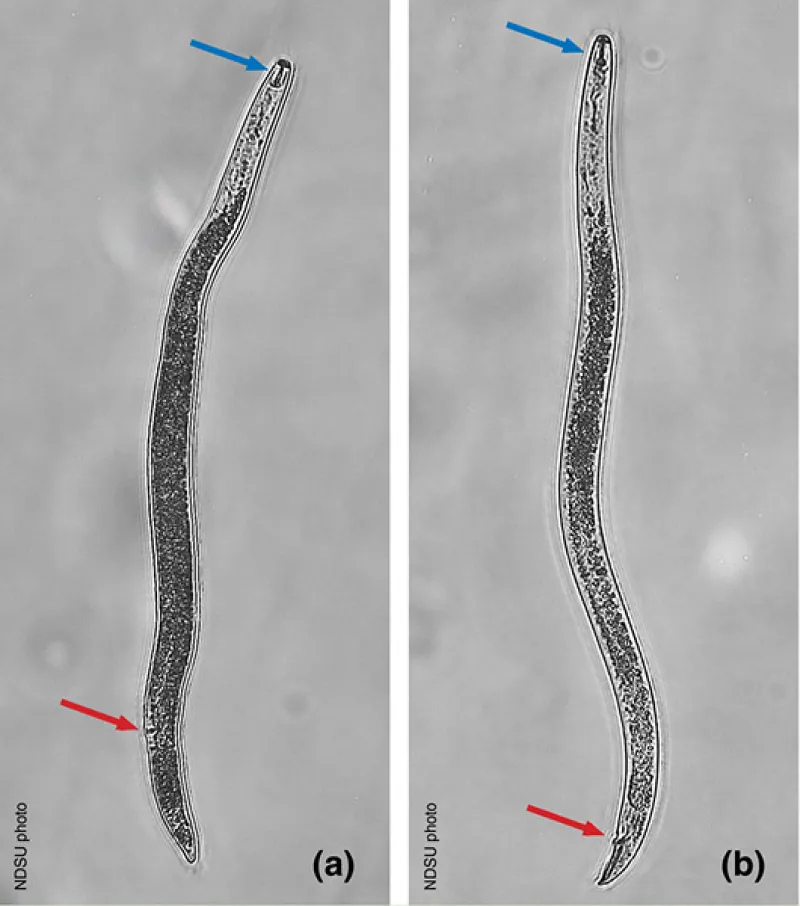
Figure 1
Photo Credit:
NDSU Photo
Microscopic images of Pratylenchus penetrans: female (a) showing vulva (red arrow) positioned at approximately 80% of total body length, and male (b) showing spicules (red arrow), with stylets (blue arrows).

Symptoms and Damage

Root-lesion nematodes invade potato roots, where they feed and migrate through root tissues (Figure 2). Their activity causes the formation of small, dark brown to black lesions on the roots (Figure 3). As infestations progress, lesions may coalesce, leading to extensive areas of necrosis (death of tissue). Severely affected roots often appear discolored or shriveled, and they may show reduced branching and overall root mass. Damaged roots are less effective at absorbing water and nutrients, which can compromise plant health and vigor.

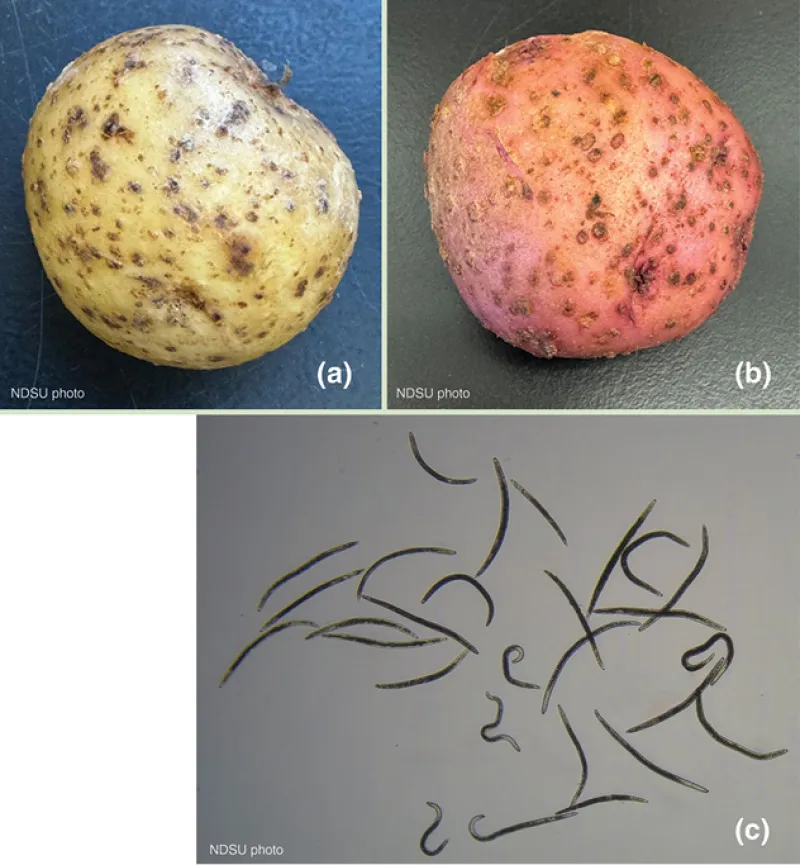
The above-ground symptoms of root-lesion nematode infestation are often subtle and can be mistaken for nutrient deficiencies or other soil-borne issues. Affected potato plants may exhibit stunted growth, reduced vigor, poor canopy development, premature yellowing (chlorosis) of lower leaves and wilting, especially under moisture stress. These symptoms typically appear in patches within a field, reflecting the uneven distribution of nematodes in the soil. While root-lesion nematodes primarily target roots, they can also invade developing tubers. This may result in small, superficial brown or reddish-brown to black spots or blemishes on the tuber surface, often resembling symptoms of common scab or powdery scab (Figure 4). In some cases, wartlike protuberances or dark, wartlike bumps that may turn purple in storage can also develop on the tuber surface.

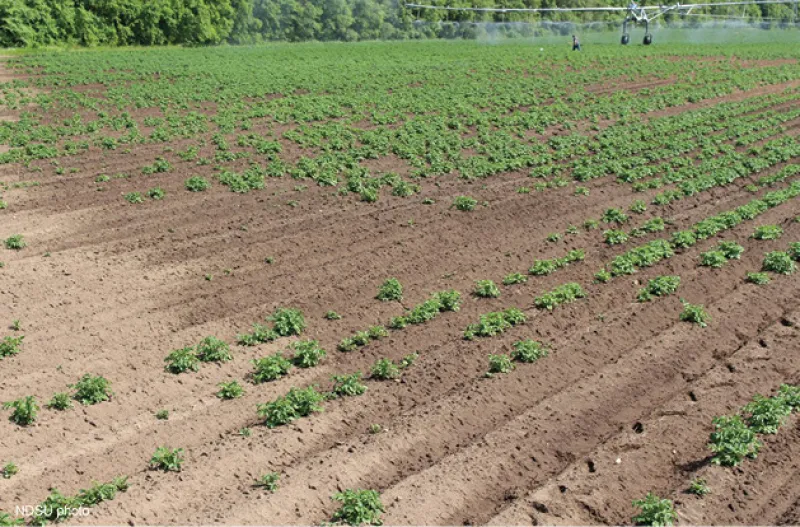
In addition to causing direct damage, root-lesion nematodes, especially P. penetrans, play a critical role in the potato early dying (PED) complex. The synergistic interaction between Verticillium dahliae and root-lesion nematodes accelerates plant decline and can lead to substantial yield losses. Root-lesion nematodes are also frequently associated with Fusarium oxysporum, contributing to emergence disorders (Figure 5). Even in the absence of other pathogens, root-lesion nematodes alone can cause significant yield reductions, especially in fields with high nematode populations or with short rotations between potato crops. In severe cases, yield reductions of up to 70% have been reported. The combination of direct root damage, reduced plant vigor and increased susceptibility to other diseases underscores the importance of effective nematode management in potato production.
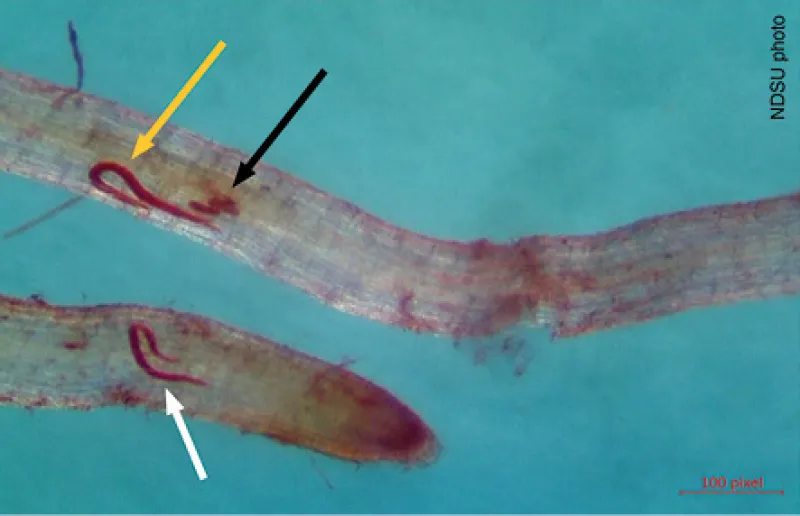
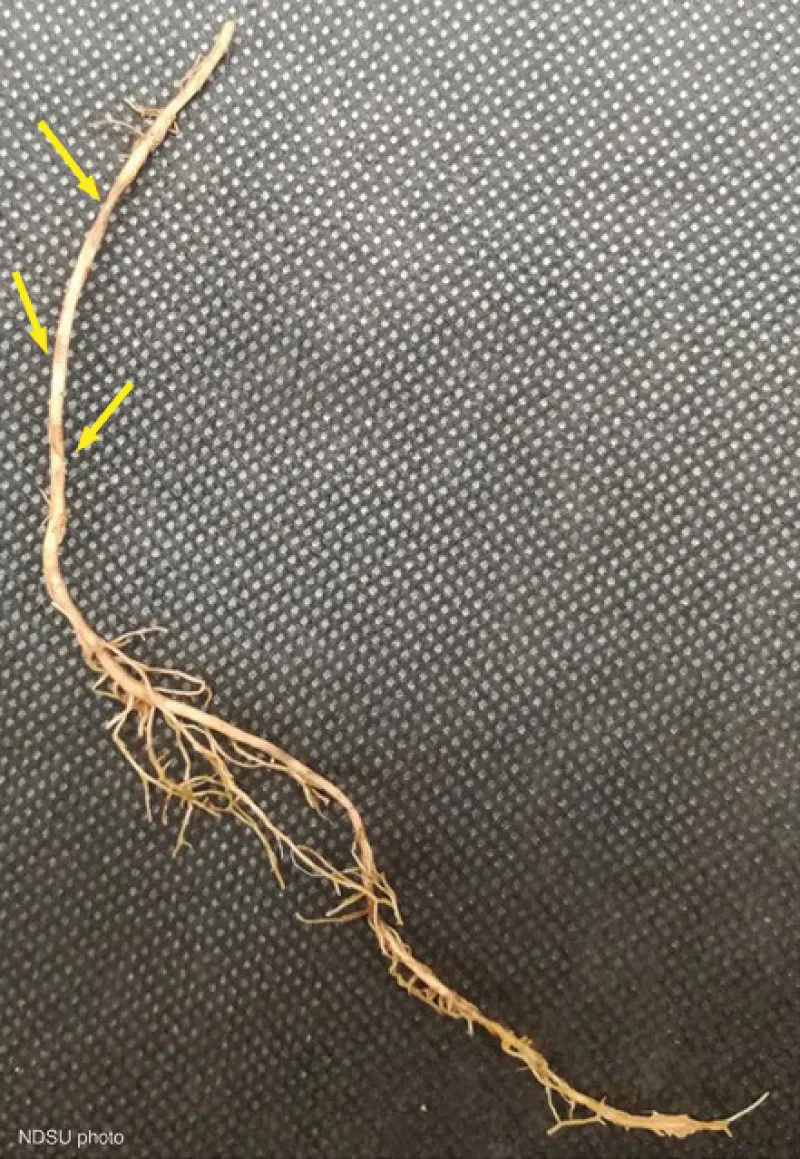
Figure 2
Photo Credit:
NDSU Photo
Pratylenchus scribneri egg (black arrow), adult female (gold arrow) and juvenile (white arrow) stages stained with red food color dye in potato roots observed under a microscope 35 days after planting.
Figure 3
Photo Credit:
NDSU Photo
Necrotic lesions (yellow arrows) in a single potato root fiber caused by Pratylenchus penetrans infection.
Figure 4
Photo Credit:
NDSU Photo
Symptoms of Pratylenchus penetrans infection on potato tubers, showing lesions on cultivars Yukon Gold (a) and Red Norland (b) grown under the greenhouse conditions in P. penetrans-infested soil, and the nematodes extracted and recovered from the infected potato tuber peels (c).
Figure 5
Photo Credit:
NDSU Photo
Co-occurrence of Pratylenchus penetrans and Fusarium oxysporum in a potato field exhibiting emergence disorder in Central Minnesota.

Nematode Life Cycle

Root-lesion nematodes (Pratylenchus spp.) are migratory endoparasites that invade and move through potato roots, feeding on the root tissues and causing characteristic lesions. They use a stylet to mechanically pierce cells and secrete enzymes that degrade cell walls and cytoplasm. Both juveniles and adults are motile and capable of infecting roots. Pratylenchus penetrans reproduces sexually, with both males and females present in populations. The life cycle of root-lesion nematodes consists of six stages: egg, four juvenile stages (J1 to J4) and adult. Eggs are laid singly or in small groups in root tissue or soil. The first-stage juvenile (J1) develops within the egg and molts to the second-stage juvenile (J2). The J2 then hatches and uses its stylet to penetrate the root surface, typically just behind the root cap or in the elongation zone. Once inside, nematodes migrate through the root cortex, feeding on cells and causing necrosis and cell breakdown. They continue to molt through J3 and J4 stages, eventually becoming adults. Both juveniles and adults are capable of leaving and re-entering roots, moving through the soil to find new feeding sites or hosts.

The duration of the life cycle varies with temperature, soil moisture, and host suitability, typically ranging from 45 to 65 days under field conditions. Multiple generations can develop during a single growing season, allowing populations to build up rapidly when conditions are favorable. Root-lesion nematodes can overwinter in soil or infected plant tissues, contributing to their persistence from season to season. Their ability to survive and remain infective in the absence of a host makes them a continual management challenge in potato production systems.

Management Strategies

Root-lesion nematodes are challenging to manage because of their wide host range and ability to survive on many crops and weeds. Effective management in potatoes relies on an integrated approach that combines cultural, chemical and biological tactics, as well as careful field monitoring.

Cultural Practices

Cultural practices help reduce nematode damage by making the field less favorable for their survival and reproduction. Through crop rotation, cultivar selection, sanitation, weed control and other cultural methods, growers can lower nematode levels and support long-term management.

  • Potato cultivars: Although no truly resistant potato cultivars are currently available, preliminary trials suggest that cultivars such as Dakota Pearl and Columba tend to be less susceptible and may perform better in fields with low nematode pressure.
  • Crop rotation and cover crops: Rotating potatoes with poor or nonhost crops can help reduce root-lesion nematode levels. In greenhouse trials, an alfalfa cultivar (Bullseye) consistently performed as a poor host, and a winter rye cultivar (ND Dylan) was a poor host for P. penetrans in most cases. African marigold (Tagetes erecta) has shown nematode-suppressive effects against root-lesion nematodes in other regions. However, no field trials have been reported for the use of cover crops or specific rotation schemes for root-lesion nematodes in North Dakota or Minnesota, so no firm recommendations can be made at this time.
  • Weed management: Since weeds can serve as alternative hosts for nematodes and undermine rotation efforts, managing them effectively can help disrupt the nematode life cycle. A weed species that is a poor host for one root-lesion nematode species may still be a good host for another, which can complicate management. In potato fields, Canada thistle (Cirsium arvense), common lambsquarters (Chenopodium album), quackgrass (Elytrigia repens) and eastern black nightshade (Solanum nigrum) are considered key hosts for P. penetrans. While pigweeds (Amaranthus spp.) are poor hosts for P. penetrans, both Amaranthus and Chenopodium spp. appear to support P. scribneri. Additionally, wild oat (Avena fatua) is a good host for P. neglectus. Managing these weeds can help reduce nematode pressure and protect potato yield and quality.
  • Sanitation: Preventing the introduction of nematodes into clean fields can be supported by thoroughly cleaning equipment, minimizing the movement of infested soil or plant debris, managing cull piles properly and eliminating volunteer potatoes. Using certified, nematode-free seed potatoes can reduce the risk of spreading root-lesion nematodes such as P. penetrans and P. scribneri through infected tubers.
  • Biofumigation: Incorporating certain Brassica cover crops has been shown to release isothiocyanates that can suppress nematodes in laboratory settings. However, both species and cultivar choice are critical, as many Brassicas commonly used as cover crops are also good hosts for P. penetrans. Field data from North Dakota and Minnesota are lacking, and it remains unclear whether Brassicas ultimately reduce nematode populations under local weather and soil conditions. Therefore, biofumigation should be considered cautiously and only as part of an integrated approach until more research provides solid recommendations.

Chemical Control

Regular soil and root sampling to determine nematode levels help determine when chemical treatments are needed. Combining chemicals with cultural practices supports long-term, sustainable management and reduces the risk of resistance. Using both fumigant and nonfumigant nematicides together often provides better control and protects yields more effectively than using either alone.

  • Fumigants: Preplant fumigants such as 1,3-dichloropropene (Telone II), metam sodium, metam potassium and chloropicrin have been shown to be effective for managing root-lesion nematodes. Optimal application occurs at soil temperatures between 50 degrees and 80 degrees Fahrenheit and soil moisture of 50%-75% field capacity. Sandy soils allow better fumigant movement than heavy or organic soils, and high organic matter or excessive crop debris can reduce effectiveness. Application rates may need adjustment based on nematode pressure. Check labels prior to fumigation to ensure all directions are followed, especially that the water table in the field meets the required depth. Growers can seek advice from local extension specialists or certified crop advisors to tailor fumigation practices in their field conditions.
  • Nonfumigant nematicides: Products such as oxamyl (Vydate), fluopyram (Velum Prime), fluensulfone (Nimitz) and spirotetramat (Movento) can help suppress nematode populations, especially when applied at planting or early post-plant.
  • Plant-based nematicides: Natural compounds such as benzaldehyde, carvacrol, thymol and 3-octanol have demonstrated nematicidal activity against P. penetrans under laboratory conditions, but field validation is still lacking. These phytochemicals appear to damage nematode tissues and carry lower environmental risks compared to conventional chemicals.

Field Monitoring and Sampling

Effective field monitoring and sampling are essential for accurately detecting, quantifying and managing root-lesion nematodes. Regular soil and root sampling provides valuable information on nematode population levels and helps guide management decisions. Additionally, understanding the field’s history and mapping nematode hotspots allows for more targeted and effective control measures.

When to sample?

  • The ideal time for sampling potatoes for root-lesion nematodes is in the late summer or early fall, shortly before or just after potato harvest. At this point, nematode populations are typically at their highest and most detectable after a full season of root colonization.
  • Spring sampling, after soils have warmed and before potato planting, can give reliable results for preplanting management decisions.
  • Sampling during extremely wet, dry or frozen conditions reduces sample quality and can lead to inaccurate population counts.

What areas in the field to sample?

  • Larger potato fields are best divided into blocks of no more than 5 acres, with each block representing uniform cropping history, injury patterns or soil types.
  • Within each block, samples are most representative when collected systematically using a grid or zigzag pattern across the potato field.
  • Sample the transition zones or edges between healthy and symptomatic plants, rather than just symptomatic areas, as these boundaries often reveal the highest nematode activity and provide valuable diagnostic information.
  • Potato fields and areas within a field that differ in soil type, cropping history or problem areas should be sampled separately for more accurate nematode detection.

Where and how to sample?

  • Soil cores collected from a depth of 6 to 12 inches are effective for detecting root-lesion nematodes, as this is where most potato feeder roots and nematodes are concentrated.
  • Collection of a total of 20-30 soil cores per 5-acre block provides a representative sample when evenly distributed across the potato field.
  • Nematode populations are best captured by sampling both the zone adjacent to potato roots and the surrounding soil, as these nematodes migrate between root tissue and soil during the season.
  • Accurate nematode quantification requires analyzing both potato root and soil samples, as nematodes inhabit both environments and their distribution varies with the plant’s growth stage.
  • Subsamples should be thoroughly mixed in a clean bucket, with debris removed, to create a composite sample. From this, about 1 pound of soil is placed in a sturdy, sealed plastic bag, properly labeled with relevant information (e.g., field location, crop history and date of collection) and submitted to a diagnostic laboratory for nematode analysis. If a sample needs to be transported, place in a cooler or fridge to cool and keep moisture, but do not freeze. When possible, potato plants with roots should also be included.

References

Baidoo, R., Yan, G., Nagachandrabose, S., and Skantar, A. M. (2017). Developing a real-time PCR assay for direct identification and quantification of Pratylenchus penetrans in soil. Plant Disease, 101(8), 1432-1441.

Davis, E. L., and MacGuidwin, A. E. (2000). Lesion nematode disease. Plant Health Instructor. DOI: 10.1094/PHI-I-2000-1030-02.

Gorny, A., and Grode, A. (2021). Lesion nematode in potato. NC State Extension Publications. https://content.ces.ncsu.edu/lesion-nematode-in-potato.

Neupane, K., and Yan, G. (2023). Host suitability of cover crops to the root-lesion nematode Pratylenchus penetrans associated with potato. Plant Disease, 107(7), 2096-2103.

Orlando, V., Grove, I. G., Edwards, S. G., Prior, T., Roberts, D., Neilson, R., and Back, M. (2020). Root-lesion nematodes of potato: Current status of diagnostics, pathogenicity and management. Plant Pathology, 69(3), 405-417.

Pscheidt, J. W., and Ocamb, C. M. (Senior Eds.). (2025). Fumigating soils for nematode control. In Pacific Northwest Plant Disease Management Handbook. Oregon State University. https://pnwhandbooks.org/node/378.

Upadhaya, A., Yan, G., Secor, G., and Robinson, A. (2020). Effects of co-inoculation with Pratylenchus penetrans and Fusarium oxysporum on growth and yield of potato cultivar Red Norland. American Journal of Potato Research, 97(3), 246-255.