Ventenata, Ventenata dubia
(R2289 January 2026)Ventenata is more problematic than other annual invasive grasses because it is highly unpalatable to livestock and most wildlife, and very difficult to manage with mowing; however, more sensitive to herbicides. It is widely distributed throughout the western United States and threaten native grasslands by increasing fire risk, replacing native plants, and decreasing grazing and haying options, often with tremendous associated costs in forage losses.
Contact your county NDSU Extension office to request a printed copy.
NDSU staff can order copies online (login required).
General Description
Ventenata is native to central and southern Europe, Asia, and Africa. Ventenata has established itself in a number of states in the United States and provinces in Canada since first being reported in North America in 1953. It is expanding across the northwest United States.
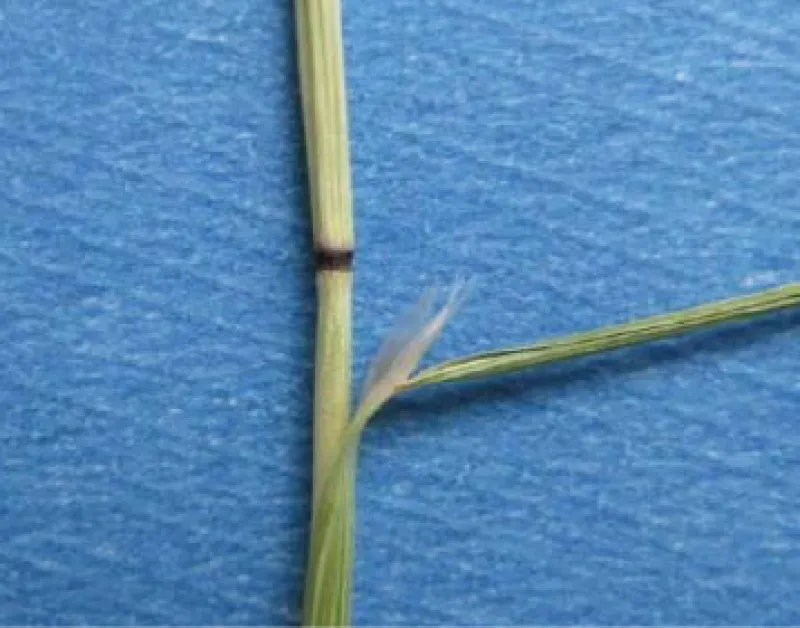
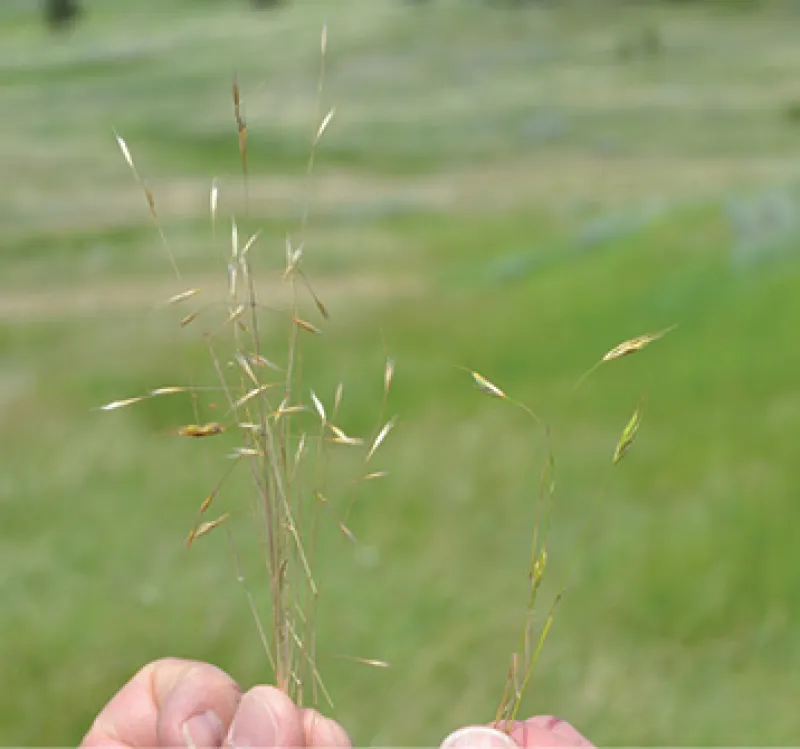
Ventenata is a shallow rooted, basally branching tufted winter annual grass that has rolled or folded leaves with membranous long ligules with tattered tips (Figure 1). The seed head (panicle) is openly branched with a pyramidal shape, comprises spikelets that are typically three florets, and overall plant height up to 16 inches long. The awns of some of the florets are bent and twisted, especially towards the top of the plant (Figure 2). Nodes are reddish-black (Figure 1).
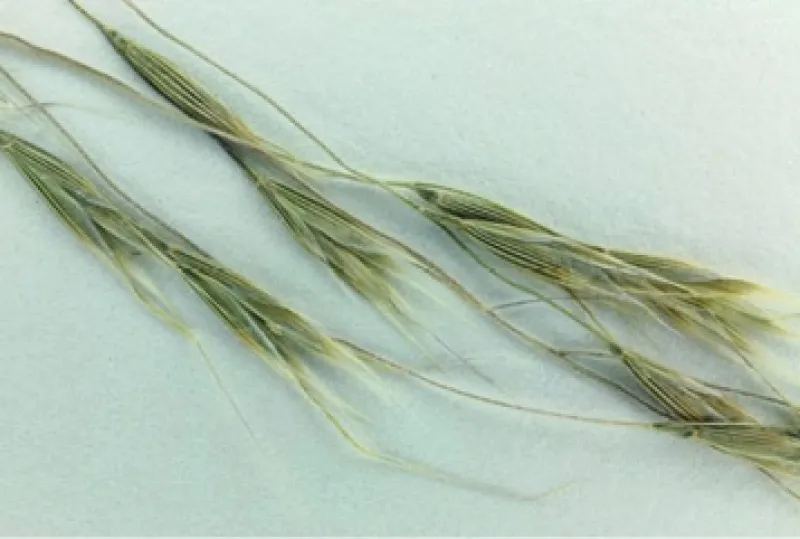
The panicle is light yellow in color and is sometimes described as shiny or with a sheen. Because of where the spikelets disarticulate, on mature plants the straight-awned floret remains, while the bisexual florets with bent awns have broken away (Figure 3).
The leaves mostly occur on the lower half of the stem and have open leaf sheaths. Leaves are smooth and hairless, with a membranous ligule that is obtuse and usually lacerate, cut into narrow segments. The leaf blades are thin and 1 to 3 inches long, occasionally up to 4 inches, usually smooth and hairless on the upper surface, scabrous on the lower surface, and initially flat before becoming rolled or folded.
The stems are slim, upright to erect, and 4 to 18 inches tall, though they can grow up to 29 inches tall. Stems can be covered in small hairs, while the nodes are smooth. The nodes are exposed and in late spring are purple-black in color.
The fruit is a caryopsis (a dry, one-seeded fruit) that is smooth and about three mm long. Each plant may produce 15 to 35 or more seeds. Most seeds have an 18-month germination duration but it can be viable up to 3 years. It germinates in the fall and overwinters as a seedling.
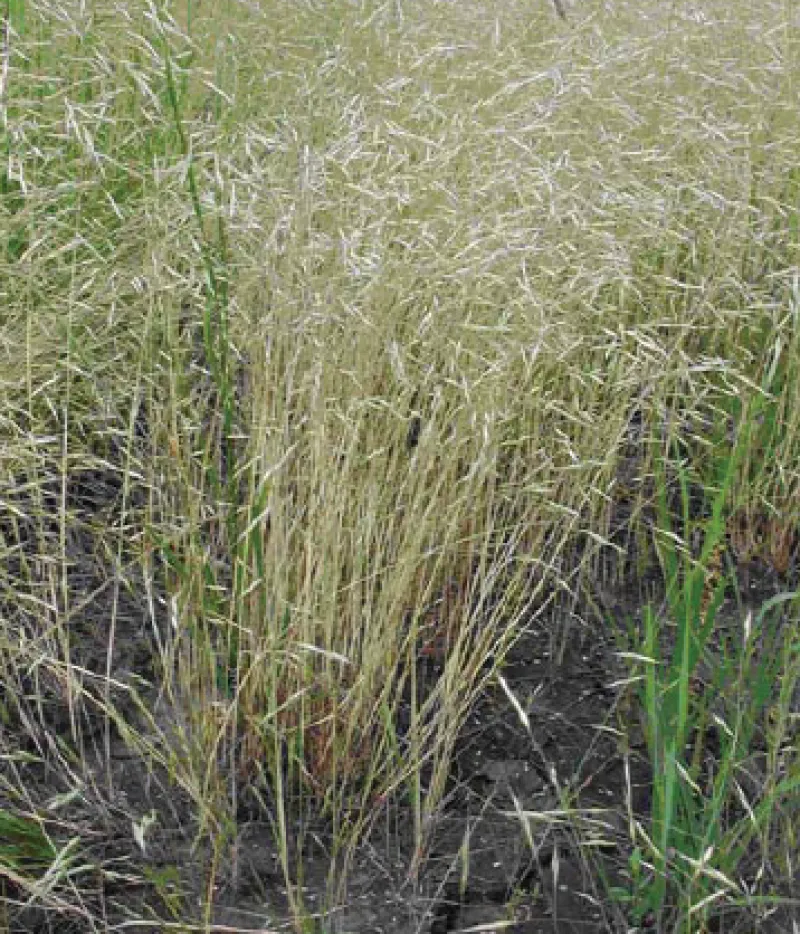
From a distance, ventenata can be mistaken for other common invasive annual grasses such as field brome and cheatgrass (Figure 4). Close inspection and monitoring are important to identify and control stands before they become established and spread.
Range
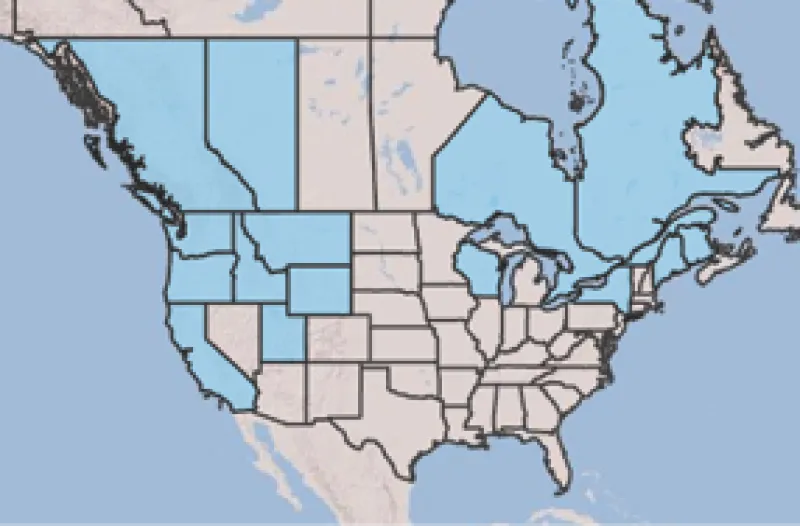
Ventenata occurs sporadically or ephemerally in the Pacific Northwest region and east central North America (Figure 5). Ventenata has not been found in North Dakota as of January 2025, but found in eastern Montana, northeastern Wyoming and northwestern South Dakota.
Habitat
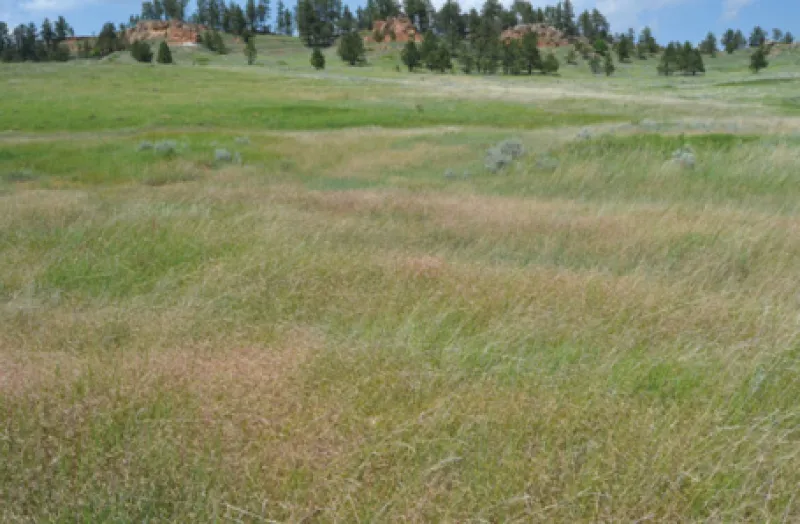
Ventenata grows in a variety of dry, open and often disturbed habitats, tending to prefer sites that are moist in early spring but dry out by late spring. In Montana and Idaho, ventenata is first found in low-lying areas of the landscape, including ditches, then moves into the upland, drier sites. Commonly found on south-facing hillsides with shallow, rocky clay or clay-loam soils, though it can be found on other aspects and substrates (Figure 6).