
Title

Ventenata, Ventenata dubia

(R2289 January 2026)
File
Publication File:
Summary

Ventenata is more problematic than other annual invasive grasses because it is highly unpalatable to livestock and most wildlife, and very difficult to manage with mowing; however, more sensitive to herbicides. It is widely distributed throughout the western United States and threaten native grasslands by increasing fire risk, replacing native plants, and decreasing grazing and haying options, often with tremendous associated costs in forage losses.

Lead Author
Lead Author:
Kevin Sedivec, NDSU Extension Rangeland Management Specialist
Other Authors

Penny Nester, Bowman County Extension Agent
Miranda Meehan, NDSU Extension Livestock Environmental Stewardship Specialist

Availability
Availability:
Available in print from the NDSU Distribution Center.

Contact your county NDSU Extension office to request a printed copy.
NDSU staff can order copies online (login required).

Publication Sections

Introduction

Non-native, invasive annual grasses are widely distributed throughout the western United States and threaten native grasslands by increasing fire risk, replacing native plants, and decreasing grazing and haying options, often with tremendous associated costs in forage losses. In some areas, these species comprise over 50% of forage production. Ventenata (Ventenata dubia (Leers) Durieu) is one species of concern that continues to spread eastward toward the Dakotas, with populations in Montana and northwest South Dakota.

Ventenata is more problematic than other annual invasive grasses because it is highly unpalatable to livestock and most wildlife, and very difficult to manage with mowing; however, it is more sensitive to herbicides. It closely resembles field brome and other annual grasses, which makes early detection challenging and often allows it to become established before it is identified.

Synonym Names

  • North Africa grass
  • wiregrass
  • hairgrass
  • soft-bearded
  • oat grass

General Description

Ventenata is native to central and southern Europe, Asia, and Africa. Ventenata has established itself in a number of states in the United States and provinces in Canada since first being reported in North America in 1953. It is expanding across the northwest United States.

Ventenata is a shallow rooted, basally branching tufted winter annual grass that has rolled or folded leaves with membranous long ligules with tattered tips (Figure 1). The seed head (panicle) is openly branched with a pyramidal shape, comprises spikelets that are typically three florets, and overall plant height up to 16 inches long. The awns of some of the florets are bent and twisted, especially towards the top of the plant (Figure 2). Nodes are reddish-black (Figure 1).
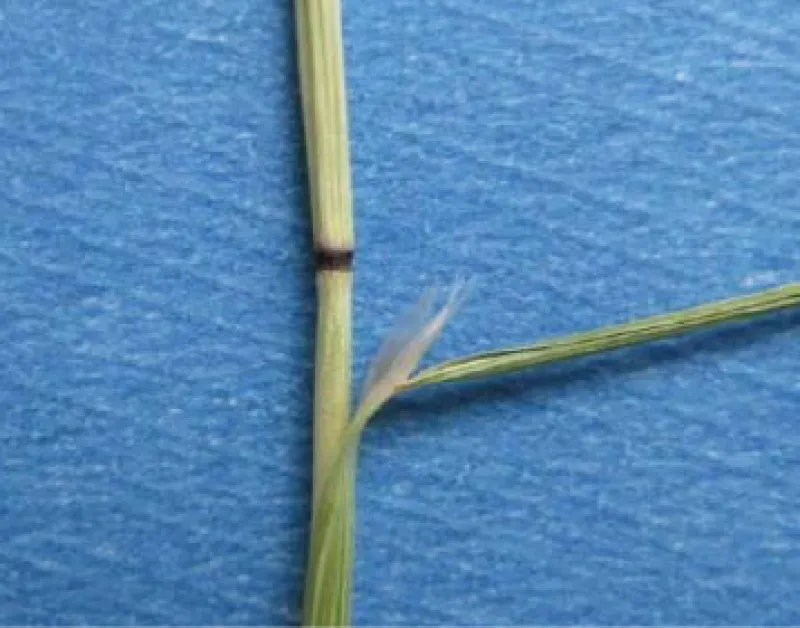
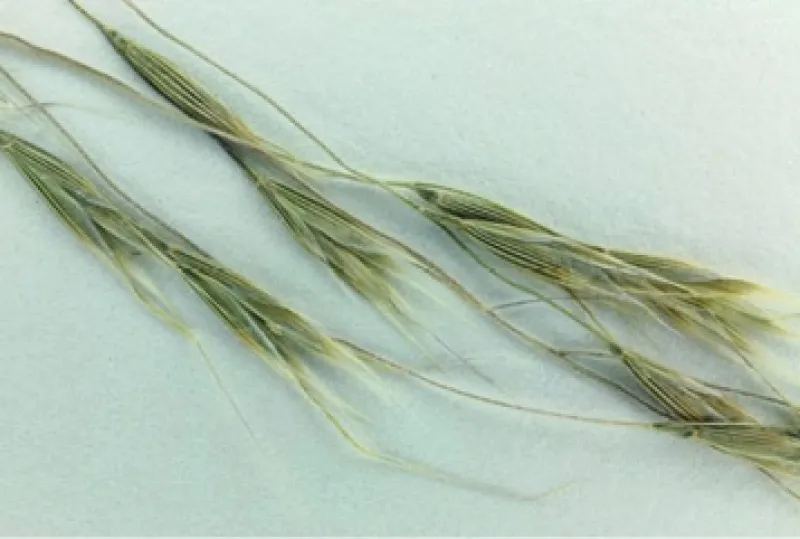
Figure 1
Photo Credit:
Pamela Scheinost (USDA NRCS Pullman PMC)
Ventenata has membranous long ligules with tattered tips with dark reddish-black nodes.
Figure 2
Photo Credit:
Steve Matson (California Invasive Grass Council)
Ventenata with spikelets that are typically three florets and awns of florets are bent.

The panicle is light yellow in color and is sometimes described as shiny or with a sheen. Because of where the spikelets disarticulate, on mature plants the straight-awned floret remains, while the bisexual florets with bent awns have broken away (Figure 3).
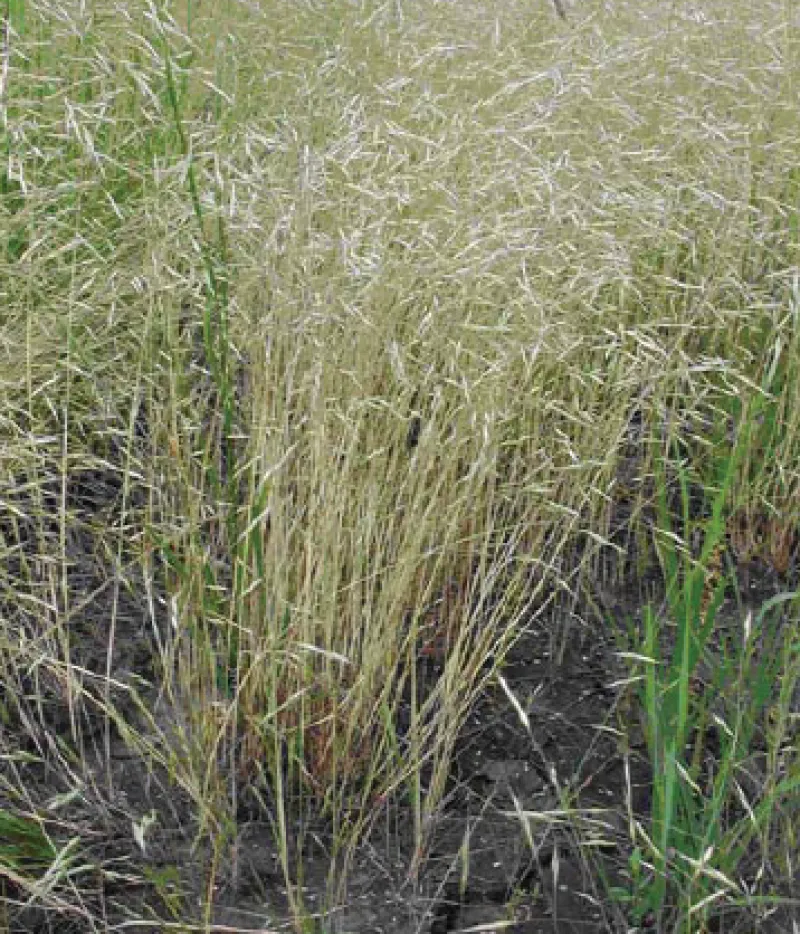
Figure 3
Photo Credit:
Pamela Scheinost (USDA NRCS Pullman PMC)
Ventenata panicle is light yellow in color and has a shine.

The leaves mostly occur on the lower half of the stem and have open leaf sheaths. Leaves are smooth and hairless, with a membranous ligule that is obtuse and usually lacerate, cut into narrow segments. The leaf blades are thin and 1 to 3 inches long, occasionally up to 4 inches, usually smooth and hairless on the upper surface, scabrous on the lower surface, and initially flat before becoming rolled or folded.

The stems are slim, upright to erect, and 4 to 18 inches tall, though they can grow up to 29 inches tall. Stems can be covered in small hairs, while the nodes are smooth. The nodes are exposed and in late spring are purple-black in color.

The fruit is a caryopsis (a dry, one-seeded fruit) that is smooth and about three mm long. Each plant may produce 15 to 35 or more seeds. Most seeds have an 18-month germination duration but it can be viable up to 3 years. It germinates in the fall and overwinters as a seedling.

From a distance, ventenata can be mistaken for other common invasive annual grasses such as field brome and cheatgrass (Figure 4). Close inspection and monitoring are important to identify and control stands before they become established and spread.
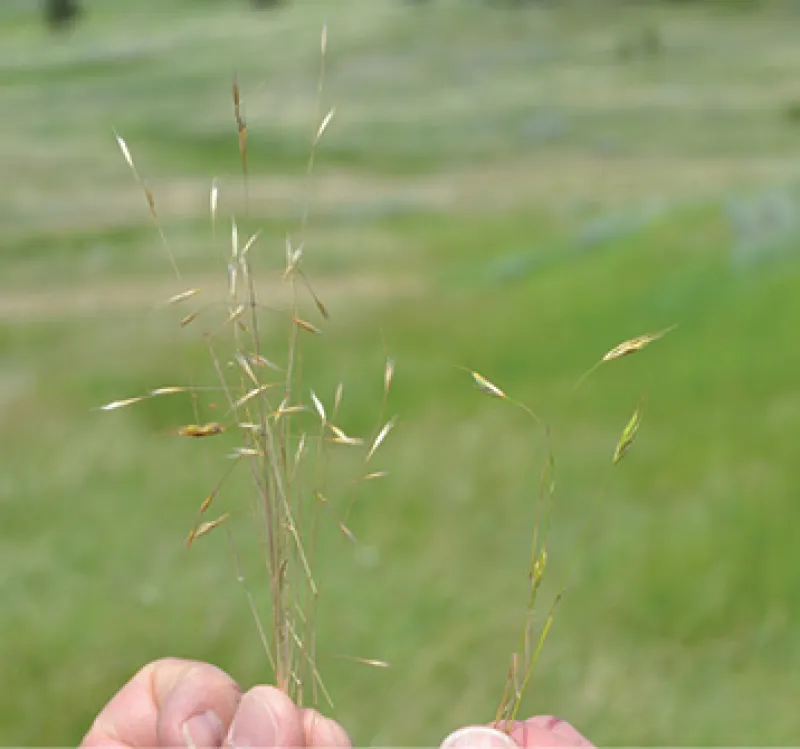
Figure 4
Photo Credit:
Penny Nester (NDSU Extension)
Left: Ventenata with spikelets that are typically three florets and awns of florets are bent. Right: Field Brome with straight awns and two or more drooping spikelets.

Range

Ventenata occurs sporadically or ephemerally in the Pacific Northwest region and east central North America (Figure 5). Ventenata has not been found in North Dakota as of January 2025, but found in eastern Montana, northeastern Wyoming and northwestern South Dakota.
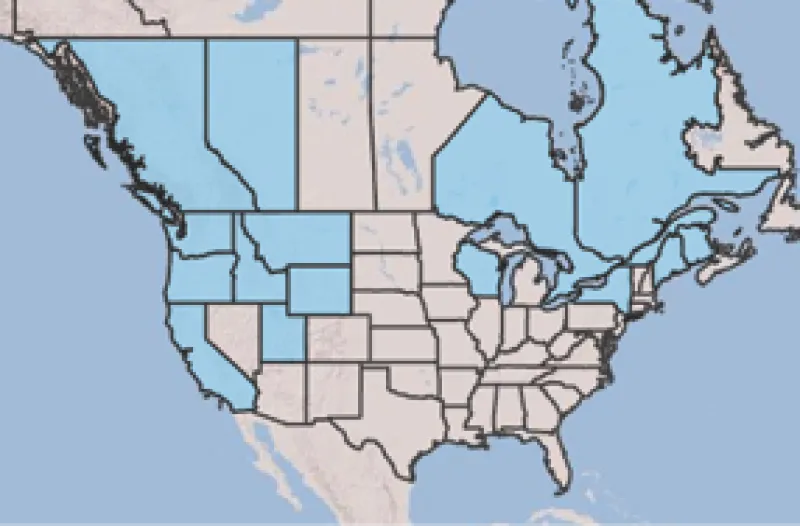
Figure 5
Photo Credit:
USDA-NRCS Plants Database.
Distribution of ventenata in North America.

Habitat

Ventenata grows in a variety of dry, open and often disturbed habitats, tending to prefer sites that are moist in early spring but dry out by late spring. In Montana and Idaho, ventenata is first found in low-lying areas of the landscape, including ditches, then moves into the upland, drier sites. Commonly found on south-facing hillsides with shallow, rocky clay or clay-loam soils, though it can be found on other aspects and substrates (Figure 6).
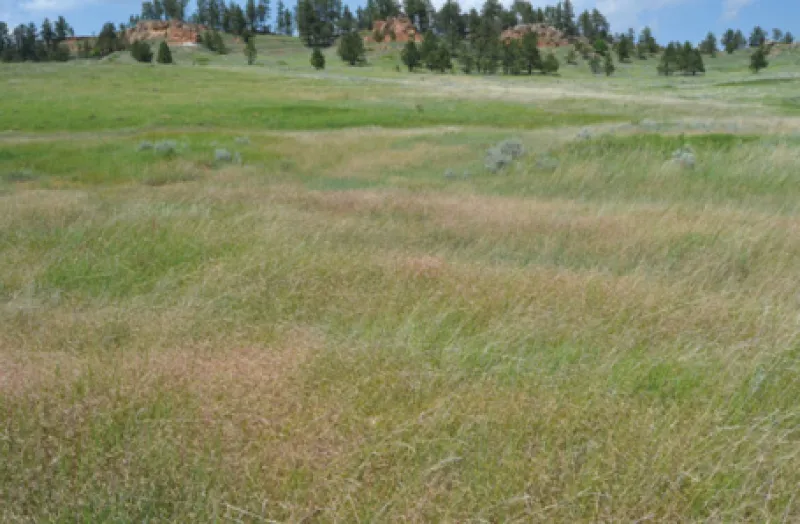
Figure 6
Photo Credit:
Penny Nester (NDSU Extension)
Ventenata is commonly found on south-facing hillsides with shallow, rocky clay or clay-loam soils.

Forage Quality

Ventenata is extremely unpalatable to livestock and wildlife due to its high silica content (Table 1). Silica is an element found in vegetation that is very sharp and causes animals to avoid consumption. Awns can cause damage to grazing animals and can burrow into the skin of pets. When haying, it may bind-up and cause damage to harvesting equipment.

Table 1. Forage quality comparisons of common winter annuals to the perennial cool season western wheatgrass in the vegetative growth phase. Data provided by Jane Mangold – Montana State University Bozeman.

Common NameCrude Protein (%)Neutral Detergent Fiber (%)Silica (%)
Ventenata10.364.48.9
Cheatgrass14.454.22.9
Field brome14.155.86.1
Western wheatgrass15.9643.4

Control

General Information

Ventenata can be difficult to control, and an integrated approach is needed for effective control to promote and support healthy plant communities. Be proactive and prevent the spread of ventenata to new locations. Ventenata can be easily spread through movement of hay. When purchasing hay from areas known to have ventenata, purchase weed-free certified hay. If hay is questionable for having ventenata, feed imported hay in a designated area that can be monitored.

When working around areas infested with ventenata, make sure to clean equipment and clothing to prevent dispersing seed to new locations. Ventenata seed can survive in the seedbank up to three years, so a three-to four-year intensive integrated management method is needed to reduce its effects on the plant community.

Healthy perennial grasses will compete with ventenata seedlings. Establishing and promoting diverse, healthy plant communities will provide competition to ventenata and help reduce infestations.

Manual/Mechanical Control

Hand pulling plants can be effective when the soil is moist, but only where infestations are small, as hand-pulling is labor intensive. Mowing may help to prevent seed production in some cases. Mow just prior to seed head production as plants will only bend or become tangled in equipment when in the heading stage. Plants that are mowed prior to heading may produce another flush of inflorescences, so mowing multiple times throughout the growing season will be required to prevent seed production.

Targeted mowing in hay land and Conservation Reserve Program lands is an option, but requires harvesting early before ventenata produces seeds. Ventenata stems can be difficult to cut due to the high levels of silica in the plant, so it is critical that equipment is sharpened and slow mow speeds are required.

Biological Control

There are no approved biological control agents or grazing management strategies for ventenata. Ventenata has very little nutritive value and silica concentrations higher than most winter annual grasses, which in turn discourages grazing by wildlife and livestock.

Herbicide Control

Herbicides can be effective in the management of ventenata. Ventenata has shown tolerance to glyphosate and sethoxydim. Research studies found that fall applications provided the greatest control of ventenata; however, more recent studies out of University of Wyoming have shown excellent control when applied in June, July and August.

Until recently, only one year of control could be obtained by using herbicides. The use of Flufenacet/Metribuzin (Axiom) provided variable control from year to year. The herbicide Imazapic (Plateau) normally provides one year of control; however, injury (delayed heading, plant reduction) can occur to specific grass species (i.e., cool-season perennial grasses such as western wheatgrass, Kentucky bluegrass, smooth brome). Triasulfuron (Amber), Rimsulfuron (Matrix), and Sulfosulfuron (Certainty) can also provide effective control, but control can be variable year to year.

The most effective multi-year control can be with the use of the herbicide Indaziflam (Rejuvra; Table 2). This herbicide prevents germination of seeds, depleting the soil seed bank. It is a pre-emergent herbicide that has been shown to control annual grasses up to six years with one application of Indaziflam at 7 oz/acres.

Table 2. Study of selected herbicides and combination with Indaziflam (Rejuvra) with herbicides one- and two-years post treatment in southcentral Montana. They applied the herbicide treatments in November with effects one- and two-year post treatment collected in July (Mangold et al. 2024, Invasive Plant Science and Management).

Herbicide TreatmentOne-year Post Treatment
Percent (%)
Canopy Cover
Two-years Post Treatment
Percent (%)
Canopy Cover
Control6819
Glyphosate (Roundup)5640
Propoxycarbazone-sodium (Olympus)213
Imazapic (Plateau)9.54.5
Indaziflam (Rejuvra)50.6
Glyphosate + Indaziflam10.4
Propoxycarbazone-sodium + Indaziflam0.90.2
Rimsulfuron (Matrix)0.81.5
Imazapic + Indaziflam0.50.3
Rimsulfuron + Indaziflam0.50.1

For the most effective control, using a combination mixture of Imazapic, Triasulfuron, Rimsulfuron or Sulfosulfuron with Indaziflam will provide control of actively growing ventenata plants while controlling the germination of seedlings.

Always read and follow the herbicide label instructions. Check with your local county noxious weed coordinator to discuss treatment options.

Conclusion

Being vigilant and proactively monitoring areas is key to preventing the establishment of ventenata in North Dakota. If you suspect populations of this grass, mark the area and contact your local weed board officer or Extension agent for positive identification and control options.

NDSU Extension does not endorse commercial products or companies even though reference may be made to tradenames, trademarks or service names.

For more information on this and other topics, see www.ndsu.edu/extension