Prairie Reconstruction Guidebook for North Dakota
(R1840 Revised February 2026)The purpose of this document is to provide prairie reconstruction guidance for land managers in North Dakota and surrounding areas. Described methodologies for improved outcomes on prairie reconstructions and management planning.
Paula Comeau, Soil and Water Leadership Development Program Coordinator, Leadership and Civic Engagement, NDSU Extension
Kristine Askerooth, Biologist, U.S. Fish and Wildlife Service (Retired)
Jack Norland, Associate Professor Emeritus, School of Natural Resources Sciences, NDSU
Kevin Sedivec, Rangeland Management Specialist, NDSU Extension
(Keith Frankii, USFWS)
Contact your county NDSU Extension office to request a printed copy.
NDSU staff can order copies online (login required).
Introduction
This guidebook focuses on prairie reconstruction, which involves planting a diverse mixture of native plants, including grasses, forbs and small shrubs, in areas previously cultivated or otherwise significantly disturbed by human activity. This differs from restoration, which focuses on enhancing native plant composition in remnant prairies (areas where the sod remains intact) using treatments such as prescribed burning and grazing.
Reconstructing prairies helps create sustainable, resilient grasslands by providing benefits such as improving soil health, limiting invasive species and creating wildlife habitat. While these are often primary goals, it is crucial to recognize that grassland ecosystems are driven by three key processes: the water cycle, energy flow and the nutrient cycle (Pellant et al. 2020). Although this guidebook primarily focuses on plant communities, these underlying processes ultimately shape the system, with plant composition reflecting their function.
The purpose of this publication is to provide prairie reconstruction guidance for land managers in North Dakota and surrounding areas. Described methodologies will allow for the proper planning, implementation and establishment of prairie reconstructions based on intended goals. This information summarizes the current literature along with insights from seasoned experts who have extensive experience with prairie reconstruction.
Preparing for Prairie Reconstruction
Preparing for a prairie reconstruction is a multiphase process, dictated by the historic land use, severity of soil disturbance, current plant community and land manager goals. Detailed descriptions of each reconstruction phase are provided below, with a summary presented in Table 1. Careful consideration of each step, in terms of the reconstruction goals, creates the strongest opportunities for success.
| Table 1. The phases of prairie reconstruction, along with associated steps and descriptions | ||
| Phase | Steps | Description |
| Planning | ■ Goals and Objectives ■ Site Selection | The Planning Phase involves developing goals and objectives and identifying the site for reconstruction. Decisions made during this phase inform the subsequent phases. |
| Implementation | ■ Site Preparation ■ Planting ■ Seed Mixture | The Implementation Phase incorporates methodologies for site preparation, planting and developing a seed mixture. |
| Establishment | ■ Management Actions ■ Evaluation | The Establishment Phase incorporates the management actions and evaluation measures critical for determining goal and objective achievement. |
Planning Phase
The Planning Phase should start with developing goals for the prairie reconstruction, creating objectives and thinking about long-term management strategies and methods for evaluation. Decisions for selecting a reconstruction site are also intertwined with this phase.
Step 1
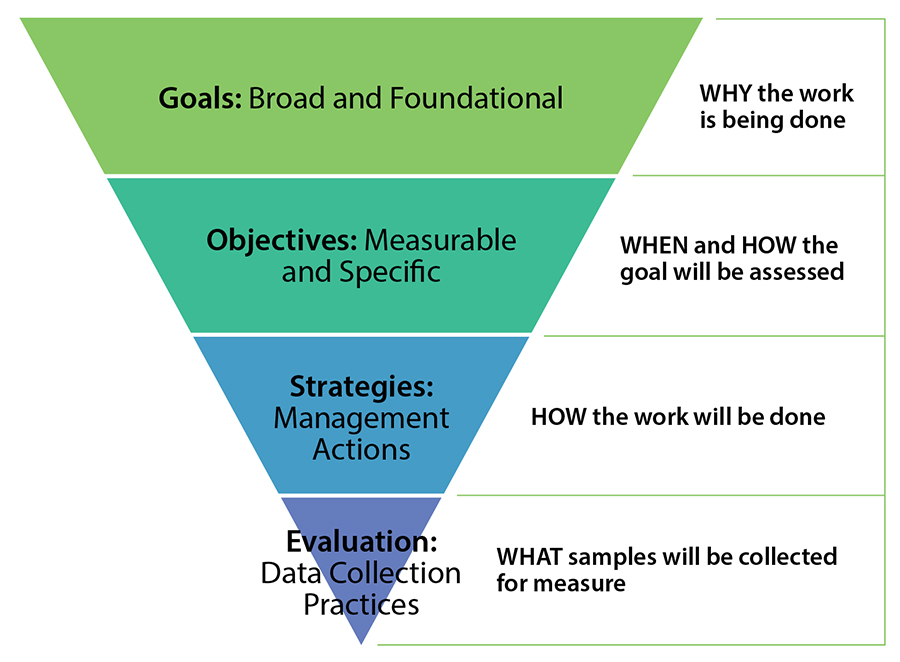
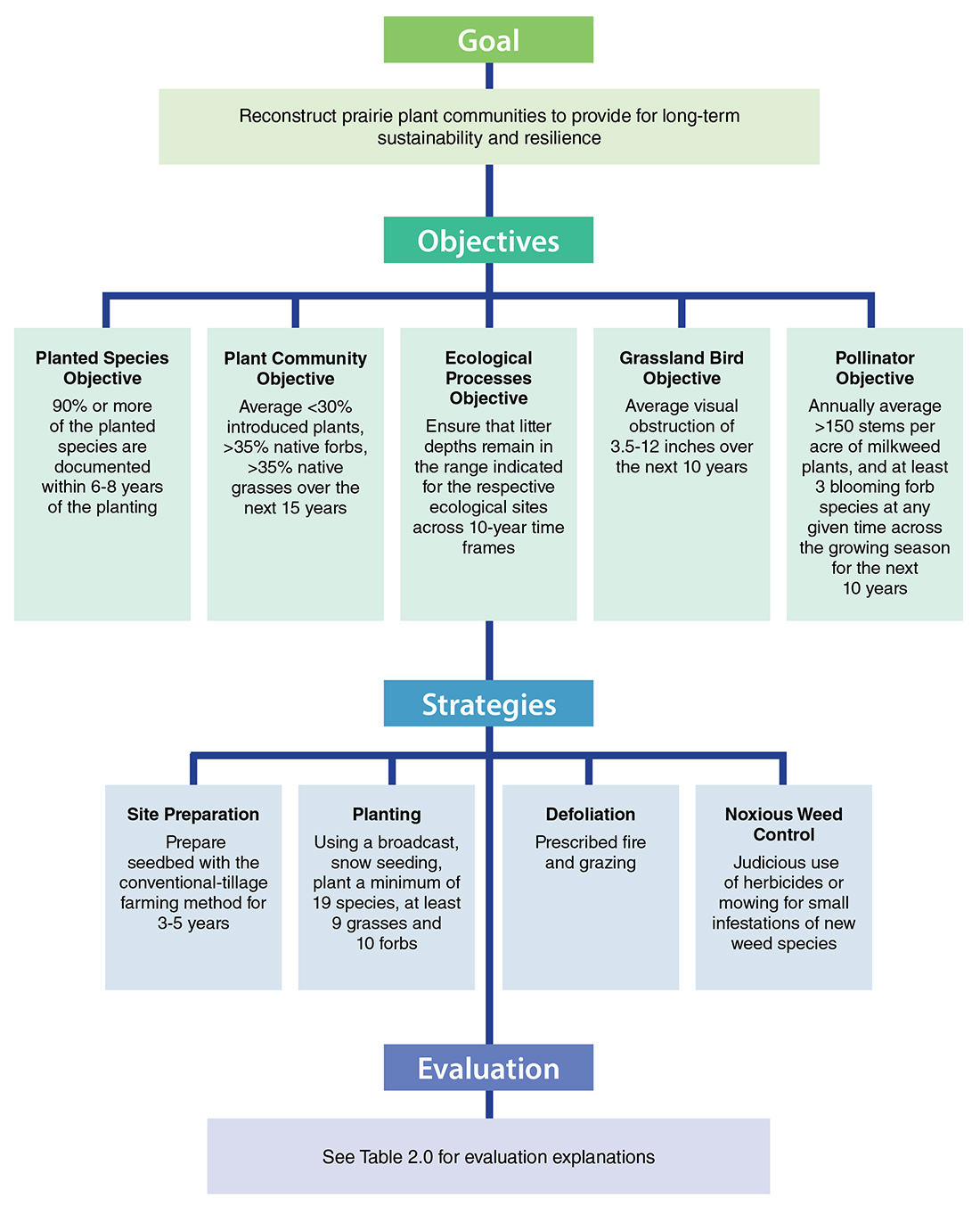
Developing plans for prairie reconstruction involves creating clear goals and objectives. Goals are a general description or guideline of optimal reconstruction outcomes, while objectives articulate clear and measurable short-term targets reached by a specific time frame (Laubhan et al. 2012). Strategies are actions used to achieve the objectives, and evaluations measure the progression toward achieving the objective. Figure 1 defines goals, objectives and strategies, while Figure 2 provides example goals, objectives and strategies highlighting timeframes and measures. Given the extensive changes prairie landscapes have undergone since early European presence, prairie reconstruction goals, objectives and strategies should aim to achieve desired outcomes for today’s landscape rather than attempting to recreate a historic reference state.
Figure 1 depicts the hierarchical relationship and definitions among the four levels in planning for a reconstruction. Starting with the goals, which form the highest and foundational level of the pyramid, there is a natural progression in focus and specificity down to the lower levels. Following the planning process outlined in these four levels provides for improved reconstruction expectations and, ultimately, success.
Figure 2 provides examples of goals, objectives and strategies to help create site-specific (e.g., local climate, soil types, land management history) plans. Information provided throughout this guidebook may help develop site-specific goals, objectives, strategies and evaluations.
Evaluation varies from objective to objective, depending on the goal and objectives for the reconstruction. For this reason, it is important to consider what information will be beneficial to the specific reconstruction when developing a management and evaluation plan. Table 2 provides examples from the recommended “Three-Tier” evaluation approach of the example objectives provided in Figure 2.
Step 2 – Site Selection
Understanding the limitations or the reconstruction potential of a particular site can facilitate reasonable goal development and appropriate objectives and strategies. A reconstruction site contains an area of land with physical characteristics that enable it to produce a specific native plant community as described in the ecological site descriptions (ESD; see Sedivec and Printz 2012). The “Plant Community Composition and Group Annual Production” tables within the respective ESD identify potential climax plant communities for any given site based on hydrogeomorphic factors. Sedivec and Printz (2012) provide guidelines for determining stable, transitional, degraded and climax plant communities for many soil types found in mixed and tallgrass prairie sites in North Dakota. Consider that a site’s reconstruction potential may be influenced by its history, including factors such as prior cultivation, fertilizer applications and pesticide or herbicide treatments.
Site-specific potential can also be determined using numerous tools to direct prioritization. Species distribution and spatial models are two potential tools. Species distribution models can be developed to determine the suitability of a site for certain weeds (e.g., yellow toadflax [Linaria vulgaris], leafy spurge [Euphorbia esula]; Crall et al. 2013, Uden et al. 2015). For example, if an area planned for reconstruction is vulnerable to leafy spurge invasion, land managers may want to reconsider or adjust the seed mixture to provide more competition. Several online tools exist that may help direct prioritization and provide information for the respective site, including the Land Treatment Exploration Tool and INHABIT, a tool for invasive plant management.
Spatial models for wildlife may also be useful in determining and prioritizing sites for reconstruction. Descriptions of model development and associated examples for waterbirds are described by Reynolds et al. (2006) and Niemuth et al. (2008). Johnson et al. (2010) describe the background behind the Grassland Bird Conservation Areas, providing associated figures to help identify sites that may be a priority for reconstruction across the Prairie Pothole Region based on predicted bird occurrences. Niemuth et al. (2017) provide maps showing predicted distributions of several grassland birds, including those in North Dakota. Several sources suggest that expanding existing grasslands through reconstructions is often beneficial for grassland-obligate birds and pollinators, as these species thrive in larger, contiguous grassland habitats (e.g., Niemuth et al. 2017, Niemuth et al. 2021, Johnson et al. 2019).
| Table 2. Example objectives with potential evaluation methods using the “Three-Tier” approach The tiered approach is based on the level of effort required to implement (i.e., Tier 1 involves the least effort, and Tier 3 the most). Further explanations are found in “Step 7 – Evaluation.” The Objectives and Methodologies presented here are intended for example purposes only, with the goal of “Reconstructing a prairie plant community to provide for long-term sustainability and resilience.” | |
| Objective | Tier and Example Methodology |
| Planted Species 90% or more of the planted species are documented within six to eight years of planting. | Tier 1 Planted Species Checklist |
| Plant Community Average less than 30% introduced plants, more than 35% native forbs, more than 35% native grasses over the next 15 years. | Tier 2 Composition Measurement Using Belt Transect Method (Grant et al. 2004) |
| Ecological Processes Enable ecological processes by ensuring that litter depths remain in the range indicated for the respective ecological sites across 10-year time frames. | Tier 2 Litter Depth Measurement |
| Grassland Bird Average visual obstruction (height and density) of 3.5-12 inches over the next 10 years. | Tier 2 Visual Obstruction Measurement |
| Pollinator Annually average more than 150 stems per acre of milkweed plants, and at least three blooming forbs species (nectar sources) at any given time across the growing season for the next 10 years. | Tier 3 Nested Frequency Plots |
Implementation Phase
The Implementation Phase incorporates methods for site preparation, planting and seed mixture development. Several options exist for site preparation depending on the individual site characteristics. Planting methods include factors such as timing, species selection and seed sources. Developing a seed mixture includes multiple factors, such as a diversity of plants and seed sourcing.
Step 3 – Site Preparation
The goal of site preparation is to increase the likelihood of the planted species’ establishment. This process involves excessive litter removal in order to improve seed-to-soil contact and reduce weeds by promoting planted species’ growth (Smith et al. 2010). Inadequate weed control, especially of introduced cool-season grasses, causes more planting failures than any other factor (Duebbert et al. 1981, Larson et al. 2017, Norland et al. 2015). These species readily resprout from persistent seedbanks or remnant root and vegetative fragments. In general, controlling introduced plants should be performed in the years preceding planting as well as shortly before seed installation (Smith et al. 2010, USDA 2024). Preparation activities should be well planned prior to planting and followed throughout the site preparation period. Shortcuts can lead to establishment failures (Schramm 1990, Smith et al. 2010).
Potential methods for site preparation are described within this section and presume the site possesses a history of cultivation. A summary of these methods is provided in Table 3.
Table 3. Overview of site preparation methods
Methods for site preparation are listed based on the associated site conditions, limitations, time commitments and actions required. More details about each method are provided in the accompanying text.
| Method | Site Conditions | Limitation | Time Commitment | Action(s) Required |
| Conventional-Tillage Farming | Areas currently being farmed or other formerly cropped sites with a current cover of perennial introduced plants (e.g., smooth brome, Kentucky bluegrass) | May require three to five years of farming an annual crop for site preparation | Three to five years or possibly less if site has been in cropping rotation prior to reconstruction decision | Tillage, herbicide, crop production |
| No-Tillage Farming | Areas with previous cropping history that have been in a conservation tillage system | May require three to five years of cropping for site preparation Extra straw or chaff needs to be removed prior to seeding Concerns with seed-to-soil contact | Three to five years or possibly less if site is currently being farmed with an annual crop rotation prior to reconstruction decision | Straw or chaff removal with harvest equipment, herbicide and crop production |
| Stand Enhancement | Former cropped areas with established plant stands | Competition from current stand of plants may limit opportunities for success | One to three years or longer | Possible actions: burning, mowing, grazing, herbicide, light discing |
Conventional-Tillage Farming Method
This method is the preferred option for site preparation in North Dakota and surrounding areas when reconstructing sites dominated by introduced cool-season grasses (e.g., smooth brome [Bromus inermis] and Kentucky bluegrass [Poa pratensis]), in addition to various weedy forbs. Establishing an annual crop prior to planting allows repetitive herbicide and tillage applications, serving as a control method for these undesirable plants. If the site has a high density of the latter, land managers often complete a three- to five-year cropping rotation (i.e., conventional-tillage farming method) to ensure a clean seedbed, giving the seeded native plants the best chance to establish and thrive. Land managers should account for residual herbicide effects from the cropping, as some herbicides can inhibit the growth of native grasses and forbs for up to four years after application (Smith et al. 2010).
The primary drawbacks of this method are soil erosion and short-term impacts on soil structure and organic matter. However, these attributes will recover as native perennial vegetation becomes established. Li et al. (2021) found that prairie reconstructions on former croplands improved soil health across physical, chemical and biological properties. However, their research suggests that reconstructed sites did not reach the same soil health levels as remnant prairies (a reminder that remnant prairies are irreplaceable). Further studies are needed to better understand the relationship between native plant re-establishment and soil quality in reconstructions.
No-Tillage Farming Method
The no-tillage farming method allows for seeding, without tillage, into standing stubble of a previous crop (USDA 2024). This method occurs under a conservation tillage or no-tillage cropping system. Excess straw or chaff should be removed prior to seeding; however, a light layer of residue may be desirable. To prevent excess chaff problems, use harvest equipment that spreads straw along a minimum of 80% of the header width (USDA 2024). If introduced plant species are present or previous crops have excessive regrowth, herbicides may be needed (Schramm 1990, USDA 2024). Again, keep in mind the potential impacts of herbicide residues.
Stand Enhancement (Interseeding)
Seed addition into an established stand of vegetation without disrupting the soil is called “stand enhancement” or “interseeding.” Established vegetation stands may range from monotypes of warm-season native grasses to introduced cool-season grasses. Enhancement commonly involves increasing heterogeneity through native forb and native grass inclusion without totally removing the established stand (Smith et al. 2010). Site preparation includes multiple years of consecutive prescribed burning, mowing, grazing and possible herbicide treatments to increase opportunities for seed-to-soil contact and reduced competition (Packard and Mutel 1997; Smith et al. 2010).
Stand enhancement as a seeding method results in mixed success (Martin and Wilsey 2006, Foster et al. 2007, Martin and Wilsey 2014, Rossiter et al. 2016). When seeding into well-established vegetation stands, there are several variables that may limit success, especially when introduced cool-season grasses exist. If the current plant community includes smooth brome, soil legacies facilitate the growth of this plant and may limit the growth of native plants (Jordan et al. 2008). When Kentucky bluegrass dominates a site, it develops a thatch layer (Palit et al. 2021) that limits seed-to-soil contact despite prescribed burning, herbicide, grazing and discing with a harrow. Even if the current stand of plants includes native plants, there will likely still be challenges for emergence and growth due to competition for sunlight (Rossiter et al. 2016), moisture and nutrients.
Before attempting the seed enhancement method, clarify your objectives. Most studies that examine stand enhancement and its long-term effects do not define what success looks like, meaning the expected outcomes of this strategy remain unclear. Given this, it is essential to establish a clear definition of success before starting stand enhancement efforts. Additionally, do not expect to achieve the same level of plant composition (i.e., species richness) that can be attained with the previously described site preparation methods. If increasing forb abundance is desired, Grygiel et al. (2009) provide a method for creating small disturbances within established stands utilizing a technique that requires cultivating and seeding small patches.
Other Considerations
Cover Crops
Cover crops are quick-growing annual crops (e.g., oats) that are planted during the growing season before or during the reconstruction planting (USDA 2024). The thought is that they will help protect the soil and limit weed growth (Smith et al. 2010, USDA 2024). Opinions on cover crops differ, and research on their impact in the northern Great Plains remains limited when using cover crops as part of the reconstruction process (as opposed to using cover crops as part of an agricultural cropping system). Some reconstructionists favor their use, as cover crops aid in distributing native seed through the drill and may protect the soil on erosion-prone sites. Others, however, worry that cover crops may compete with native plants for moisture and sunlight. Based on their interviews with multiple practitioners, Helzer et al. (2010) indicate that weedy forb suppression does not occur with cover crop use. Research is still lacking in the area of tuber (radishes, turnips, etc.) cover crops. Current literature should be reviewed, and discussions with experienced personnel should occur prior to utilizing cover crops. Unless a reconstruction objective specifically calls for cover crops, prairie reconstructions in eastern North Dakota and western Minnesota have achieved significant success without their use (e.g., Comeau et al. 2020, Mortenson 2019, Norland et al. 2015).
Mycorrhizal Fungi
There has also been growing interest in inoculating soils with arbuscular mycorrhizal fungi (AMF), which form symbiotic relationships with the roots of many prairie plants, aiding in water and nutrient uptake in exchange for sugars, prior to seeding. The hypothesis is that AMF inoculation prior to seeding will foster a positive relationship between the seeded plants and the fungi, leading to improved establishment and growth. However, previous studies suggest that the effects of AMF inoculation are complex and influenced by many biotic and abiotic factors (Vink et al. 2022). For instance, Malz and Treseder (2015) found that commercial AMF inoculants do not consistently enhance establishment and growth, and in some cases, AMF may behave parasitically rather than mutually. Given the current understanding, it is not recommended to use commercially purchased inoculants until more is known about their effects on the plants.
Nutrients
Prior to early European presence, the prairie was a nitrogen-limited system, but anthropogenic activities have changed nutrient processes (Funk and Vitousek 2007, Nelson et al. 2025). Overnitrification of soil is often a concern that needs to be addressed in the site preparation process. Soil nutrient levels can increase due to fertilization of soils, carbon dioxide (CO2) and the varying nutrient cycles of non-native plants (e.g., yellow sweetclover [Melilotus officinalis]).
Several studies have shown a correlation between increased nutrients and invasion of introduced plants (e.g., Dornbusch et al. 2018, Funk and Vitousek 2007, Rowe 2008), as well as declines in forbs (Nelson et al. 2025); therefore, reducing nitrogen (N) and phosphorus (P) availability on cultivated lands prior to implementing a reconstruction can reduce the likelihood of invasion. For example, shoot production of established Canada thistle (Cirsium arvense) is positively correlated with N availability in soils (Hamdoun 1970). Vasquez et al. (2008) developed a conceptual model that predicts the outcome of community dynamics based on N availability and demonstrates the relationship between invasion by introduced plants and soil nutrients. This model predicts that, at some increased level of N, early seral species and introduced annual grasses are able to grow and reproduce more successfully than native mid- and late-seral species (Vasquez et al. 2008). Similarly, at some point, an increase in P will promote early seral and introduced species rather than native, late-seral species (Grygiel et al. 2010). Nutrients are especially important to consider in cropland-dominated landscapes where there is an increased likelihood of high nutrient levels due to frequent fertilizer applications (McLauchlan 2006).
Utilizing annual crops in site preparation that utilize high nutrients (e.g., corn and sunflowers) is one way to remediate high nutrient levels in soils. To best understand the current soil condition, practitioners should collect soil samples and test the nutrient content. There are companies that can provide analysis of phosphorous, nitrogen and other constituents of soil samples. This kind of documentation will help direct the planning process for seeding. For example, if phosphorus levels are high enough to support a corn crop, the site is likely too nutrient-rich to promote native plants over undesirable plants. Although dealing with nutrient issues during the site preparation phase is the best option, certain native plants (e.g., sunflower) uptake nutrients better than others and could be added to a seed mixture to help with such issues (see Levang-Brilz and Biondini 2002). For more details on selecting species to seed, see “Step 4 – Planting.”
Herbicide Residue
Herbicide application history is an important factor to consider in site preparation. Herbicide residue can inhibit establishment of some native grasses and forbs for up to four years after application due to climate and different soil types (Smith et al. 2010). For this reason, the herbicide history of the previous four years should be reviewed prior to seeding. If herbicide use is suspected on a site, delaying planting reduces potentially negative effects from residual herbicide carryover.
Firm Seedbed
The final step in preparing the site is creating a firm seedbed, which ensures the seed is placed at the appropriate depth. The soil should be firm enough that adult footprints are hardly visible when walking across the packed soil (USDA 2024, Packard and Mutel 1997). Often, site preparation activities (e.g., conventional-tillage farming method) produce a firm seedbed; however, if this does not occur, a standard agricultural cultipacker can be used to pack the soil.
Methods
Planting seeds at the proper depth and facilitating good seed-to-soil contact are key factors in a successful prairie reconstruction. The optimum depth for native grasses, forbs and small shrubs is c to ¼ inch (Smith et al. 2010, USDA 2024). Seeds planted too deep in the soil will not germinate due to the inability of light to penetrate. There are two main planting methods used in reconstructions: drilling and broadcasting.
Drill
A grass drill is well suited for seeding into an existing plant stand, firmly packed bare seedbed, or following an annual crop (Smith et al. 2010). The seed must be cleaned, prepared, mixed, calibrated and debearded (if necessary). The drill operator must properly calibrate and operate the drill for a successful planting. It is important to monitor planting depth to ensure a continually shallow (c to ¼ inch) distribution occurs, since seeds planted too deep will not emerge. Forb seeds must be seeded to a very shallow depth to promote emergence (Smith et al. 2010, USDA 2024).
Drills can usually handle different types of seed with their various seed boxes. See the examples below:
■ clean, smooth seeds (e.g., western wheatgrass [Pascopyrum smithii], slender wheatgrass [Elymus trachycaulus]);
■ fluffy or awned seeds (e.g., little bluestem [Schizachyrium scorparium], porcupine grass [Hesperostipa spartea]); and
■ fine, smooth seed (e.g., switchgrass [Panicum virgatum], Canada milkvetch [Astragalus canadensis]) (USDA 2024).
For details on which boxes are best for individual species, see Smith et al. (2010), Table 5.2, pages 66-68. In addition, USDA (2024) provides documentation on drill calibration; however, land managers inexperienced with drilling native seed should seek guidance from professionals skilled in calibrating and operating drills.
Broadcast
Broadcast seeding requires a smooth, firmly packed seedbed with minimal residual cover. Seeds must be thoroughly mixed, and the seeding rate carefully calculated. This method is compatible with native-harvested seed, including uncleaned seed (e.g., seed with attached stems or awns that have not undergone mechanical cleaning), as well as cleaned seed. Unless utilizing the snow/frost seeding method (see description in the “Timing” section), it is recommended that a drag harrow, cultipacker, roller packer or similar equipment be pulled behind the broadcaster to press the seed into the soil surface to maximize seed-to-soil contact. Higher seeding rates are recommended for broadcast seeding to compensate for losses from wind erosion, predation and seeds distributed too deeply. Sources suggest increasing seeding rates to 1.25-1.5 times the indicated full seeding rates to ensure adequate seed for a site (USDA 2024, Smith et al. 2010), especially if the seeding occurs during the dormant season (Smith et al. 2010).
When using the broadcast method, reconstructionists prefer to plant in soybean stubble rather than corn, as corn residue creates furrows that can hinder the seed’s contact with the soil (Helzer et al. 2010, Rowe 2010). In comparison, soybeans create a light layer of residue that can help bind seeds (Rowe 2010). However, several successful seedings have occurred in corn stubble when stocks are lying down and the soil is packed appropriately.
Deciding whether to broadcast or drill depends on the seeding objective and site-specific factors. For example, broadcasting is the preferred method when seeding a diverse mixture (including warm- and cool-season plants) on a site with adequate moisture (Helzer et al. 2010, Norland et al. 2015); conversely, drilling may be preferred for a warm-season, grass-dominated mixture seeded in the spring (Rowe 2010). Initial establishment is similar between the two methods (Bakker et al. 2003, Rowe 2010), as is the cover of planted, native nonplanted and introduced species 10 years after planting (Larson et al. 2017).
Despite the similarities, the two planting methods do have their own advantages and disadvantages. Drilled seeds tend to be more buffered from drying than those broadcast onto the soil surface. In Saskatchewan, germination was higher for grass seeds buried 0.4 inch deep than for those scattered on the soil surface (Ambrose and Wilson 2003). The opposite result occurred at another site nearly 80 miles away, where broadcasting was more effective (Bakker et al. 1997). Norland et al. (2015) identified that planting a seed mixture with a diversity of grasses and forbs in conjunction with broadcast seeding produced the most successful results. Drilling promotes grass germination (Larson et al. 2011, Yurkonis et al. 2010) and appears to have a potential negative effect on forb diversity (Grygiel et al. 2009, Larson et al. 2011, Norland et al. 2015). The variability of these findings emphasizes how necessary it is to base a reconstruction on site conditions (soils and weather), timing, history and existing vegetative cover. No matter which approach is used, the site should be prepared so that it is free of competing vegetation, firmly packed, not subject to excessive erosion and in a location unaffected by herbicide residues or excessive nutrients. See Table 4 for a summary of the two different planting methods.
| Table 4. Overview of planting methods Methods for planting are listed along with associated critical thinking factors for implementation. See more detailed information in “Step 4 – Planting.” | ||||
| Method | Soil Requirements | Tools Required | Pros | Cons |
| Drill | A firmly packed bare seedbed or established stand | Grass Drill | Increases grass germination Decreases seed dry out Maximizes seed to soil contact | Seeds may be drilled too deep Not ideal for fluffy or uncleaned seed May decrease forb diversity Calibration can be challenging Drill rows visible for several years postplanting |
| Broadcast | Smooth, firmly packed seedbed with minimal residual cover | Broadcast Seeder or hand dispersal Drag harrow, cultipacker, roller packer | Increased forb diversity No visible rows created from planting Useable with native-harvested seed (uncleaned) | Increased seed dry out Increased seeding rates Uncleaned seed can lead to clogging during planting |
Timing
The time of year that a planting occurs is another critical factor to consider in this step. The following options exist for the time of year a planting may occur in North Dakota: dormant, spring, summer, and snow or frost. Detailed information on the timing options is provided in the text, while an overview of each method is provided in Table 5.
| Table 5. Overview of timing Considerations for planting periods are listed along with associated critical-thinking factors. See more detailed information in “Step 4 – Planting.” | |||
| Timing | Temperature/time Requirements | Advantages | Disadvantages |
| Dormant | Soil must be 40 degrees Fahrenheit for minimum of five days | Mimics natural cycle Forbs respond well | Seed mixtures with more warm-season grasses may not respond as well |
| Spring | April-June, depending on year and location | Favors cool-season species with early spring planting Favors warm-season grasses if seeded in mid- to late spring | Forbs requiring stratification may not initially germinate |
| Summer | Mid- to late summer | Species that germinate quickly may thrive | Does not provide enough time between germination and winter Increased likelihood for drought-related damage |
| Snow or Frost | Late winter to early spring when temperatures are above freezing in the day and below freezing at night | Freezing and thawing provides seed-to-soil contact Fewer opportunities for predators and pathogens to affect planting | Unknown germination rates Narrow window of opportunity to plant |
Dormant
Dormant planting can be performed when soil temperatures are below 40 degrees Fahrenheit for a minimum of five days (usually after Nov. 1) (USDA 2024). This timing ensures that seeds will not germinate until the following spring. Two methods can be used to determine if soil temperatures are appropriate: 1) the North Dakota Agriculture Weather Network or 2) field measurements at a depth of 2 inches (USDA 2024). Planting in this window mimics the natural progression of seed ripening and autumn/winter dispersal of prairie plants. Due to this synchrony with the natural cycle, many reconstructionists prefer the dormant season planting period (Rowe 2010). Many forb species respond well to dormant planting because the cold winter months provide the stratification that facilitates germination. Smith et al. (2010) indicate that if a seed mixture contains 50:50 forb- (or more) to-grass seed ratio based on the number of species, a dormant planting is a viable option. Likewise, Larson et al. (2011) documented that perennial forbs responded more favorably to the dormant broadcast planting, but warm-season grasses responded more favorably to drill planting during the growing season. Meyer and Gaynor (2002) also indicate that cool-season native grasses tend to do better than warm-season native grasses with dormant seedings.
Dormant planting may not be the best option for seed mixtures with higher grass-to-forb seed ratios. If dormant planting is selected for high grass-to-forb seed ratio mixtures, Brandt et al. (2015) suggest increasing grass seed by 25% to compensate for seed loss. Additionally, the seed should be planted into the soil (c to ¼ inch deep) and packed. Managers should avoid planting onto ice or frozen ground, as this will increase opportunities for predation and wind dispersal (Smith et al. 2010).
Spring
Spring planting usually takes place in North Dakota from late April to mid-June (see recommendations specific to your Major Land Resource Area; USDA 2024). An early spring planting may favor species such as cool-season grasses, sedges and certain forbs. This contrasts with a later spring planting that favors warm-season grasses and certain forbs. Some forbs require stratification and may not germinate until the required environmental conditions are reached in subsequent years (Smith et al. 2010).
Summer
Summer planting takes place in mid- to late summer. It is usually not recommended because of the potential for drought and onset of cold temperatures, both of which can harm newly emerged plants (Smith et al. 2010). Data from Larson (2011) indicates that summer plantings (June 8 to Sept. 1) had the lowest success rates in western Minnesota and eastern North Dakota. In wet areas, where this season may be the only option, selection of specific species that germinate and mature quickly may increase over-winter survival.
Snow or Frost
Snow or frost planting is a dormant planting that occurs in late winter to early spring when temperatures are above freezing during the day and drop below freezing at night. The freezing and thawing action can improve seed-to-soil contact. Individuals in eastern North Dakota and western Minnesota who utilize this technique are attempting to seed on top of the snow or frozen soil using a broadcast seeder. As freezing and thawing occur, the seed gets embedded into the saturated soil. Germination rates for snow planting compared to other planting times are currently unknown. Proponents of snow planting note that one of the prominent benefits is that the seed is in the soil for less time compared to a fall dormant planting; thus, predators and pathogens have fewer opportunities to affect seed (Smith et al. 2010).
Selecting Species to Plant
Establishing a diverse, native plant community is key to producing a reconstruction capable of regenerating and providing long-term plant succession (Smith et al. 2010). Diverse seed mixtures increase likelihood of long-term resilience (Biondini 2007) and allow for successful establishment of the target community (Piper and Pimm 2002). It is well documented that diverse plantings provide ecological resilience, reduce weed invasion and offer season-long resources for herbivores, pollinators and other wildlife (Blumenthal et al. 2003, Helzer et al. 2010, Pokorny et al. 2004, Pokorny et al. 2005, Sheley and Half 2006, Tilman 1997).
Re-establishing key ecological functions, such as nutrient cycling and energy flow, is essential for both structure and function (Pokorny et al. 2005). A diverse plant mixture, including forbs, supports the belowground community by developing a strong root system that helps plants withstand climate variations, fire and herbivory (Guo et al. 2006). Sheley and Half (2006) indicate that in areas of high competition, planting a wide range of forbs increases the likelihood that forbs will inhabit more niches and experience increased survival.
In addition, seed mixtures with high forb densities have been found to reduce densities of introduced species. Norland et al. (2013) found that Canada thistle can be reduced by incorporating functionally similar forbs and seeding them at high densities (identified as “spiked” mixtures). The spiked native forbs were seeded at a rate of approximately 100-300 seeds per square foot, leading to a reduction in Canada thistle in the first three growing seasons. By the sixth growing season, Canada thistle remained reduced compared to nonspiked sites, while planted species richness and diversity increased. Additionally, the spiked species, which initially dominated the plant community, balanced out over time (Comeau et al. 2020). In the end, the use of multiple forbs may help overcome several obstacles because some of the species will likely germinate despite competition and dynamic North Dakota weather conditions (Sheley and Half 2006, Tilman and Downing 1994).
Further supporting the benefits of increased species diversity, Norland et al. (2015) found that approximately 20 species in a mixture (including both grasses and forbs) provided the highest probability of success. They also advocated for inclusion of a diverse forb component in the mixture. This information was based on their assessment of reconstructed sites in eastern North Dakota and western Minnesota. Similarly, Guo et al. (2006) identified that at least 16 species were necessary, and no more than 32 species promoted long-term productivity. Other opportunities, such as Precision Prairie Reconstruction (Grygiel et al. 2009), may provide better opportunities for inclusion of rare species if desired. Considering species selection, Norland et al. (2015) suggest avoidance of five or fewer grasses and excessively low (less than 10) and excessively high (more than 30) forb species. Rowe (2010) documents that most practitioners have reduced the seeding rates of grasses relative to forbs, which has improved forb establishment and resulted in a more diverse reconstruction. Smith et al. (2010) suggest six grasses, three sedges and 25 forbs for plantings in the tallgrass prairie, with a planting ratio of 50:50 grass-to-forb seed. Interestingly, multiple sources suggest that including more species in a mixture does not necessarily lead to better outcomes (i.e., more is not always better). Pizza et al. (2025) suggest that high-diversity mixtures (30-plus species with rare species at low densities) do not ensure high diversity reconstructions; rather, diverse mixtures (15-30 species) can result in diverse reconstructions due to interactions of granivore and herbivore consumers and pre-existing plant species. Piper and Primm (2002) show that, as diversity increases in a seed mixture, dominant species stand a better opportunity to outcompete subdominants, while Mortenson (2019) suggests that 15 species may be the point at which there are diminishing returns. The key takeaway is that more is not always better when it comes to reconstruction outcomes. Based on current evidence, designing a diverse (as opposed to a high-diversity) mixture can still result in a successful reconstruction. This can be reassuring, especially given the cost and limited availability of seed.
Several practical (e.g., seed cost, seed availability, goal of planting) and ecological (slope and aspect, soils, hydrology) factors should be considered when selecting species to seed. Probably the best resource available to address ecological factors is the Ecological Site Descriptions (ESD; Sedivec and Printz 2012). Community-specific information provided on plant composition, general functional groups (grasses, forbs, shrubs, etc.) and community pathways provide valuable information for developing site-specific seed mixtures and management strategies. For each ESD, the climate data, growth curves, soil data and water features are documented. These factors may help determine the timing and methods for seeding the site and develop a plan for postplanting management. It is common for there to be multiple ESDs within a single reconstruction site. Even so, some reconstructions may utilize one seed mixture and apply it uniformly across a single unit; however, a preferable approach may be to develop various seed mixtures based on a unit’s multiple ecological sites, as reported by Sedivec et al. (2014). This is known as a “sculptured planting.” Potentially, longevity and diversity of reconstructed sites can be enhanced by sculpturing the planting (Jacobson et al. 1994).
Seed Sources
Sourcing seed involves a few considerations. Multiple publications recommend utilizing local ecotype seed sources; however, the definition of “local ecotype” can vary among individuals (Helzer et al. 2010, Packard and Mutel 1997, Shirley 1994, Smith et al. 2010). Schramm (1978) suggested a 200-mile radius but also suggested considering the east-west rainfall regimes as a better guide for regional variability. Similarly, Thornburg (1982) suggested that native seed should not be moved more than 300 miles north or 200 miles south of its point of origin. These precautionary ranges are intended to prevent problems with genetic drift, winter hardiness, longevity and disease. Larson et al. (2021) suggest that seed sourcing from no more than 169 miles from its origin helps minimize the risk of unintentionally introducing novel non-native plants while ensuring sufficient seed availability for reconstruction projects. Seed vendors should know the origin of seed they are selling, and it is important for land managers to know what seed varieties are appropriate for their site. Special caution should be used when planting tallgrass prairie species in an area of mixed grass prairie to ensure that nonlocal species are not accidentally introduced.
Sometimes native-harvested (i.e., local ecotype) seed can be purchased from vendors, but more likely this is a task that needs to be completed individually using mechanical or hand-harvest methods. Remnant prairies are typically harvested in the fall (e.g., September) using a combine, seed stripper or flail vacuum or by hand. While fall is an optimal season for harvest of warm-season species, it may not be the best time to harvest earlier-blooming species (e.g., early-blooming forbs, native cool-season grasses). These species may require hand harvesting earlier in the season to create a more diverse mixture. If the decision is made to implement a native harvesting program, several resources are available (e.g., Houseal 2007, Smith et al. 2010), and collaboration with individuals already involved in this effort is encouraged.
Seed sourcing is a current focus in the reconstruction community, with ongoing research revealing new insights and implications. The Northern Great Plains Seed Strategy (Perkins et al. 2024) is a collaborative effort aimed at addressing knowledge gaps, improving seed production capacity and developing best practices for seed handling and storage. Several projects associated with this collaboration are in progress, and ongoing information can be found on South Dakota State University’s “Native Plant Initiative” website.
Cultivars are cultivated varieties of native grass and forb species developed by the U.S. Department of Agriculture (USDA) Plant Materials Center. Cultivar grass and forb varieties are developed through collecting and propagating seeds from individual plants from multiple locations to select for certain traits. For example, there are two developed ecotypes for little bluestem: Badlands (USDA 2013) and Itasca (USDA 2010). The Badlands ecotype was developed for early maturing, good plant vigor, seed production, disease resistance, etc. Origins include a composite of 68 vegetative collections from various native sites across North and South Dakota. In comparison, the Itasca composites of 72 vegetative collections are from eastern North Dakota, north-central South Dakota and central and northwest Minnesota.
Cultivars provide a straightforward method to ensure that purchased seed will grow in the specific area of the reconstruction. The USDA Plant Materials Center provides numerous publications on its website to assist with identifying cultivars specific to your area (Publications Available from the Bismarck Plant Materials Center; see link in Appendix A). Cultivars do not exist for all species that may be desired in a seed mixture, and caution should be used when purchasing species if the origin or variety is not listed. Working with seed vendors to find local ecotype seed or harvesting the targeted species are options for inclusion of specific species. Most native seed suppliers can custom-blend and bag to meet individual needs.
Using named cultivars for native plant seedings in the northern Great Plains is a practical and acceptable approach, especially when local ecotype availability is limited. Cultivars are not inherently problematic, since they are developed from regional sources (e.g., in North Dakota) with specific genetic traits selected to enhance resilience, adaptability or performance. While differences exist between cultivars and local ecotypes, it remains unclear whether one is significantly superior to the other. The best choice often depends on the reconstruction objectives, site conditions and desired ecological outcomes. For example, Lodorm green needlegrass (Nassella viridula) was developed to shorten dormancy periods, enabling earlier germination and quicker establishment. This allows the cultivar to provide faster ground cover, benefiting wildlife habitat and enhancing competition against introduced cool-season grasses.
When a bag of seed is obtained, the entire bag is known as “bulk” seed. Seeding rates are based on pure live seed (PLS), which factors in the purity and germination rate of the seed. Purity measures weeds and inert matter mixed with the actual seed. Germination accounts for the percentage of dead or dormant seed and is an indicator of the percentage of seed that will sprout and grow. It is important to determine the PLS of the bulk seed. PLS is determined by multiplying the percent of pure seed by the percent of germination and dividing by 100 (USDA 2024). Details for these calculations can be found in USDA’s Herbaceous Vegetation Establishment Guide (USDA 2024; see link in Appendix A).
To order seed from a vendor, the following information is needed:
- Species name (e.g., big bluestem [Andropogon gerardii])
- Full seeding rate (this is provided in USDA [2024]; for big bluestem = 7.5 PLS lbs per acre)
- Percent of the individual species (typically, for purchasing seed, you will do so by pounds of seed) you want in the mixture (you can go over 100% for all species in the mixture, depending on the number of species and percentage of each desired)
- Seeded PLS pounds per acre (this is the full seeding rate multiplied by the percent of the species in the mixture)
- Number of acres you plan to seed
- Total PLS pounds (this is the number to provide the vendor); this is the seeded PLS pounds per acre multiplied by the number of acres
Calculations should be made in the native planting planning sheets available from multiple sources (see Appendix A). These tools already contain the necessary formulas, so manual calculations are not required.
Seeding rates for species like big bluestem, yellow prairie grass (Sorghastrum nutans) and switchgrass have been decreased over the years because of the tendency of these species to dominate (Nerlekar et al. 2024). The same can occur with cool-season grasses, especially when using cultivars of green needlegrass, slender wheatgrass, western wheatgrass and Canada wildrye (although some reconstructionists prefer high rates of these species for competition against smooth brome and Kentucky bluegrass). Selecting the right percentage for each species in the mixture is dependent on your planting objectives (refer to “Step 1 – Setting Goals and Determining Objectives”) and the specific characteristics of the planting site, such as soil type. It is advisable to consult with an experienced practitioner in your area for localized insights to help determine the appropriate percentages.
Seeding rates tend to increase with soil productivity, annual rainfall and perennial weed pressure. For example, there are major moisture regime changes from the Red River Valley to more drought-prone western parts of North Dakota. USDA (2024) provides a method for calculating the numbers of seeds per square foot needed if you are using a drill to plant. Smith et al. (2010) recommend a minimum of 40 seeds/foot2 and, for slopes of 3:1 or greater, a minimum of 60-80 seeds/ft2 is recommended because of erosion concerns. Sedivec et al. (2014) estimate that a reconstruction should include approximately 10-12 PLS pounds per acre. USDA (2024) has a listing that identifies seeds per pound, seeds per foot2 and PLS pounds per acre for numerous species. If a species is not on this list, several books exist that list seed weights for the tallgrass prairie:
- Smith, Daryl, Dave Williams, Greg Houseal, and Kirk Henderson. 2010. The Tallgrass Prairie Center Guide to Prairie Restoration in the Upper Midwest. The University of Iowa Press, Iowa City, IA.
- Shirley, Shirley. 1994. Restoring the Tallgrass Prairie. The University of Iowa Press, Iowa City, IA.
- Houseal, Greg A. 2007. Tallgrass Prairie Center Native Seed Production Manual. The Tallgrass Prairie Center, Cedar Falls, IA.
- Natural Resources Conservation Service. (2024). Herbaceous vegetation establishment guidance document 2024. U.S. Department of Agriculture.
Establishment Phase
The Establishment Phase section documents expectations associated with the initial and succeeding plant communities. As with remnant prairies, management actions such as burning and grazing will be perpetually necessary to sustain the native plants. Finally, suggestions for evaluation methods are provided using example objectives.
Establishment
There is an establishment period for prairie reconstructions that can last three to five years, depending on several variables (e.g., moisture regimes and seed mixture; Packard and Mutel 1997, Smith et al. 2010). Annual weeds typically dominate the first year of a planting. Reconstructionists in wetter areas of the tallgrass prairies, including Minnesota and Iowa, frequently utilize mowing in the first year and possibly the second, as low light levels in a closed canopy may reduce emergence and growth of native plants (Williams et al. 2007). However, in the drier parts of the tallgrass and into mixed grass prairies, mowing is not as common, since the weeds are not as tall and robust. Experienced reconstructionists in North Dakota advise against mowing or applying herbicides unless there are extenuating circumstances (e.g., neighboring landowner concerns, an early detection and rapid response to weeds). If mowing is necessary, use spot mowing to target specific plants. Set the mower height to 8-10 inches and mow before weed seeds become viable, but not so late that native plants lack time to benefit before winter (USDA 2024). If herbicides are deemed necessary, opt for spot spraying instead of broadcast spraying to avoid harm to the planted species. Hand pulling may be an option to avoid mowing and herbicides if the infestations are small. Potentially, an optimal and proactive method to deal with weeds during the establishment period is a spiked seed mixture. This includes high forb densities that outcompete and cover up annual and perennial weeds in reconstructions (Norland et al. 2013, Comeau et al. 2020). Rather than annual weeds, the site will be dominated by the spiked forbs for the first couple of years (see more details on this method in “Step 5 – Seed Mixture”).
During years 2-4, more of the planted species become prominent, and there tend to be fewer annual weeds. By Year 2, cool-season native grasses (e.g., green needlegrass, slender wheatgrass, Canada wildrye) may dominate, depending on the seed mixture; however, over time, these will lessen, and the other planted species will also emerge and flourish.
Years 3-5 usually provide enough litter fuel to carry a fire, and therefore, a prescribed burn is often implemented depending on fuel accumulation and availability of prescribed fire crews. Prescribed fire is an important and necessary tool for reconstructions to help minimize litter accumulation and sustain the planted species (Smith et al. 2010). Depending on the reconstruction objective, varying the season of fire across the years will be optimal to help with sustaining and increasing the presence of all the planted species and managing litter levels. For example, late-spring fires are expected to favor warm-season grasses, whereas dormant-season (early spring or fall) fires are expected to benefit cool-season grasses and forbs (Smith et al. 2010).
Grazing should be delayed until the planted species are established, since new seedlings do not have well-developed root systems with adventitious roots above the sown seed (USDA 2024). Although (USDA 2024) states that grazing may be possible in Year 2 of the reconstruction, it is most likely optimal to wait until at least Year 3. Often, reconstructionists in North Dakota will burn in years 3 or 4, then do the initial graze in years 5 or 6.
It is worth mentioning that Canada thistle and other perennial weeds may become problematic throughout the planting’s lifetime. Mowing or spraying may not be the best solution for control; rather, competition from the native plants provides a systemic and less detrimental control option (e.g., Comeau et al. 2020, Norland et al. 2013). Opening up the canopy through mowing may improve opportunities for Canada thistle growth because it thrives in open canopy areas (Bakker 1960, Hodgson 1968). Herbicides can adversely affect the planted species, particularly native forbs; therefore, herbicide use should be limited to early detection and rapid response to weeds. Utilizing spot spraying to target specific undesirable plants, rather than opting for broadcast spraying, minimizes the risk of damaging the planted species. Anecdotal information indicates that certain forbs may demonstrate tolerance to specific herbicides (Corteva 2019). However, it is important to emphasize that this information has not been subjected to rigorous testing or published in a peer-reviewed journal. Therefore, it should be treated with caution until further research can offer more definitive insights.
It is essential to recognize that certain undesirable or noxious weeds, such as Canada thistle and absinthe wormwood (Artemisia absinthium), are common and well established across the landscape and will likely always be present in plantings to some extent. The tolerance for differing invasion levels of such plants varies based on several factors, including the individual land manager’s perspective, the location of the plantings (e.g., the potential for seed dispersal to neighboring properties) and the overarching objectives of the planting project.
Post-establishment
The prairies of North Dakota historically relied on climate, fire and herbivory to support a patchy, heterogeneous composition of native vegetation (Severson and Sieg 2006). Similarly, modern-day prairie reconstructions will require defoliation (e.g., burning and grazing) to maintain integrity and diversity (Smith et al. 2010). There is still much to learn about fire and grazing in the context of reconstructions, particularly regarding timing, frequency and intensity. This is especially true in today’s changing landscape, where ecological shifts and human-driven changes continue to shape management approaches. When planning for post-establishment management, it is essential to stay aligned with the reconstruction goals and objectives outlined in the “Planning Phase” section. Many practitioners base their management decisions on factors such as planting age, management history, litter thickness, or the need to either maintain or adjust vegetation composition. If the focus is on the latter, there are some considerations.
Introduced cool-season grasses, mainly smooth brome and Kentucky bluegrass, pose the most concerns for invasion beyond the establishment phase (Norland et al. 2015). Annual or noxious weeds tend to be opportunistic early in the reconstruction process and following defoliations; however, introduced cool-season grasses usually invade gradually and over the long term. Appropriate site preparation (Smith et al. 2010) and seed selection (Comeau et al. 2020, Norland et al. 2013) will provide the foundation for reducing introduced plant problems both during and beyond the establishment phase. Norland et al. (2015) suggest that increasing the likelihood of successful establishment and reducing issues with smooth brome and Kentucky bluegrass can be achieved by the following: incorporating a diverse seed mixture (e.g., 20 species), using broadcasting as the planting method and implementing a dormant or snow planting strategy. Additionally, sources such as Gannon et al. (2024) highlight the long-term effectiveness of burning and grazing for promoting native plant growth. These practices have been shown to increase native plants on remnant prairies heavily invaded by smooth brome and Kentucky bluegrass. Prescribed fire is especially effective at reducing Kentucky bluegrass and increasing native plants in mixed grass (J.J. Gannon, U.S. Fish and Wildlife Service, unpublished data) and tallgrass prairies (Gannon et al. 2025). In reconstructions, the priority should be to prevent these two grasses from establishing dominance and outcompeting the planted vegetation.
Natural Failure Rate
Despite implementing the best-known practices to achieve success in a prairie reconstruction, there exists a natural failure rate. Uncontrollable factors such as climate, pathogens and unintended human-caused actions (e.g., pesticide overspray) may negate the opportunities for success (Norland et al. 2018). Ironically, the attempt to reconstruct prairie involves changing a site from a more simplified vegetative state (e.g., a crop field or monotype of introduced cool-season grasses) to a more complex state (i.e., a diverse native plant community). Judging failure rate based on this more simplified state produces expectations for high success (e.g., 95%-100%); conversely, in a more complex state, such as a reconstruction, success rates are estimated to be around 80% (Norland et al. 2015, Mortenson 2019). Research intended to reduce knowledge gaps may not increase the latter success rate, considering that uncontrollable factors persist in complex states (Hildebrand et al. 2005, Suding 2011). Controlling all variability to achieve 100% success rate is likely a fallacy and unachievable for prairie reconstructions. By embracing this knowledge, land managers can manage their expectations for prairie reconstruction outcomes. Developing clear goals and objectives and allowing ample time for the reconstruction to progress well beyond establishment (e.g., more than five years) will help to judge a planting as a success or failure.
Step 7 - Evaluation
Patience is important and necessary when evaluating prairie reconstructions. Warm-season plants may require three growing seasons for full establishment (USDA 2024) and may even require as long as three to five years, depending on site conditions (Packard and Mutel 1997, Smith et al. 2010). Environmental factors such as precipitation, drought and temperature can delay seedling emergence and development (USDA 2024). Developing a well-thought-out plan and method for evaluation allows for appropriate measurement of goals and objectives and, ultimately, the success or failure of a planting.
Identifying an adequate method for evaluation depends on the intended objectives. Monitoring prairie reconstructions often involves evaluating vegetation (examples provided in “Step 1 – Setting Goals and Determining Objectives”). Prior to implementing any monitoring program, resources such as “A Technical Guide for Monitoring Wildlife Habitat,” “Measuring and Monitoring Plant Populations” and “How to Develop Survey Protocols” (Elzinga et al.1998, Rowland and Vojta 2013, USFWS 2013) might be useful in developing an evaluation plan and methods.
The following section details a tiered approach for monitoring reconstructions. Each tier describes potential methods for monitoring certain characteristics of prairie reconstructions. The amount of time, effort, and detail needed by each approach varies based on the tier and intended objectives (i.e., Tier 1 involves the least effort, whereas Tier 3 requires the most). These are examples intended to assist land managers with developing site-specific approaches and objectives.
Tier 1 Monitoring Approach
Example Objective – Planted Species:
Reconstruct prairie to a mixture of native plants that is specific to the site, where 90% or more of the planted species are documented within the first six to eight years of planting.
The “Tier 1” option provides minimal inputs based on the specifics needed to meet the objective. Create a checklist of the seeded species in a spreadsheet or database. Annually, conduct a meandering walk (or use an all-terrain vehicle) through the reconstruction within the same two- to three-week time period and place a check by a species when it is identified. If species are unidentifiable because they are not flowering, multiple walks a year may be necessary. Walk the full length of the site at various segments across the planted area. Capture data in the associated spreadsheet or database after each monitoring walk to ensure an accurate evaluation can take place following years 6-8. A more detailed protocol on this method was developed by members of the “Prairie Reconstruction Initiative” and can be found at this link (https://iris.fws.gov/APPS/ServCat/DownloadFile/169115).
Tier 2 Monitoring Approach
Example Objective – Plant Community:
Plant a site-specific native seed mixture that, on average, provides the following composition: less than 30% introduced plants, more than 35% native forbs, more than 35% native grasses over the next 15 years.
“Tier 2” requires more intensive effort and specific information than “Tier 1” because of the need for quantitative data to meet the needs of the objective. The “Belt Transect Method” (Grant et al. 2004) provides one option for monitoring this objective. This method requires the evaluator to develop a list of plant groupings that will be identified along a transect (in this example objective, the plant groupings could be based on the plants included in the seed mixture). Gathering data with this method is relatively rapid considering that plant groupings along a transect are often similar (Grant et al. 2004). Transect length and placement varies depending on the field size, slope and aspect, and ecological sites. For example, a transect length could vary from 10 meters (large variations in ecological sites) to 100 meters (maybe only a couple of ecological sites). It is recommended that a statistician be consulted to ensure that the design is appropriate for evaluating the intended objective.
Data from this method can be entered into a spreadsheet or database to quantitatively measure the percent composition of the targeted plant groupings. Grant et al. (2004) provide examples for analyzing data with this method.
Example Objective – Ecological processes:
Enable ecological processes on reconstructed prairie by ensuring that litter depths remain in the range indicated for the respective ecological sites across 10-year time frames.
Ecological processes generally refer to the water cycle, energy flow and nutrient cycle. Due to the complexities of grasslands, ecological processes are difficult to measure or observe; therefore, as a metric for reconstruction purposes, litter depth is suggested as an overall representation. Based on the “Indicators of Rangeland Health” (Pellant et al. 2020), litter amount is an indicator for two out of three attributes (i.e., hydrologic function and biotic integrity), suggesting that this is a reasonable metric to monitor for ecological processes. Litter is defined as dead plant material that is detached from the base of the plant and is in contact with the ground (Pellant et al. 2020). References for the appropriate thickness of the litter are provided within the Ecological Site Descriptions on the “Rangeland Health Reference Sheet.” Again, it is recommended that a statistician be consulted to identify the number of litter measurements needed on a site based on the number and acreages of ecological sites. Data collected can be put in a spreadsheet or database to quantitively measure the average litter depths across the indicated period. Proper techniques to measure litter depths in grasslands are found in the “Interpreting Indicators of Rangeland Health.”
Example Objective – Grassland Bird:
Reconstruct prairie to benefit grassland nesting birds to a site-specific mixture of native plants that provides an average visual obstruction (height and density) of 3.5-12 inches over the next 10 years.
The Robel pole (Robel et al. 1970) is a common method to collect visual obstruction data for grasslands. A Robel pole is a 1-meter-tall pole with a spike on the base for securing it in the ground. Red or black marks occur on the pole in half and whole decimeter increments (this could be changed to inches or feet if preferable), starting with 0 at the base and ending with 10 at the top. This rapid technique measures the height and vertical density of standing vegetation by reading the last mark visible on the pole. Data are used to estimate standing biomass or correlated with grassland bird nesting cover. Accuracy of data depends on appropriate training of the observers, since ocular estimations can be variable. Data from this method can be entered into a spreadsheet or database to quantitatively measure the average visual obstruction of the reconstruction over the stated period. It is recommended that a statistician be consulted to identify the number of Robel pole readings needed for a prairie reconstruction site. More information on the Robel pole method is available on the following website: Visual Obstruction Method - Robel Pole.
Tier 3 Monitoring Approach – Composition Measurement using Nested Frequency Plots
Example Objective – Pollinator:
Reconstruct prairie to a site-specific mixture of native plants that annually averages more than 150 stems per acre of milkweed plants and at least three blooming forb species (nectar sources) at any given time across the growing season for the next 10 years.
“Tier 3” requires more intensive monitoring because of the need to monitor the site annually and look at specific plants in the community over the long term. Nested frequency monitoring, as outlined in the “National Protocol Framework for Monitoring Vegetation in Prairie Reconstructions” (McCoplin et al. 2019), is a method used to track changes in plant communities over time. This approach involves recording the presence of plant species within a series of increasingly larger subplots nested within a single sampling frame (made out of PVC pipe). By using different subplot sizes, the method captures both common and rare species, providing a comprehensive assessment of the plants on a site. Data from this method allow for comparisons between and among years to evaluate trends and changes in plant composition. The “Prairie Reconstruction Initiative” is a group that developed and supports this protocol; therefore, there is potential to use their database and analysis platforms if desired. McCoplin et al. (2019) can be accessed at this link (https://iris.fws.gov/APPS/ServCat/DownloadFile/169115) to obtain more information about planning for and implementing this monitoring method. More information about the “Prairie Reconstruction Initiative” can be found at the following website: Prairie Reconstruction Initiative.
Photo Points
Photographs can be used to supplement monitoring approaches by providing an overall view of the dominant vegetative cover and site conditions. Considerations for photo points include the following:
- Mark permanent locations where your photos will be taken (e.g., a monumented transect start point);
- Ensure that the identical scene is photographed each year;
- Take the photo at exactly the same time each year;
- Use the same zoom or focus;
- On subsequent years, bring the previous year’s photo to assist with taking the photo from exactly the same position.
As a final suggestion, you may want to use a fence post or survey pole as the center point of the photo each year just as a benchmark for the vegetation height.
Final Thoughts
This document leverages expert insights and knowledge derived from published literature. However, it is important to acknowledge that on-the-ground experience and site-specific expertise are invaluable when making decisions regarding reconstructions. Transitioning from a simplified system, such as an annual crop or a grass monoculture, to a more complex system like a reconstruction often necessitates a balance between the art and science of land management. Paying close attention to local climate specifics, remaining aware of potentially problematic introduced plants and considering the historical management of the site are all especially important. Additionally, new and ongoing stressors will continue to shape the landscape for North Dakota, requiring attentiveness to environmental changes and an awareness of the uncertainties that lie ahead. Perkins et al. (2019) note the need to anticipate challenges such as persistent and prevalent introduced plants, fragmentation, anthropogenic chemical loading, and climate variability. Such challenges may cause practitioners to make adjustments in the planning and implementation phases, especially based on the local-level specifics. For example, in the future, when selecting species to plant, one may need to consider strategies for enhancing genetic diversity, especially if the reconstruction site is isolated from other grasslands (e.g., surrounded by cropland). For those new to reconstructions, connecting with experienced individuals in the region can provide valuable insights into local conditions and best practices, helping to inform decisions and improve outcomes. Staying engaged with the latest literature and research on reconstructions is also essential for identifying and applying the most effective strategies for long-term success.
Appendix A. Prairie Reconstruction Resource Guide
Planting Calculators:
Iowa Prairie Seed Calculator
https://tallgrassprairieseedcalculator.com/
Xerces Society Seed Calculator
https://view.officeapps.live.com/op/view.aspx?src=https%3A%2F%2Fwww.xerces.org%2Fsites%2Fdefault%2Ffiles%2Fseed-mix-calculators%2FPLS-Seed-Mix-Calculator_2020.xls&wdOrigin=BROWSELINK
NDSU Calculator
https://www.ndsu.edu/agriculture/ag-hub/ag-topics/crop-production/tools/native-seed-mix-calculator-tool
Information on Species:
Natural Resources Conservation Service Ecological Site Descriptions (ESD)
https://efotg.sc.egov.usda.gov/#/state/ND/documents/section=2&folder=52065
Click on the dropdown in the left column titled “Upland and Riparian Ecological Site Descriptions, Range Site Descriptions, and Reference Worksheets.” Underneath this, the ESDs within the associated Major Land Resource Area are listed. Click on the one you need.
Natural Resources Conservation Service Herbaceous Vegetation Establishment Guide
https://efotg.sc.egov.usda.gov/references/public/ND/North_Dakota_Herbaceous_Veg_Est_Guide_2026.pdf
Natural Resources Conservation Service Plant Materials Center
https://www.nrcs.usda.gov/plant-materials/ndpmc
Natural Resources Conservation Service Range Planting (North Dakota)
https://efotg.sc.egov.usda.gov/api/CPSFile/35152/550_ND_PS_Range_Planting_2022_pdf
Prairie Moon Nursery
https://www.prairiemoon.com/catalog-request.html
Prairie Seedling and Seeding Evaluation Guide
https://secure.iowadot.gov/lrtf/docs/PrairieSeedlingGuide.pdf
The Tallgrass Prairie Center Guide to Prairie Restoration in the Upper Midwest
Daryl Smith, Dave Williams, Greg Houseal, Kirk Henderson (2010)
https://uipress.uiowa.edu/books/tallgrass-prairie-center-guide-prairie-restoration-upper-midwest
Developing a seed mixture using a seed calculator – Pages 30-34
Details on seed dormancy – Pages 239-247
Tallgrass Prairie Center Native Seed Production Manual
https://tallgrassprairiecenter.org/native-seed-production-manual
Xerces Society Information on Seed Mixes
https://xerces.org/pollinator-conservation/pollinator-conservation-seed-mixes
Literature Cited
Ambrose, L. G. and S. D. Wilson. 2003. Emergence of the introduced grass Agropyron cristatum and the native grass Bouteloua gracilis in a mixed-grass prairie restoration. Restoration Ecology11(1):110-115.
Bakker, D. 1960. A comparative life-history study of Cirsium arvense (L.) Scop. and Tussilago farfara L., the most troublesome weeds in the newly reclaimed polders of the former Zuiderzee. Pp. 205-222 in the biology of weeds (J.L. Harper, editor). Blackwell Scientific Publishers, Ltd., United Kingdom.
Bakker, J. D., J. Christian, S. D. Wilson, and J. Waddington. 1997. Seeding blue grama in old crested wheatgrass fields in southwestern Saskatchewan. Journal of Range Management 50: 156–159.
Bakker, J.D., S.D. Wilson, J.M. Christian, X. Li, L.G. Ambrose, and J. Waddington. 2003. Contingency of grassland restoration on year, site, and competition from introduced grasses. Ecological Applications 13(1):137–153.
Biondini, M. 2007. Plant diversity, production, stability, and susceptibility to invasion in restored northern tall grass prairies (United States). Restoration Ecology 15:77–87.
Blumenthal, D. M., N. R. Jordan, and E. L. Svenson. 2003. Weed control as a rationale for restoration: the example of tallgrass prairie. Conservation Ecology 7(1): 6.
Brandt, J., K. Henderson, and J. Uthe. 2015. Integrated roadside vegetation management technical manual. Cedar Falls: Roadside Management Program, University of Northern Iowa. 83 pp.
Comeau, P., Norland, J. E., Dixon, C. S., Askerooth, K. L., & Kelsey, K. (2020). Reducing Cirsium arvense (Canada Thistle) Using Spike Seeding: Six Years Later. Ecological Restoration 38(2):67–69.
Corteva. (2019). DF Wildlife Habitat Management (Brochure). Corteva Agriscience. https://www.corteva.com
Crall, A. W., C. S. Jarnevich, B. Panke, N. Young, M. Renz, and J. Morisette. 2013. Using habitat suitability models to target invasive plant species surveys. Ecological Applications 23:60–72.
Dornbusch, M.J., R.F. Limb, and C.K. Casch. 2018. Facilitation of an exotic grass through nitrogen enrichment by an exotic legume. Rangeland Ecology and Management 71:691–694.
Duebbert, H. F., E.T. Jacobson, K.F. Higgins, and E.B. Podoll. 1981. Establishment of seeded grasslands for wildlife habitat in the Prairie Pothole Region. U.S. Fish and Wildlife Service, Special Scientific Report, Wildlife No. 234. Jamestown, ND: Northern Prairie Wildlife Research Center Online.
Elzinga, C.L., D.W. Salzer, and J.W. Willoughby. 1998. Measuring and monitoring plant populations. U.S. Department of Interior Bureau of Land Management Technical Reference 1730-1. Denver, CO. 477 pp.
Foster, B.L., C.A. Murphy, K.R. Keller, T.A. Aschenbach, E.J. Questad, and K. Kindscher. 2007. Restoration of prairie community structure and ecosystem function in an abandoned hayfield: A sowing experiment. Restoration Ecology 15:652–661.
Funk, J.L. and P.M. Vitousek. 2007. Resource-use efficiency and plant invasion in low-resource systems. Nature 446:1079–1081.
Gannon, J.J., C.S. Dixon, S.C. Vacek, and B.A. Walker. 2025. Burning questions: synchronizing prescribed fire to B. inermis phenology. Prairie Naturalist 2:19–39.
Gannon, J.J., T.A. Grant, S.C. Vacek, C.S. Dixon, and C.T. Moore. 2024. Crisis on the prairies revisited: implementation of the native prairie adaptive management program. Ecological Restoration 42(1): 64–76.
Grant, T.A., E.M. Madden, R.K. Murphy, K. A. Smith, and M.P. Nenneman. 2004. Monitoring native prairie vegetation: the belt transect method. Ecological Restoration 22:106–112.
Guo, Q., T. Shaffer, and T. Buhl. 2006. Community maturity, species saturation, and the variant diversity-productivity relationships in grasslands. Ecological Letters 9:1284–1292.
Grygiel, C.E., J.E. Norland, and M.E. Biondini. 2009. Precision prairie reconstruction (PPR): a technique for increasing native forb species richness in an established grass matrix. Ecological Restoration 27:458–466.
Grygiel, C.E., J.E. Norland, and M.E. Biondini. 2010. Can carbon and phosphorous amendments increase native forbs in a restoration process? A case study in the Northern Tall-grass Prairie (U.S.A.). Restoration Ecology 20:122–130.
Hamdoun, A.M. 1970. The effects of different levels of nitrogen upon Cirsium arvense (L.) Scop. Plants grown from seeds and root fragments. Weed Restoration 10:121–125.
Helzer C., B. Kleiman, C. O’Leary, and B. Glass. 2010. Lessons learned from the grassland restoration network: 2003-2010. 22nd Annual North American Prairie Conference, Cedar Falls, IA.
Hilderbrand, R.H., A.C. Watts, and A.M. Randle. 2005. The myths of restoration ecology. Ecology and Society 10:19.
Hodgson, J.M. 1968. The nature, ecology, and control of Canada thistle. Technical Bulletin of the U.S. Department of Agriculture, No. 1386. Washington, DC: United States.
Houseal, G.A. 2007. Tallgrass Prairie Center’s Native Seed Production Manual. University of Northern Iowa, Cedar Falls, IA. 122 pp.
Jacobson, E. T., D. B. Wark, R. G. Arnott, R. J. Haas, and D. A. Tober. 1994. Sculptured seeding, an ecological approach to revegetation. Restoration and Management Notes 12:46–50.
Johnson, D.H., L.D. Igl, J.A. Shaffer, and J.P. DeLong, eds. 2019. The effects of management practices on grassland birds (ver. 1.2, June 2023). U.S. Geological Survey Paper 1842, Jamestown, ND. https://pubs.usgs.gov/publication/pp1842.
Johnson, R.R., M.E. Estey, D. A. Granfors, R.E. Reynolds, and N.D. Niemuth. 2010. Delineating grassland bird conservation areas in the U.S. Prairie Pothole Joint Venture. Journal of Fish and Wildlife Management 1:38–42.
Jordan, N., D. Larson and S. Huerd. 2008. Soil modification by invasive plants: effects on native and invasive species of mixed-grass prairies. Biological Invasions 10:177–190.
Larson, D.L., J. B. Bright, P. Drobney, J.L. Larson, N. Palaia, P. Rabie, S. Vacek, and D. Wells. 2011. Effects of planting method and seed mix richness on early stages of tallgrass prairie restoration. Biological Conservation 144:3127–3139.
Larson, D.L., J.B. Bright, P. Drobney, J.L. Larson, and S. Vacek. 2017. Persistence of native and introduced plants 10 years after prairie reconstruction. Restoration Ecology 15(6):953–961.
Larson, J.L., D.L. Larson, and R.C. Venette. 2021. Balancing the need for seed against invasive species risks in prairie habitat restorations. PLoS ONE 16(4).
Larson, T.K. 2011. Prairie Restoration Outcomes in the Northern Tallgrass and Mixed Grass Prairie Eco-region. Master’s Thesis. North Dakota State University of Agriculture and Applied Science. Fargo, North Dakota. 93 pp.
Laubhan, M.K., B. Flanders-Wanner, and R.A. Laubhan. 2012. A conceptual approach to evaluating grassland restoration potential on Huron Wetland Management District, South Dakota. U.S. Department of Interior, Fish and Wildlife Service, Biological Technical Publication FWS/BTP-R6016-2012, Washington, D.C. 19 pp.
Levang-Brilz, N. and M.E. Biondini. 2002. Growth rates, root development and nutrient uptake of 55 plant species from the Great Plains, Grasslands, USA. Plant Ecology 165:117–144.
Li, C.; K.S. Veum; K.W. Goyne; M.R. Nunes; and V. Acosta-Martinez. 2021. A chronosequence of soil health under tallgrass prairie reconstruction. Applied Soil Ecology: 164:1–46.
McColpin A.C., P.M. Drobney, D.L. Larson, M.A. Ahlering, D.A. Buhl, C.S. Dixon, S.C. Vacek, and B.A. Walker. 2019. National Protocol Framework for Monitoring Vegetation in Prairie Reconstructions. Fort Collins, Colorado: US Fish and Wildlife Service, National Wildlife Refuge System, Division of Natural Resources and Conservation Planning.
McLauchlan, K. 2006. The nature and longevity of agricultural impacts on soil carbon and nutrients: A review. Ecosystems 9:1364–1382.
Maltz, M.R. and K.K. Treseder. 2015. Sources of inocula influence mycorrhizal colonization of plants in restoration projects – A meta-analysis: Restoration Ecology, 23(5): 625–634.
Martin, L. M. and B.J. Wilsey. 2006. Assessing grassland restoration success: relative roles of seed additions and native ungulate activities. Journal of Applied Ecology 43:1098–1109.
Martin, L. M. and B.J. Wilsey. 2014. Native-species seed additions do not shift restored prairie plant communities from introduced to native states. Basic and Applied Ecology 15:297–304.
Meyer, M.H. and V.A. Gaynor. 2002. Effect of seeding dates on establishment of native grasses. Native Plants Journal 3(2):132–138.
Mortenson, A.J. 2019. A study of prairie reconstructions in eastern Dakotas. Master’s Thesis. North Dakota State University of Agriculture and Applied Science. Fargo, North Dakota. 65 pp.
Nelson, R.A., L.L. Sullivan, E.I. Hersch-Green, et al. 2025. Forb diversity globally is harmed by nutrient enrichment but can be rescued by large mammalian herbivory. Communications Biology 8(444):1–18.
Nerlekar, A.N., Sullivan, L.L. and Brudvig, L.A., 2024. Grassland restorations must better foster forbs to facilitate high biodiversity. Restoration Ecology 32(7):1-6.
Niemuth, N.D., M.E. Estey, S.P. Fields, B. Wangler, A.A. Bishop, P.J. Moore, R.C. Grosse, and A.J. Ryba. 2017. Developing spatial models to guide conservation of grassland birds in the U.S. Northern Great Plains. The Condor 119(3):506–525.
Niemuth, N.D., R.E. Reynolds, D.A. Granfors, R.R. Johnson, B. Wangler, and M.E. Estey. 2008. Landscape-level planning for conservation of wetland birds in the U.S. Prairie Pothole Region. In J.J. Millspaugh and F.R. Thompson (Eds.), Models for planning wildlife conservation in large landscapes, Elsevier Science, Burlington, MA.
Niemuth, N.D., B. Wangler., J.J. LeBrun, D. Dewald, S. Larson, T. Schwagler, C.W. Bradbury, R.D. Pritchert, and R. Iovanna. 2021. Conservation planning for pollinators in the U.S. Great Plains: considerations of context, treatments, and scale. Ecoshpere 12(7):1–22.
Norland, J., C.S. Dixon, D.L. Larson, K.L. Askerooth, B.A. Geaumont. 2018. Prairie reconstruction unpredictability and complexity: what is the rate of reconstruction failures? Ecological Restoration 36(4):263–266.
Norland, J., S. Fasching, C. Dixon, K. Askerooth, K. Kelsey, and G. Wang. 2013. Reduced establishment of Canada thistle (Cirsium arvense) using functionally similar native forbs. Ecological Restoration 31(2):143–146.
Norland, J., T. Larson, C. Dixon, and K. Askerooth. 2015. Outcomes of past grassland reconstructions in eastern North Dakota and northwestern Minnesota: analysis of practices. Ecological Restoration 33(4):409–417.
Packard, S. and C.F. Mutel. 1997. The Tallgrass restoration handbook for prairies, savannas and woodlands. Society for Ecological Restoration: Washington, D.C.
Palit, R., G. Gramig, and E.S. Dekeyser 2021. Kentucky bluegrass invasion in the Northern Great Plains and prospective management approaches to mitigate its spread. Plants 10(817): 1–14.
Pellant, M., P.L. Shaver, D.A. Pyke, J.E. Herrick, N. Lepak, G. Riegel, E. Kachergis, B.A. Newingham, D. Toledo, and F.E. Busby. 2020. Interpreting Indicators of Rangeland Health, Version 5. Tech Ref 1734-6. U.S. Department of the Interior, Bureau of Land Management, National Operations Center, Denver, CO.
Perkins, L.B., M. Ahlering, and D.L. Larson. 2019. Looking to the future: key points for sustainable management of Northern Great Plains Grasslands. Restoration Ecology 27(6):1212–1219.
Perkins, L., A. Symstad, J. Zavaleta-Cheek, E. Rohrer, and K. Ehlert. 2024. Northern Great Palins Native Seed Strategy. Native Plant Initiative Newsletter and Reports. 6. https://openprairie.sdstate.edu/nativeplant_news/6
Piper, J. K. and S. L. Pimm. 2002. The creation of diverse prairie-like communities. Community Ecology 3(2):205–216.
Pizza, R.B., N.E. Turley, and L.A. Brudvig. 2025. Relative effects of seed mix design, consumer pressure, and edge proximity on community structure in restored prairies. Ecological Applications 35(1):1–15.
Pokorny, M. L., R. L. Sheley, T. J. Svejcar, and R. E. Engel. 2004. Plant species diversity in a grassland community: evidence for forbs as a critical management consideration. Western North American Naturalist 64(2):219–230.
Pokorny, M. L., R. L. Sheley, C. A. Zabinski, R.E. Engel, and T. J. Svejcar. 2005. Plant functional group diversity as a mechanism for invasion resistance. Restoration Ecology 13(3): 448–459.
Reynolds, R. E., T. L. Shaffer, C. R. Loesch, and R. R. Cox, Jr. 2006. The Farm Bill and duck production in the Prairie Pothole Region: increasing the benefits. Wildlife Society Bulletin 34:963–974.
Robel, R.J., J.N. Briggs, A.D., Dayton, and L.C., Hulbert. 1970. Relationships Between Visual Obstruction Measurements and Weight of Grassland Vegetation. Journal of Range Management 23:295.
Rossiter, S.C., M.A. Ahlering, B.J. Goodwin, and K.A. Yurkonis. 2016. A resource-based approach to interseeding success in reconstructed tallgrass prairie. Restoration Ecology 34(2):98–105.
Rowe, H. 2008. The influence of soil inoculum and nitrogen availability of high-elevation steppe communities invaded by Bromus tectorum. Restoration Ecology 16: 1–9.
Rowe, H. 2010. Tricks of the trade: techniques and opinions from 38 experts in tallgrass prairie restoration. Restoration Ecology 19:253–262.
Rowland, M.M. and C.D. Vojta. 2013. A technical guide for monitoring wildlife habitat. U.S. Department of Agriculture, Forest Service. General Technical Report WO-89. Washington, D.C.
Schramm, P. 1978. The “do’s and don’ts” of prairie restoration. Pages 139-150. In D. C. Glenn-Lewin and R. Q. Landers (eds.). Proceedings of the Fifth North American Prairie Conference. Iowa State University, Ames, IA.
Schramm, P. 1990. Prairie restoration: A 25-year perspective on establishment and management. Proceedings of the Twelfth North American Prairie Conference. Department of Biology. Knox College, Galesburg, IL. pp. 169–168.
Sedivec, K.K., C. Piper, J.L. Printz, A. Wick, A. Daigh, and R. Limb. 2014. Successful reclamation of lands disturbed by oil and gas development and infrastructure construction. North Dakota State University Extension Service, Fargo, ND. 15 pp.
Sedivec, K. K. and J. L. Printz. 2012. Ecological sites of North Dakota: a pictorial guide of ecological sites common to North Dakota. North Dakota State University Extension Service, Fargo, ND. 28 pp.
Severson, K.E. and C. H. Sieg. 2006. The Nature of Eastern North Dakota: Pre-1880 Historical Ecology. North Dakota State University, Fargo, ND.
Sheley R. L. and M. L. Half. 2006. Enhancing native forb establishment and persistence using a rich seed mixture. Restoration Ecology 12(4):627–635.
Shirley, S. 1994. Restoring the tallgrass prairie. University of Iowa Press, Iowa City, IA. 330 pp.
Smith, D., D. Williams, G. Houseal, and K. Henderson. 2010. The Tallgrass Prairie Center guide to prairie restoration in the upper Midwest. University of Iowa Press, Iowa City, Iowa. 301 pp.
Suding, K.N., 2011. Toward an era of restoration in ecology: successes, failures, and opportunities ahead. Annual Review of Ecology, Evolution, and Systematics 42:465–486.
Thornburg, A.A. 1982. Plant materials for use on surface-mined lands in arid and semiarid regions. USDA-SCS SCS-TP-157. 88 pp.
Tilman, D. 1997. Community invasibility, recruitment limitations, and grassland biodiversity. Ecology 78(1): 81–92.
Tilman, D. and J.A. Downing. 1994. Biodiversity and stability in grasslands. Nature 367:363–365.
Uden, D. R., C.R. Angeler, L. Corral, and K.A. Fricke. 2015. Adaptive invasive species distribution models: a framework for modeling incipient invasions. Biological Invasions 17(10): 2831–2850.
US Department of Agriculture, NRCS, Plant Materials Center Bismarck, ND. 2010 Release for Itasca Germplasm little bluestem (Schizachyrium scoparium). 2 pp. https://www.nrcs.usda.gov/plantmaterials/ndpmcrb5688.pdf
US Department of Agriculture, NRCS, Plant Materials Center Bismarck, ND. 2013 Release for Badlands Ecotype little bluestem (Schizachyrium scoparium). 2 pp. https://www.westernnativeseed.com/plant%20guides/badlandspg.pdf
US Department of Agriculture, NRCS. 2024. Herbaceous Vegetation Establishment Guide. FOTG - Section I - Reference Subject - Plant Materials. Bismarck, North Dakota. 27 pp.
US Fish and Wildlife Service. 2013. How to develop survey protocols, a handbook (Version 1.0). Fort Collins, Colorado: US Department of Interior, Fish and Wildlife Service, National Wildlife Refuge System, Natural Resource Program Center, Fort Collins, CO.
Vasquez, E. R. Sheley, and T. Svejcar. 2008. Creating invasion resistant soils via nitrogen management. Invasive Plant Science and Management 1:304–314.
Vink, S.N.; L. Aldrich-Wolfe; S.C. Huerd; J.L. Larson; S.C. Vacek, P.M. Drobney, M. Barnes, K. Viste-Sparkman, N.R. Jordan, and D.L. Larson. 2022. Belowground mutualisms to support prairie reconstruction – improving prairie habitat using mycorrhizal inoculum: U.S. Geological Survey Open-File Report 2022-1055, 18 p.
Williams, D., L. Jackson, and D. Smith. 2007. Effects of frequent mowing on survival and persistence of forbs seeded into a species-poor grassland Restoration Ecology 15:24–33.
Yurkonis, K.A., B.J. Wilsey, K.A. Moloney, P. Drobney, and D.L. Larson. 2010. Restoration Ecology 18(52): 344–353.