

Aging in Community Program
Challenges for Older Adults in Rural North Dakota
Older adults often want to stay in their own homes and communities as long as possible, but access to health care and finding resources that promote health and wellness in rural communities can be challenging.
North Dakota is faced with unique challenges in caring for and about its older residents. Two-thirds of its counties are designated as frontier (less than six residents per mile). A documented shift of the state’s population from rural counties to urban areas has resulted in a higher proportion of older adults in small towns and sparsely populated locations.
Population projections for the state’s older residents indicate a growing aging population. The population of North Dakota residents age 65 years and older is expected to grow significantly between 2025 and 2035, then decline slightly between 2035 and 2045, then begin to grow again (a projected 10% increase between 2025 and 2050). The 85+ population, the age group most likely to need care and support, is projected to grow substantially, particularly after 2040 (a projected 55% increase between 2025 and 2050). These population projections will place additional burdens on the state in terms of health care, home and community-based services, housing, and transportation.
What is Aging in Community?
Rural communities face many challenges in helping older adults age well in their homes and communities. Gaps in formal and informal services and supports, lack of suitable housing and social isolation are just a few of the issues confronting older adults who reside in rural areas. Aging in Community (AIC) is a program designed to develop local community-based models to address the needs of older adults and their family members residing in the area. AIC’s purpose is to assist older adults to be able to remain in their rural communities.
To help ensure that the local programs are designed in a thoughtful way, an Aging in Community Framework was designed to help rural communities think about goals for older adults successfully aging in place and appropriate community responses. The centerpiece of the programs is community partnerships, along with the domains of personal finance, connection and growth, transportation, health and wellness and housing.
Featured on CBS Sunday Morning


Where is Aging in Community in North Dakota?
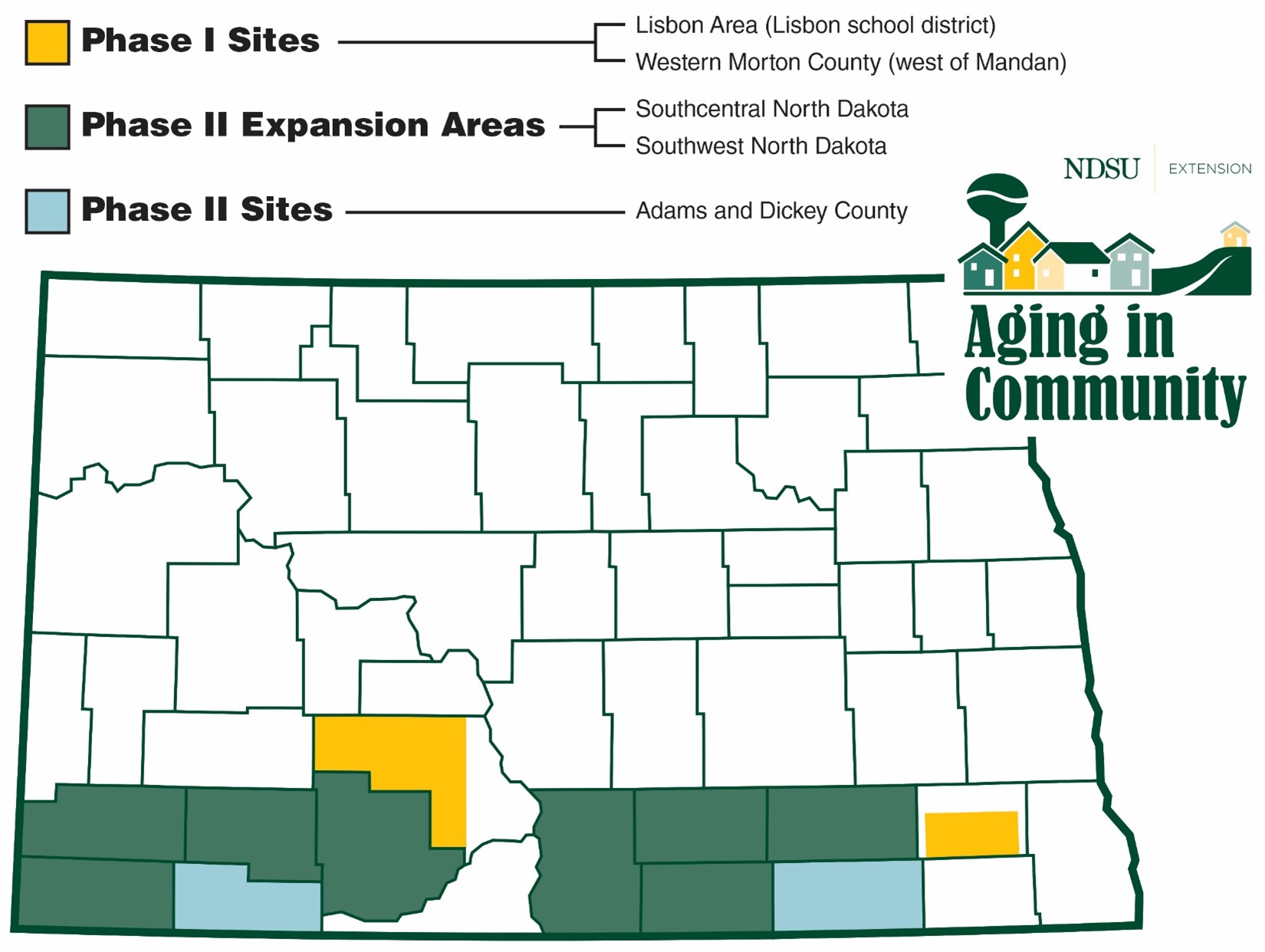
The Aging inCommunity program is currently in two areas in North Dakota. Programming began in the Lisbon Area and Western Morton County. Both the rural Morton County and Lisbon area locations are staffed and serving older adults and their families with a variety of services, including transportation assistance provided by trained volunteers.
We have strategically expanded the work of the AIC program to 10 adjacent frontier counties with a goal of piloting a new “area approach” to serving older adults in very rural and underserved parts of the state.
We have expanded to five additional counties to the west and south of Morton County - Southwest Area and five additional counties to the west of Lisbon – Southcentral Area. AIC Offices have been established in Adams County (Hettinger) and Dickey County (Ellendale). Program development is taking place in the additional counties in each area and AIC staff are working with local residents to determine the most pressing needs of older adults.
To effectively bring new services and supports to the additional expansion counties, AIC has piloted new staff positions called area program coordinators. The role of the area program coordinators includes working with local stakeholders to assess specific area needs and collaborating to find creative solutions.
|
In the Media
In a rural small town, a group of locals steps up to support senior health - NPR
Aging in Community: An Innovative, Community-based Approach to Support Rural Aging - ND Compass
Program Director

Jane has been with North Dakota State University Extension since 2012 serving as the gerontology specialist focusing on educational programs and initiatives to assist individuals to age well, such as health promotion, falls prevention, family caregiving, and aging in place. She has been part of the Aging in Community Program since 2021 where she oversees the overall administration and implementation of the program to support older adults living in rural areas. Jane has 30+ years of experience working with older adults and their family members in numerous settings including nursing home, assisted living, senior housing, and community-based care. She received a Bachelor’s degree in Business Administration from North Dakota State University, a Master’s degree in Health Services Administration from University of St. Francis, Joliet, Illinois, and a Ph.D. in Human Development – Gerontology, from North Dakota State University.
Funding
NDSU Extension has received a multiyear grant from Margaret A. Cargill Philanthropies, as well as funding from North Dakota Department of Health and Human Services, to fund the project.

