

Measuring Soil Microbial Activity by Using Litterbags
(SF2022, Revised July 2026)The main goal of the litterbag demonstration is to bring awareness of the soil biosphere (zone of life) to producers. This is achieved by examining the approximate levels of microbial activities and their effects on plant production within different cropping systems and tillage/soil management practices.
Measuring decomposer microbial communities directly in the soil requires specialized methods, and it can be expensive.
Instead of measuring the organisms, we can measure their activity through time, especially as it relates to breaking down old crop residues. We use litterbags to do this.
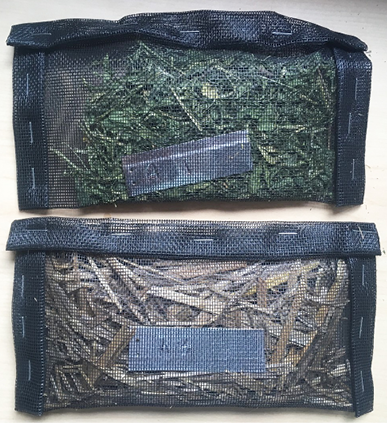
Litterbags are small mesh bags that are filled with a known quantity of litter (Figure 1). The bags are buried in the soil or placed on the soil surface for a specified time. The mesh allows microbes and small arthropods to break down the litter.
After a growing season, the litterbag is retrieved, cleaned and measured to determine how much litter disappeared due to soil microbial activity. Litterbags offer an easy way to monitor the activity of a soil’s decomposer community.
Who is doing the work?
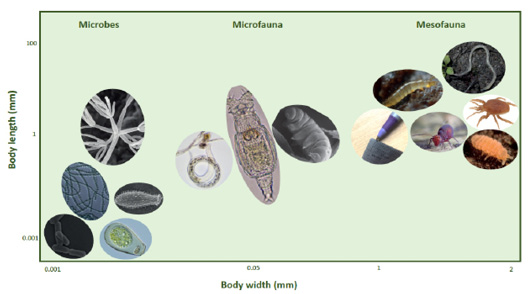
The mesh material used in this demonstration will allow entry by organisms that are smaller than 2 millimeters (mm). This includes the following groups (see Figure 2):
- Microbes: bacteria, archaea, fungi and protists. These are single- or multicellular organisms with a thin, threadlike growth form. Microbes are too small to see with the naked eye, but they are abundant in soil. They grow in and around organic matter, and they are important decomposers and nutrient cyclers.
- Microfauna: nematodes, rotifers and tardigrades. These are very small soil animals that are dependent on water films in soil because they live an aquatic lifestyle. They are also important decomposers, as well as microbial predators. Some of these are visible with the naked eye, but most microfauna viewing requires a microscope.
- Mesofauna: springtails, mites, pot worms and other small invertebrates. These are tiny arthropods and small segmented worms that can be seen with the naked eye. They are especially common in layers of plant litter on the soil surface. They play important roles in shredding and fragmenting litter or residue to speed up the decomposition process. They also prey on smaller soil organisms and each other.
The mass loss observed in this demonstration reflects the decomposition activities of these organisms. The litterbags exclude larger, perhaps more familiar decomposers, such as beetles, termites, centipedes and millipedes, earthworms, slugs and many other soil-dwelling critters.
Results
A higher loss in mass indicates higher microbial activity. Average 2019 and 2020 combined effects of litterbag placement, tillage practices and crops on mass loss (%) are presented in Figure 3.

Below are the key observations based on the results in Figure 3:
- The litterbags that were buried 2 inches in the soil had the highest mass loss, followed by the litterbags that were left at the soil surface with added nitrogen. Bags left at the surface without adding any nitrogen had the least mass loss.
- Minimum-till tillage practices had the highest mass loss, followed by no- to minimum-till, conventional-till and no-till (15 years).
- Litterbags buried in spring wheat crops had the highest mass loss, followed by soybeans. Litterbags buried in sunflowers and canola crops had a slight increase in mass, shown as negative values in Figure 3.
