Title

Phomopsis Stem Canker of Sunflower

(PP2300, July 2026)
Summary

Phomopsis is one of the most damaging sunflower diseases in North Dakota. We provide the grower-consultant audience with fundamental information (identification and management) and high quality pictures.


Other Authors

Karthika Mohan, Post Doctoral Research Fellow, Department of Plant Pathology, Microbiology and Biotechnology

Febina Mathew, Professor and Soybean Pathologist, Department of Plant Pathology, Microbiology and Biotechnology

Samuel Markell, Professor and Extension Plant Pathologist, Department of Plant Pathology, Microbiology and Biotechnology

Availability
Availability:
Web only
Publication Sections

Phomopsis stem canker is one of the most economically important diseases impacting global sunflower production. In the United States, the disease is most common in the Dakotas and Minnesota, where, in some years, the disease has been found in 50% of fields. In badly affected fields, yields can be reduced by as much as 40% as plants wilt, lodge and/or die prematurely, and sunflower heads remain small, shriveled and/or underdeveloped. The disease can also lower the oil content and quality of the seed, increasing economic losses for sunflower growers.
Phomopsis
Photo Credit:
S. Markell, NDSU
Phomopsis

Causal pathogens

Phomopsis stem canker is caused by several closely related fungi in the Diaporthe (syn. Phomopsis) genus. Five of these fungi have been found on sunflowers, but two of them (Diaporthe helianthi, D. gulyae) are responsible for most of the disease in the Dakotas and Minnesota. These fungi survive from one season to the next in infected sunflower residue. They can also survive on volunteer or wild sunflowers and some broadleaf weeds, such as cocklebur and kochia.

In the spring, the fungi produce spores during cool, wet weather. Rain and wind disperse these spores to young sunflower plants, where infections usually begin on the edges of the lower leaves through hydathodes. Once established, the pathogen grows through the leaves, through the petiole and into the stem. Disease development is favored by moderate temperatures (around 68-77 degrees Fahrenheit) and long periods of high humidity (relative humidity ≥90%, for about 36 hours), especially when plant leaves stay wet for long periods
of time. Epidemics can be severe when frequent rainfall events occur throughout the growing season.

Symptoms

The first visible symptoms of Phomopsis stem canker appear as small, uneven brown spots at the leaf margins. These spots enlarge along the leaf veins, often causing a pie-shaped brown lesion before the leaf wilts and dies (Fig. 1). The pathogen spreads through the leaf and petiole, causing both to eventually darken and wilt before entering the stem at the leaf axil.

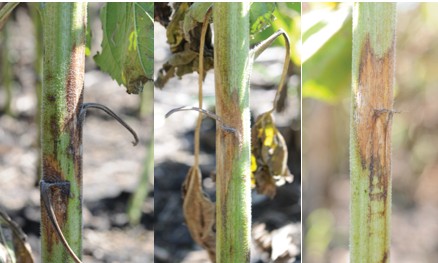
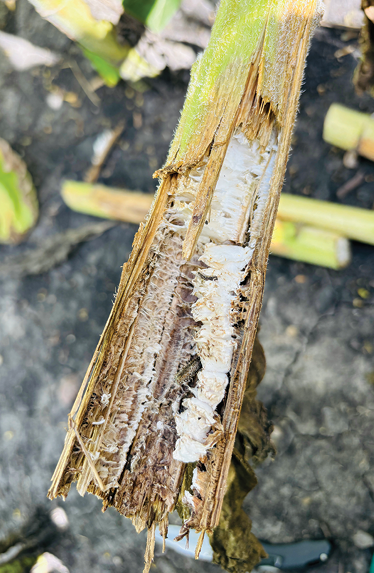
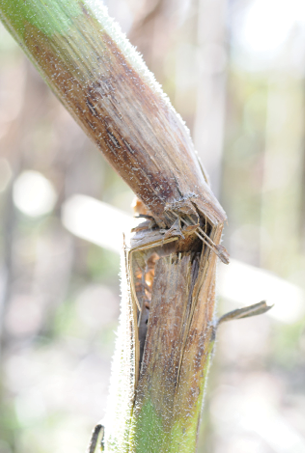
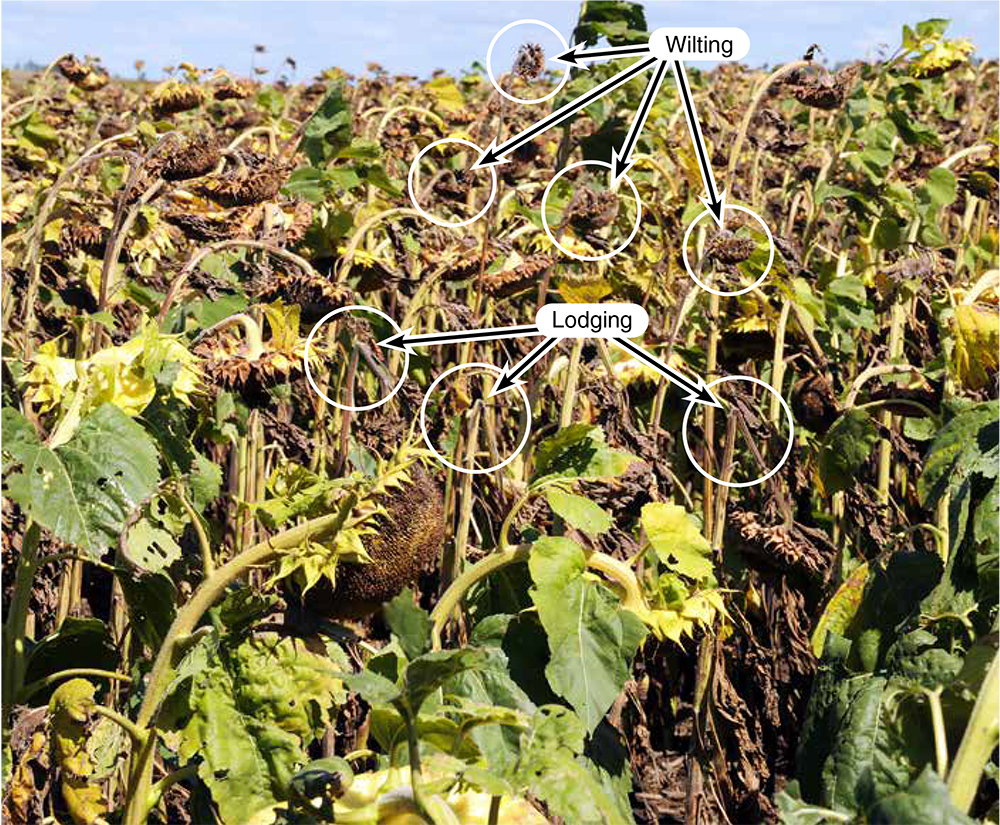
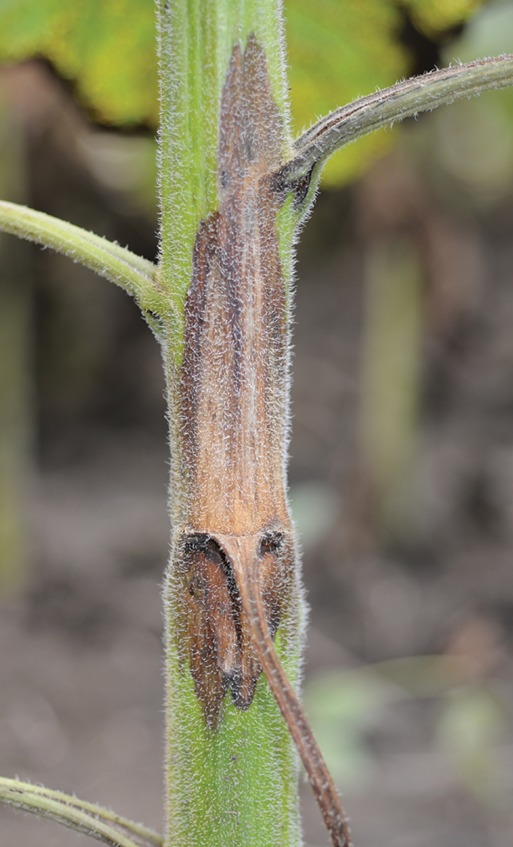
Once in the stem, a large (6 inches or more) brown lesion will develop as it expands up and down the stem (Fig. 2 and 3). In some cases, the lesion may girdle (surround) the stem. Beneath the lesion, the pathogen breaks down stem tissue, causing a hollowing of the stem (Fig. 4). Infections that develop early in the season can result in plant wilting and shriveled heads, while Infections that develop later in season can result in severe lodging, as weakened stems can no longer can support the weight of the developing head (Fig. 5). Wilting and lodging may occur in the same field, and result in high yield loss (Fig. 6).

Lesion size, color and stem integrity help distinguish Phomopsis stem canker from other sunflower stem diseases that infect from the leaves. Phoma black stem causes small (1- to 2-inch), black lesions (Fig. 7a) that usually do not hollow out or weaken the stem. Sclerotinia stem rot causes large (over 6 inches), white to tan lesions (Fig. 7b) that eventually shred stem tissue and may produce a white mold and/or black sclerotia inside and/or outside the stem.
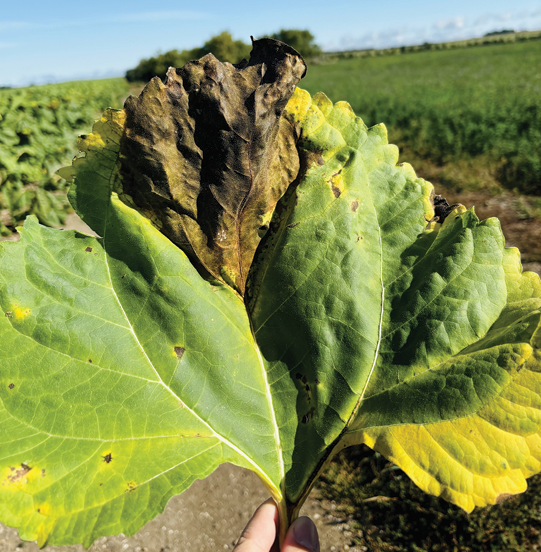
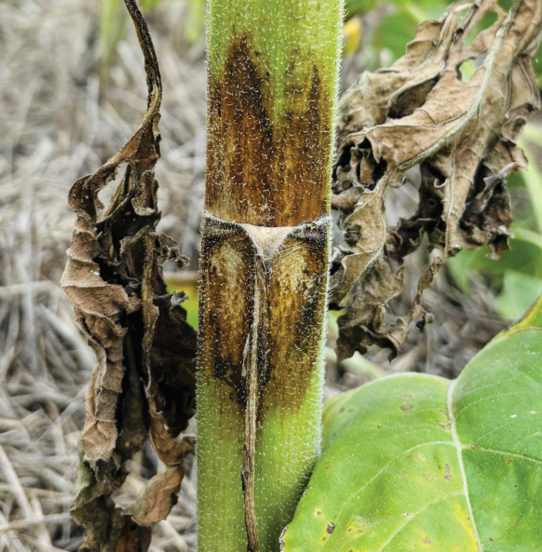
Figure 1
Photo Credit:
Karthika Mohan
Figure 1. Pie-shaped necrotic leaf lesion.
Figure 2
Photo Credit:
Karthika Mohan
Figure 2. Brown stem lesion developing at leaf axil.
Figure 3
Photo Credit:
S. Markell, NDSU
Figure 3. Range of stem lesions symptoms.
Figure 4
Photo Credit:
Karthika Mohan
Figure 4. Hollowing and disintegration beneath a stem lesion
Figure 5
Photo Credit:
S. Markell, NDSU
Figure 5. Lodging caused by stem lesion.
Figure 6
Photo Credit:
S. Markell, NDSU
Severe Phomopsis stem canker causing wilting (note small underdeveloped heads) and
lodging.

NOT Phomopsis stem canker! Other sunflower stem diseases commonly confused with Phomopsis stem canker:
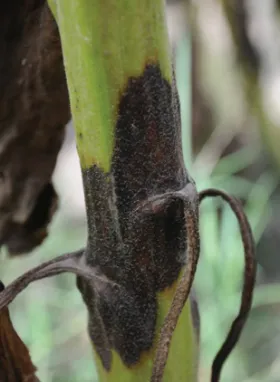
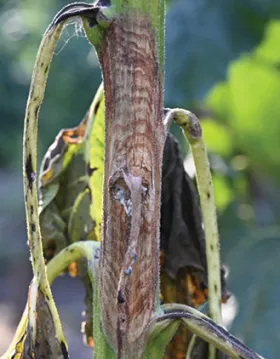
Figure 7a
Photo Credit:
S. Markell, NDSU
Figure 7. Stem lesions commonly confused with Phomopsis stem canker, a) Phoma black stem
Figure 7
Photo Credit:
S. Markell, NDSU
Figure 7. Stem lesions commonly confused with Phomopsis stem canker, b) Sclerotinia stem rot.

Management strategies

  • Crop rotation: Rotating sunflowers with nonhost crops such as corn or wheat helps reduce the amount of disease present in the field and lowers the risk of future infections. In general, a four-year rotation is recommended for sunflower production.
  • Resistant varieties: Plant sunflower hybrids that are tolerant or partially resistant. While no hybrid is completely resistant, some are less susceptible than others.
  • Canopy management: Avoid production practices that overly increase stand and canopy density resulting in a more favorable microclimate for infection (high seeding rates, excess nitrogen, etc.)
  • Weed management: Eliminating pathogen hosts that facilitate survival may reduce overwintering. This includes volunteer sunflower, wild sunflower, cocklebur, burdock, kochia, lambsquarters and more.
  • Fungicide applications: Fungicides may be used to manage Phomopsis stem canker, but will not completely control the disease. Research in the Dakotas and Minnesota commonly identified the most effective timing at the R1 growth stage (miniature floral head formation). In some trials, a single application resulted in a significant reduction of disease severity and protected yield. Efficacy among individual fungicides tested varied, but at the time of this printing, FRAC 11 chemistries were generally most effective. Refer to the most recent publication of the “North Dakota Field Crop Plant Disease Management Guide” (PP622) for more information on available fungicides in sunflower. Always follow label directions for application.

Acknowledgments:

We are grateful for the funding support provided by the USDA National Institute of Food and Agriculture-Critical Agricultural Research and Extension (CARE) (Award Number: 2024-69008-42655) for this material. We thank the National Sunflower Association for their continued support of research, Extension and education efforts to improve disease management.