

Plant Identification Guide for Natural Systems
(AS2247 September 2024)Proper plant identification is critical to successfully manage and/or restore natural and pasture systems. Natural systems include range, grasslands, wetlands, riparian areas and forest. Plant identification is important for the management of native plant species found on natural areas; forage species planted for pasture; and noxious, troublesome and common weeds. Plant identification is important to livestock producers for knowing the quality of forage species and to determine if potentially toxic plants are present. However, plant identification can be challenging. This publication will help you accurately identify plants using a field guide or by submitting a description of a plant for identification.
Contact your county NDSU Extension office to request a printed copy.
NDSU staff can order copies online (login required).
Plant Types

Plant features
Leaf structure
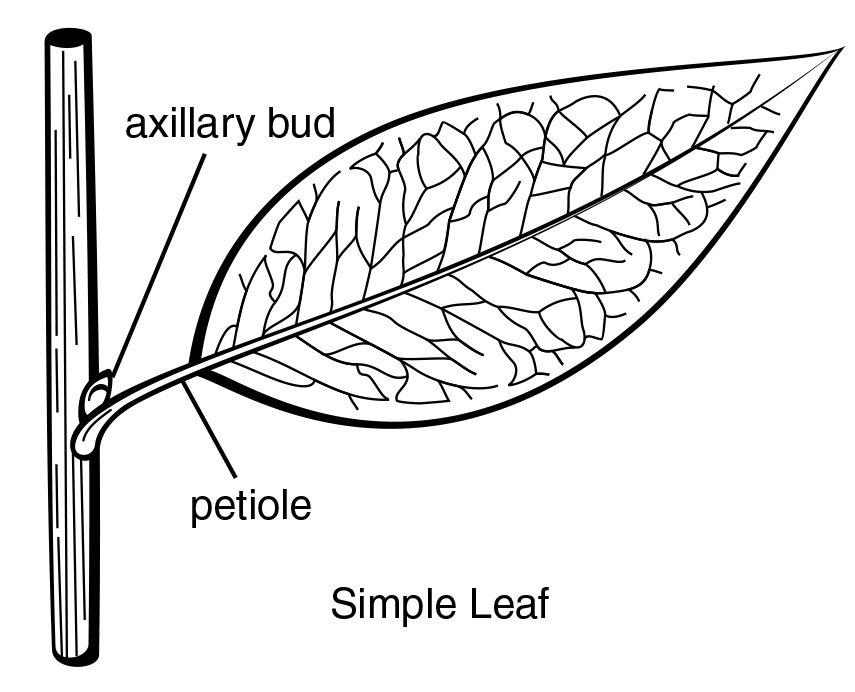
The leaves of all plant types are comprised of the blade, midrib and margin (Figure 2). The blade is the flattened part of the leaf. The midrib is the center of the leaf, and the margin is the edge of the leaf. The leaves of forbs, shrubs and trees may also have petioles, buds and stipules. The petiole is the stalk that attaches the leaf to the stem. Buds occur near the petiole and are where a new leaf begins. Stipules are spines or leaf-like growths at the base of the leaf. Not all plants have stipules, making them an identifying feature of some plants.
Leaf type
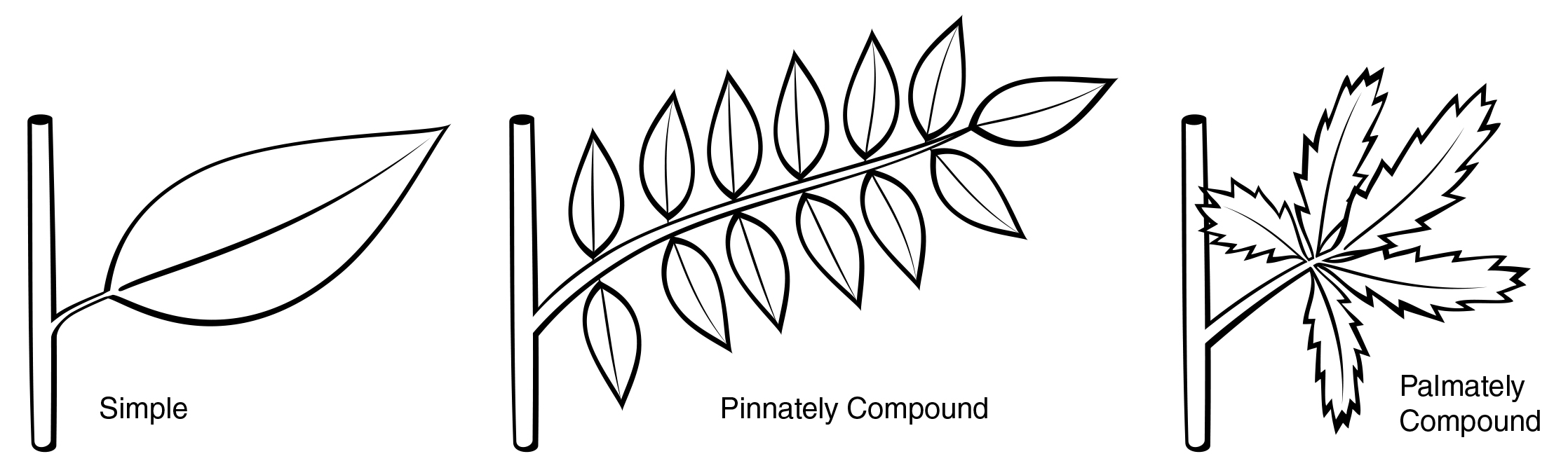
Leaves can be simple or compound (Figure 3). A simple leaf has an undivided leaf blade. All grasses and grass-likes have simple leaves. A compound leaf is divided into small leaves called leaflets that each connect to the leaf axis (center). Pinnately compound leaves have two to many leaflets that are positioned opposite each other along the leaf axis. A pinnately compound leaf may or may not have a leaflet at the end of the leaf. Palmately compound leaves radiate from a central point, like the fingers off the palm of the hand.
Leaf arrangement
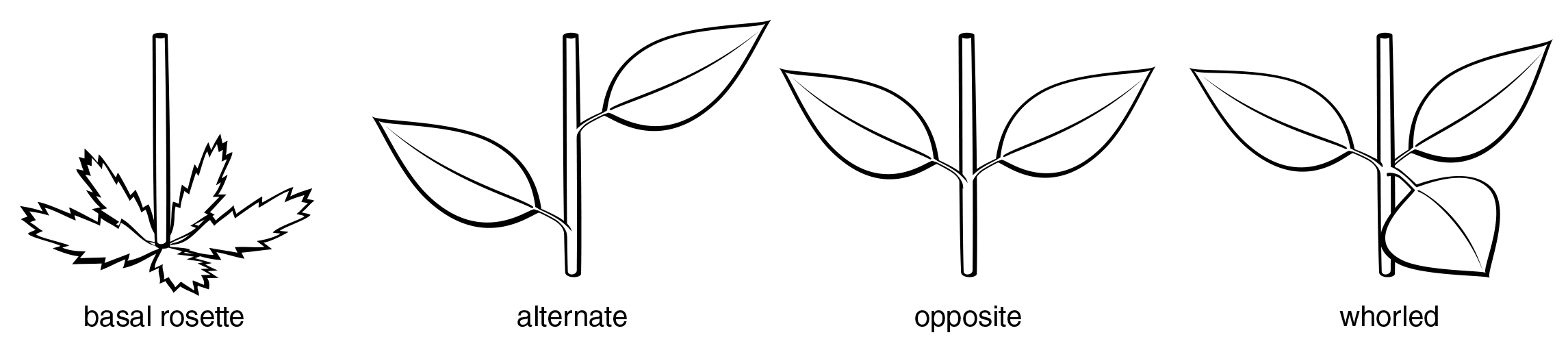
Leaf arrangement refers to the position of the leaf on the stem. There are five basic leaf arrangements:, alternate, opposite, whorled, basal (rosette) and fascicled (Figure 4). Alternate leaves alternate on each side of the stem in a flat plane. Opposite leaves grow from the same node on opposite sides of the stem in pairs. Three or more leaves connected to the same node are classified as whorled. Leaves occurring at ground level are called basal leaves. A group of basal leaves is called a basal rosette. Fascicled leaves are grouped in small, tight bundles, such as pine needles. Generally, a plant will have only one type of leaf arrangement; however, some forb and woody species may have two different leaf arrangements at different positions on the stem. For example, thistles support both basal and alternately arranged leaves.
Leaf shape
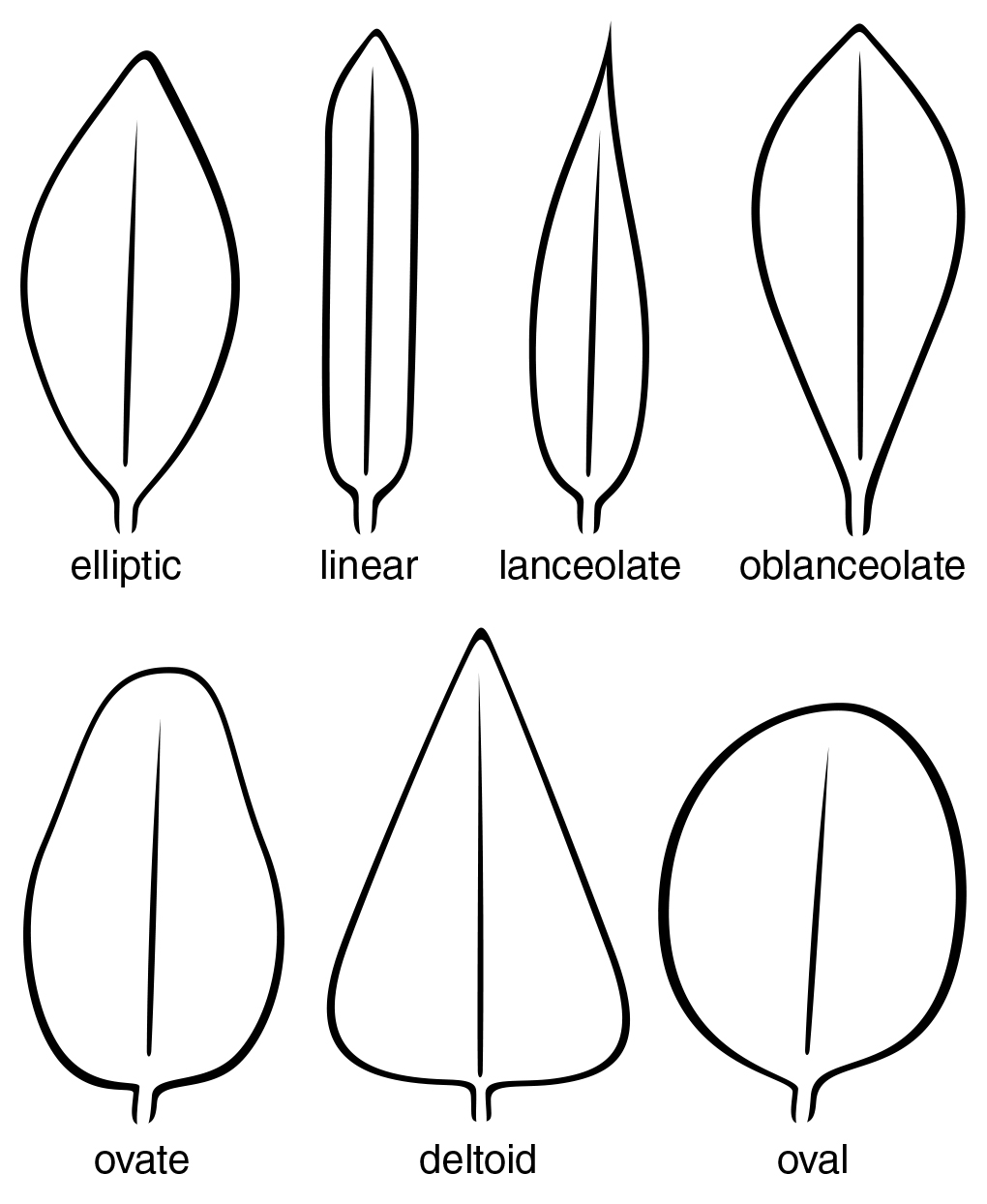
Leaf shape is another distinguishing feature of plants. There are many different leaf shapes. This guide only includes seven of the most common leaf shapes found in North Dakota (Figure 5). Elliptic leaves are broadest at the middle and narrow toward the ends. Linear leaves are long and narrow. Lanceolate leaves are lance-shaped, being broad at the end near the stem and coming to a point at the other end. Oblanceolate or spatulate are the opposite of lanceolate, being narrowest near the stem and broadening away from the stem. Ovate leaves are egg-shaped, being rounded but slightly broader at the end near the stem. Oval leaves are round to oval-shaped and do not come to a tip. Deltoid or cordate leaves are triangular with the broadest part near the stem and coming to a point at the leaf tip.
Leaf margin
The leaf margin or edge is another feature aiding in plant identification. There are many types of leaf margins. This guide only includes three of the most common leaf margins (Figure 6). Entire margins are smooth. Margins that are toothed are either serrate (teeth pointing toward the tip of the leaf) or dentate (teeth squarish and pointing outward from the margin) and can extend the complete margin or just a portion. For example, the leaf margin of alfalfa is serrated at the tip, whereas, the leaf margin of sweet clover is serrated around the entire margin. Leaves with lobed margins have indentations that cut inward toward the midvein of the leaf. Leaves with lobed margins can be slightly to deeply lobed (going to the midvein of the leaf blade, occasionally referred to as “dissected”).

Flowering Forbs, Shrubs and Trees
When present, the flowers of forbs, shrubs and trees can greatly aid in identification. However, flowers are only present during a portion of the growing season, causing plants to be identified in the vegetative stage, which depends on the plant features described above. See Figure 7.
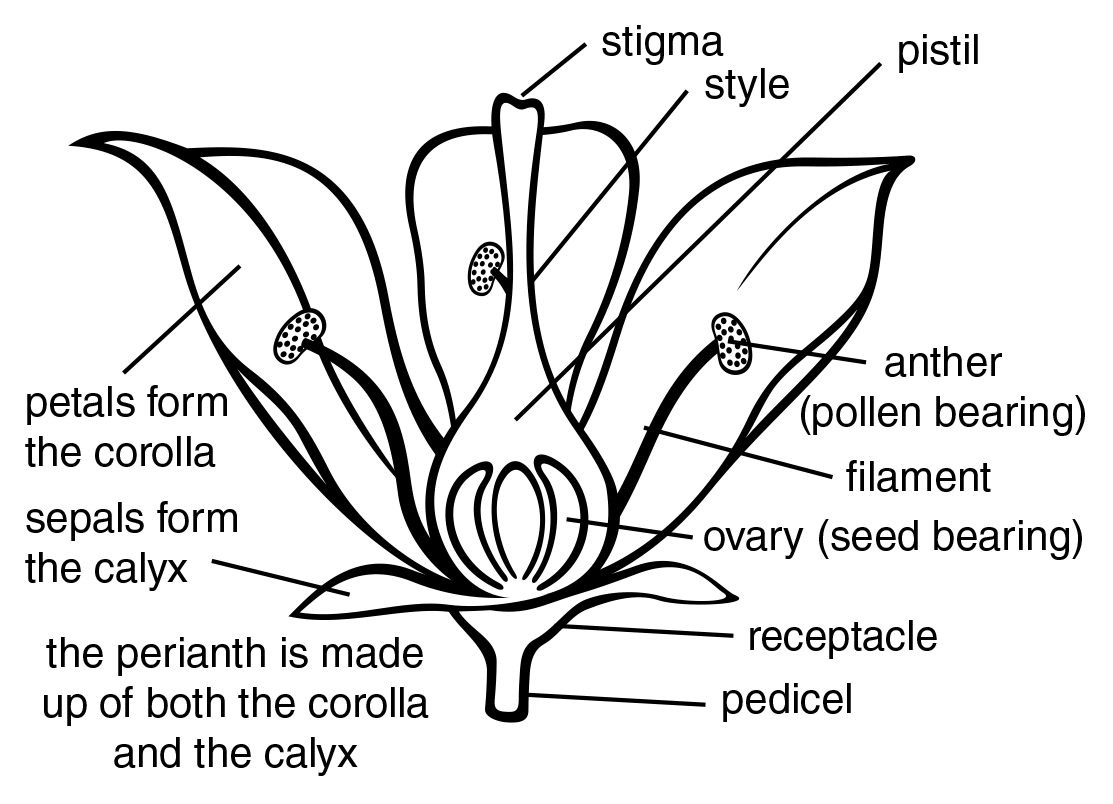
The outermost and lowest whorl of a flower is comprised of leaf-like structures called sepals. Together the individual sepals form the calyx, protecting the bud. Generally, sepals are green but can be colorful. The next whorl includes the petals, which together form the corolla and usually have the most color. Some plants don’t have petals or sepals but just one undifferentiated whorl. These unidentifiable petal-like structures are called tepals. The shape, size, color and number of petals are different for each species.
The stamen is the male reproductive organ consisting of an anther that bears the pollen and a filament, the thread-like structure supporting the anther. The number and shape of stamens can help identify plant species. The pistil is the female reproductive organ consisting of the stigma, style and ovary. Some flowers have multiple stigmas. Thus, the number of stigmas can aid in identification. Some flowers have leaf or scale-like structures surrounding the base of the flower called bracts.
A single flower having male and female parts is considered a perfect flower. Flowers can have just male parts while flowers on the same plant may have only female parts. These plants are called monoecious. It is also possible for the entire plant to have just male parts and other plants have just female parts. These types of flowers are called dioecious. Knowing this can be extremely helpful in identifying some plant species.
Flower shapes
Flower shape is another distinguishing feature of plants. There are many different flower shapes, and this guide includes five of the most common flower shapes found in North Dakota (Figure 8).

Inflorescence
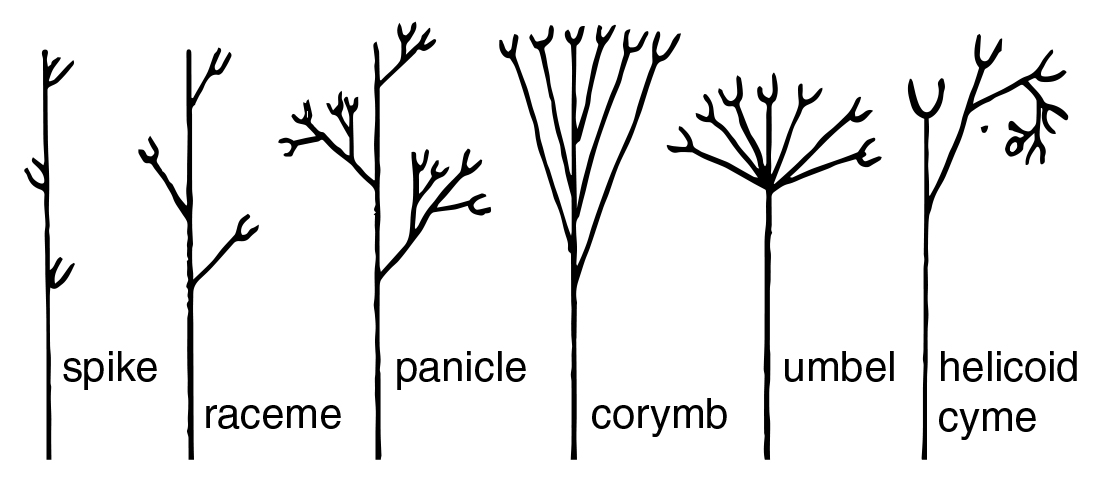
The specific arrangement of flowers is called the inflorescence. The shape of the inflorescence can vary. Some of the most common shapes include spike, raceme, panicle, corymb, simple or compound umbel, and helicoid cyme (Figure 9). On a spike, the flower is attached directly to the rachis (flower stem). On a raceme, the flower is attached to the stem by a pedicel (short stalk). A panicle is when a pedicel is attached to another pedicel before it’s attached to the rachis. On a corymb, the pedicels are different lengths, giving the flower a flat or rounded top. The pedicels of an umbel connect to a central point. An umbel has a flat or rounded top. A compound umbel has flower pedicels originating from one central point with a pedicel attaching that umbel to another central point. A cyme has a flat or rounded top. A helicoid cyme is coiled.
The flowers of spikes, racemes and panicles mature from the base upward, whereas the terminal flowers of a cyme are the first to mature.
Grasses
Grass identification is critical for assessing the condition of grassland ecosystems, including range and pasture. Grass identification is challenging, as the identifying characteristics are often small and generally not showy (Figure 10).
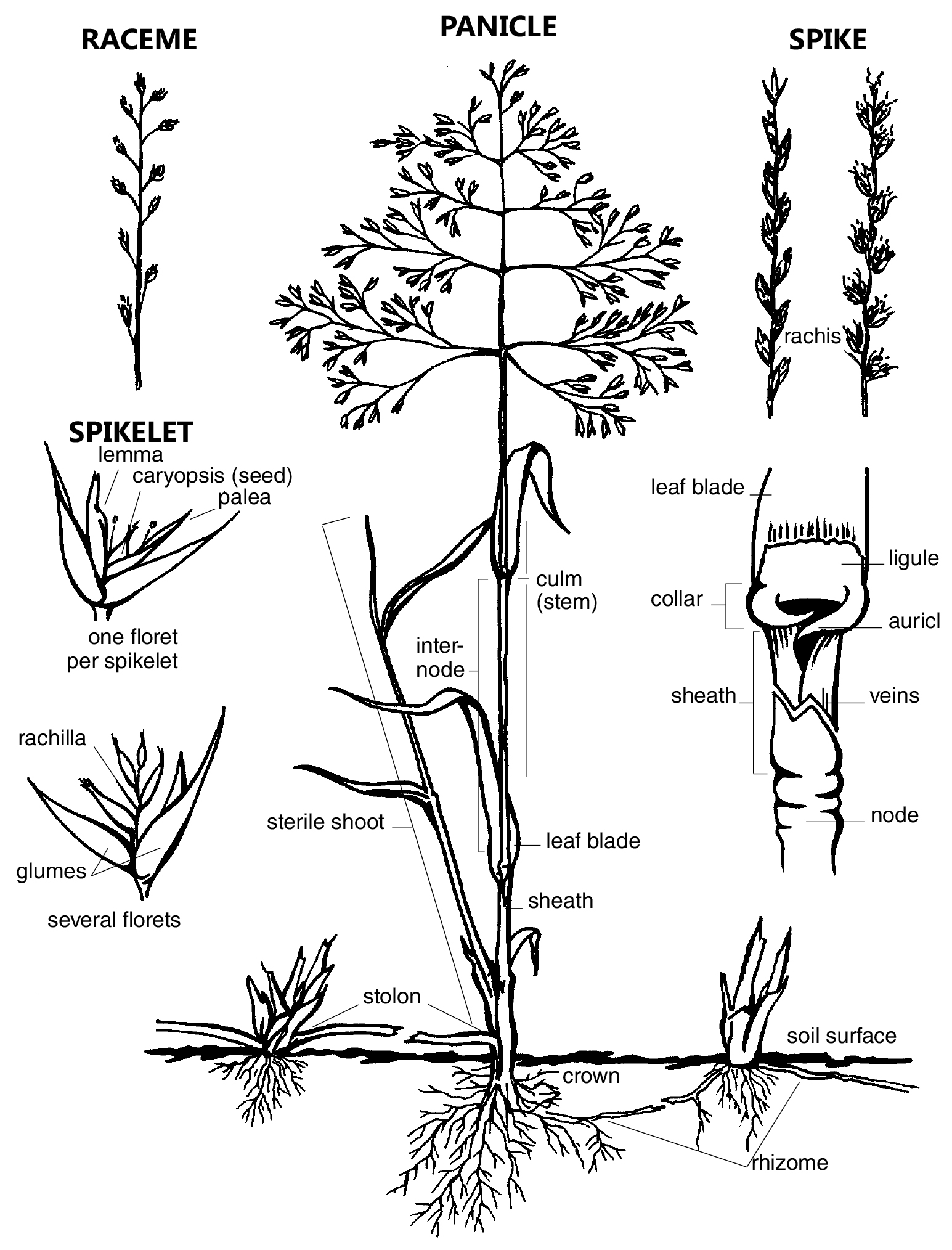
The leaf includes the sheath (wrapped around the stem) and the leaf blade. The sheath arises from a node. The blade diverges from the plant at the upper end of the sheath called the collar. Features associated with the sheath and blade, particularly the presence or absence of hairs, often are used to distinguish grass species. Stem growth can be described as a series of cylinders or tubes, one nested within the next. The stem (also known as the culm) elongates and the grass matures as a new internode extends from the node. The last internode is a flowering stem, which gives rise to the inflorescence that matures into the seed head. The basic unit of the inflorescence is the spikelet that includes two glumes and one or more florets. Because the inflorescence develops in the later stages of growth, leaves and associated structures are used for grass identification.
Sheath
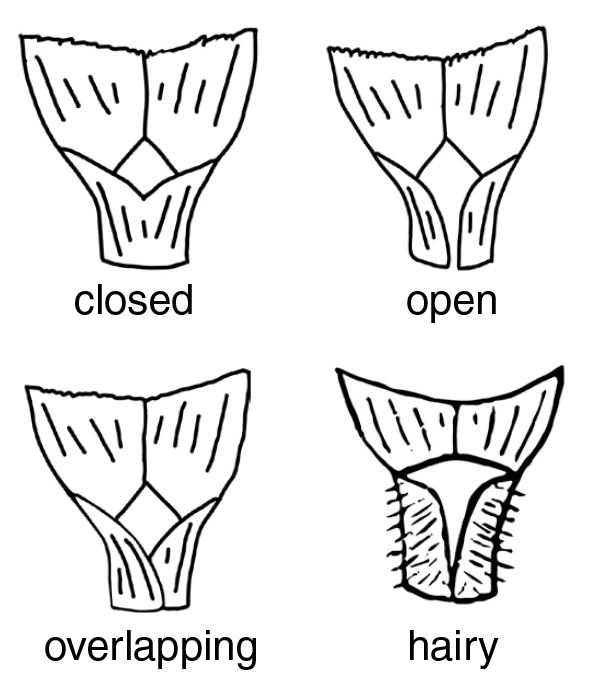
The sheath is the lower part of the grass leaf. Sheaths can be closed, open or overlapping (Figure 11). The margins of a closed sheath meet equally like a zipper on a coat and do not show the underlying stem. The margins of an open sheath do not meet and have a slit showing the underlying stem. The margins of an overlapping sheath create a V shape, similar to a shirt that is not buttoned to the top, showing the underlying stem. Another feature of the sheath is the presence or absence of hair.
Auricles
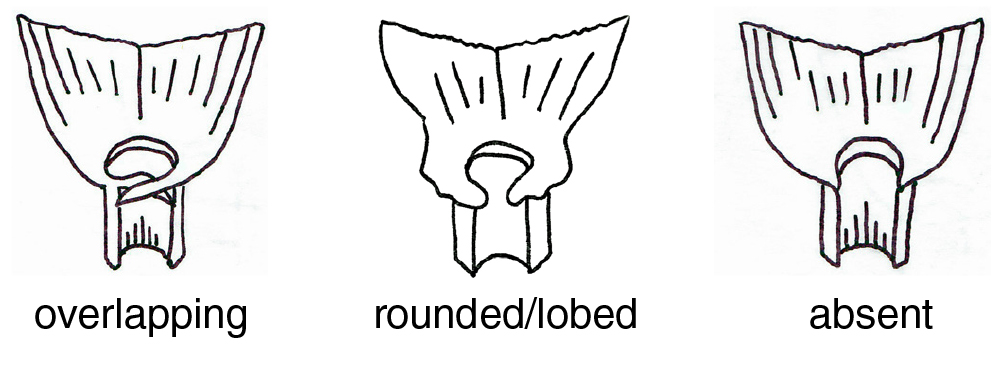
Auricles are the small growth that can occur on the sides of the junction between the leaf blade and sheath. Not all grasses have auricles. Auricles can be clasping, where they appear to be hugging the stem, or rounded (Figure 12).
Ligules
A ligule is a thin membrane or line of hairs on the interior of the collar (junction between the leaf blade and sheath) that is often important for identifying grasses (Figure 13). The size and shape of membranous ligules is variable and can be used to identifying grasses. For example, green needlegrass has a very short, blunt ligule, and needle-and-thread grass has a long, split ligule. Hairy ligules can have different lengths and density of hairs. Some grasses, such as green needlegrass, have both a membranous and hairy ligule.

Inflorescence
The shape of the inflorescence is another diagnostic feature that is useful for identification. The three most common types of inflorescence are the spike, raceme and panicle (Figure 10). A spike is unbranched with the spikelets attached directly to the rachis (inflorescence stem). A raceme is tightly branched with the spikelets attached to the rachis by a short stalk (pedicel). A panicle is organized with the spikelet attached with a stalk that is attached to another stalk that is then attached to the rachis. Panicles can have short stalks creating a tight panicle or long stalks with a very open and wide panicle.
The presence or absence of awns and the length and shape of awns can be helpful in identifying several grass species (Figure 14). An awn is a slender bristle that is attached to a part of the floret.

