Title

Brown Stem Rot in Soybeans

(PP2297, July 2026)
File
Summary

Brown stem rot (BSR) is a significant disease affecting soybean production in the North Central Region, including North Dakota. This disease, caused by the soilborne fungus Cadophora gregata (formerly known as Phialophora gregata), can lead to significant yield losses, especially in fields with a history of BSR and under conducive environmental conditions. BSR is particularly problematic in fields with cooler, moist conditions during the early growing season and has the potential to go undetected until substantial damage has already occurred.

Lead Author
Lead Author:
Richard “Wade” Webster, Extension Soybean Pathologist, Department of Plant Pathology, Microbiology, and Biotechnology
Other Authors

Hope Becton, Research Assistant Professor, Department of Plant Pathology, Microbiology, and Biotechnology

Suzette Arcibal Baldwin, Extension Plant Diagnostician, Department of Plant Pathology, Microbiology, and Biotechnology

Febina M. Mathew, Soybean Pathologist, Department of Plant Pathology, Microbiology, and Biotechnology

Availability
Availability:
Web only
Publication Sections

Casual Agent

Cadophora gregata survives in the soil and crop residue between growing seasons. This fungus is soilborne, entering soybean plants through the roots early in the growing season. Once inside the plant, this pathogen moves into the stem, where it disrupts the flow of water and nutrients, leading to characteristic symptoms later in the season.

There are two known types of C. gregata: Type A and Type B. Type A is the more aggressive of the two and is primarily associated with the most severe cases of BSR. Type B is generally less virulent but can still cause yield loss under favorable conditions. One distinguishing factor between these two types is that Type A will often lead to browning of the stem pith and the development of foliar symptoms, while Type B will often only develop the browning in the pith.

Symptoms

The primary symptom of BSR is the browning or darkening of the soybean stem pith (the inner tissue of the stem (Fig. 1). This discoloration often starts around stem nodes, and it is often found on the lower stem. As the disease progresses, this browning of the pith will develop upward along the stem. The internal browning of the stem is a key diagnostic feature of BSR and can be observed by splitting the stem lengthwise. This is often described as looking like segmented graphite in a pencil.

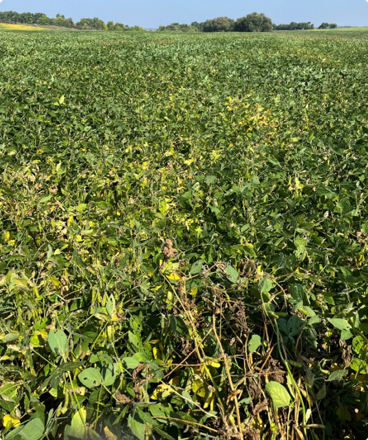
In addition to stem symptoms, BSR can also cause foliar symptoms that resemble those of other soybean diseases. Infected plants may exhibit interveinal chlorosis, where the tissue between the veins of the leaves turns yellow while the veins remain green (Fig. 2). Over time, this chlorosis can progress to necrosis (death of the tissue), causing the leaves to die and drop prematurely (Fig. 3). However, in some cases, plants infected with BSR may not show foliar symptoms, making it difficult to detect without inspecting the stem. This symptomology is very similar to the symptoms of sudden death syndrome (SDS). However, the leaflets will remain attached to the petioles with BSR.

BSR symptoms often become most visible during the reproductive stages (R3-R6), when plants are under strong energy demands due to pod fill. Plants that appear healthy early in the season can develop severe symptoms later in the growing cycle.
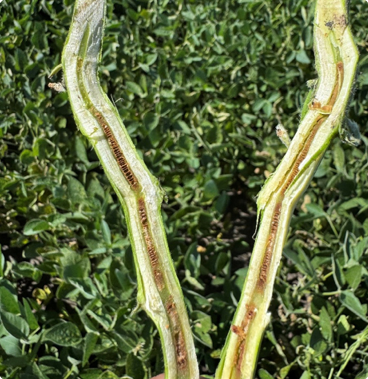
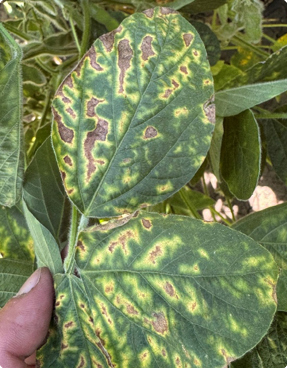
Figure 1
Photo Credit:
NDSU Photo
Figure 1. Brown stem rot causing browning in the pith tissue of the soybean stem
Figure 2
Photo Credit:
NDSU Photo
Figure 2. Development of foliar symptoms (interveinal chlorosis) due to brown stem rot of soybean.
Figure 3
Photo Credit:
NDSU Photo
Figure 3. Brown stem rot of soybeans in the field.

Disease Cycle

The causal agent, C. gregata, survives in the soil and soybean residue over the winter. During the growing season, the fungus enters soybean plants through their roots, typically early in the vegetative stages. Once inside the plant, the fungus moves into the stem, where it disrupts the flow of water and nutrients (Fig. 4). The disease development is favored by cool, wet conditions, particularly in the early growing season. BSR can be particularly problematic in no-till or reduced-till fields, where soybean residue is left on the soil surface, allowing the pathogen to remain present in the field for several years.

The development of BSR is often more severe in fields also infested with soybean cyst nematode (SCN) due to synergistic interactions between the two pathogens. SCN feeding damages roots and alters host defense responses, believed to create entry points and physiological stress that lead to infection of C. gregata. Consequently, higher BSR severity and yield loss are frequently observed in SCN-infested fields.
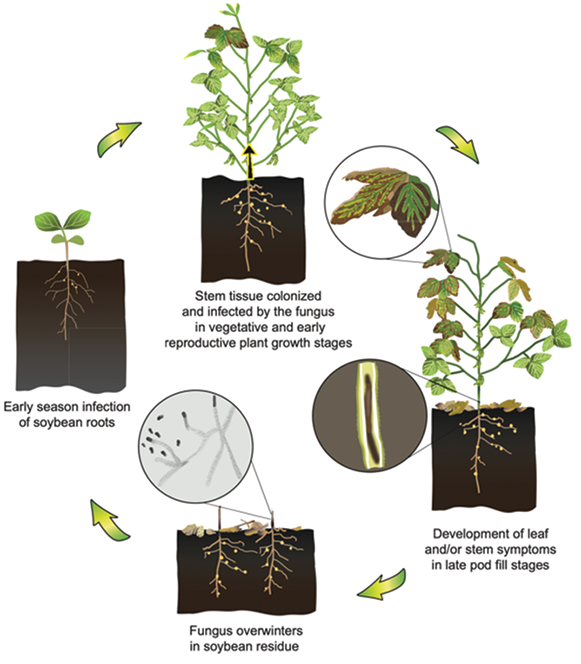

Figure 4
Photo Credit:
Crop Protection Network
Figure 4. Disease cycle of brown stem rot.

Management Strategies

Managing BSR requires a combination of cultural practices, crop rotation and the use of resistant soybean varieties. These strategies can help reduce the development of BSR and reduce its impact on soybean yield.

  1. Resistant Varieties: Planting BSR-resistant soybean varieties is one of the most effective management strategies. Resistant varieties are available and should be chosen for fields with a history of BSR or where the disease is known to be a problem. When possible, growers should also choose varieties with resistance to SCN, as this can help minimize BSR severity.
  2. Crop Rotation: Rotating soybeans with nonhost crops like corn or small grains can help reduce the buildup of C. gregata in the soil. Because the pathogen survives in soybean residue, rotating to nonhost crops for multiple years can help lower inoculum levels in the field, resulting in lower levels of BSR development the next season soybeans are grown.
  3. Residue Management and Tillage: Since C. gregata survives in soybean residue, tillage practices that bury infected residue can help improve inoculum degradation and reduce future BSR development and yield losses.
  4. Field Scouting: Regular scouting is important for early detection of BSR, especially in fields with a history of the disease. Farmers should monitor plants during the reproductive stages for signs of interveinal chlorosis and check the internal stem tissue for browning. By splitting stems and inspecting the pith, farmers can confirm the presence of BSR and take appropriate action in future growing seasons.
  5. Fungicides: Currently, there are no fungicides that have activity against BSR. This includes both fungicide seed treatments and foliar fungicides.

Conclusion

Brown stem rot continues to be a challenge for soybean farmers, particularly in regions with cool, wet growing conditions. However, by using resistant varieties, implementing crop rotation and managing residue effectively, farmers can reduce the risk of severe BSR outbreaks and protect their yields.

For more information on managing brown stem rot in soybeans, visit the Soybean Disease Diagnostic Series on the North Dakota State University Extension website or contact your local Extension agent.