
Estrous Synchronization for Natural Service Breeding in Beef Cattle
(AS1712, Revised July 2026)The majority of cattle herds in the United States rely solely on natural service breeding programs. While estrous synchronization is typically associated with artificial insemination, protocols exist to utilize and benefit from estrous synchronization in natural service breeding programs.
Introduction
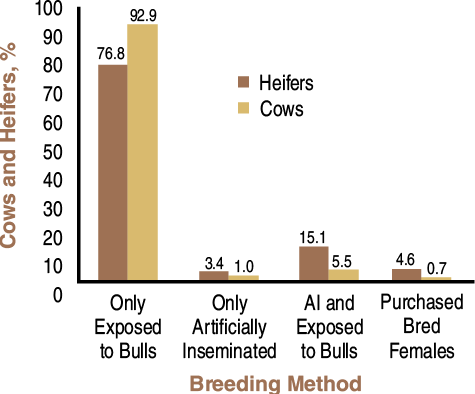
The U.S. beef industry is dominated by herds that rely solely on bull breeding. The percentage of cows exposed only to bulls was 92.9%, whereas the percentage of heifers was 76.8% (Figure 1). While estrous synchronization is typically associated with artificial insemination, utilizing natural service sires to breed estrous-synchronized females may offer opportunities to get females pregnant earlier in the breeding season, have calves born earlier in the calving season and potentially increase weaning weight of calves born to synchronized females.
A common, yet misconceived, concern when considering using estrous synchronization in natural service breeding programs is that all females will be receptive to breeding at the same time and consequently, need additional sires. However, several estrous synchronization protocols are designed specifically to be used with natural service breeding to ensure that females come into estrus over several days.
Regardless of what protocol is chosen, careful and timely planning is critical. For a complete list of natural service synchronization protocols and timelines for each, visit www.beefrepro.org/natural-service-protocols/.
Characteristics of bulls used for breeding and characteristics of the females being synchronized contribute to the success or failure of synchronized natural service breeding. Also, knowing specific synchronization protocols will give producers flexibility as they plan to implement a synchronized natural service breeding system.
Options for Synchronization With Natural Service
1 Shot PG: Prostaglandin F2a (PG) is given on the day of bull turnout. Females that respond to the PG will be in heat for approximately the next five days. The net result would be that 76.2% of cycling females would be in heat within the first five days of the breeding season. In this scenario, the average days to conception would be day 6.8 of the estrous cycle (a 3.2-day advantage compared with no synchronization, and theoretically, calves that are 3.2 days older at weaning with 3.2 extra days to gain weight after birth).
Day 5 PG:Females are gathered five days after bull turnout and given PG. The bulls would have bred 19% to 20% of cycling females before the PG, and the remaining females that respond to PG should be in heat over the next five days. Administering PG within the first five days after bull turnout does not disrupt pregnancies from breedings that took place during the previous five days; however, giving PG after day 5 can disrupt pregnancies. Using this method, 100% of cycling females would theoretically be in heat within the first 10 days of the breeding season, with the majority of breeding activity occurring around day 8. Interestingly, the average day of conception in females responding to synchronization (day 6.8 of the breeding season) would be the same as for the 1 Shot PG protocol.
7-day CIDR®: Using this protocol, a CIDR® is inserted for seven days prior to the start of the breeding season. Once the CIDR® is removed, the bulls are turned in. The CIDR® will stop cycling females from showing estrus during the time it is in place. It also has the potential to initiate estrus in some noncycling females. Within the first five days after the CIDR® is removed, 57% of cycling females would be expected to show heat, and the average days to conception in this scenario would be day 6 of the breeding season.
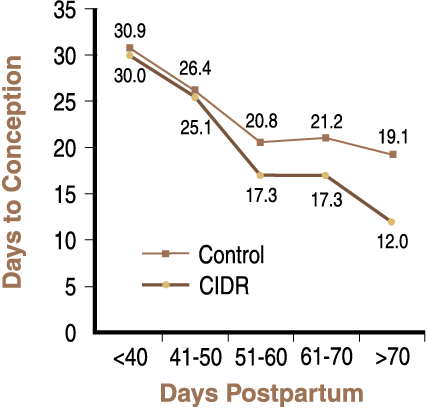
When comparing the use of a CIDR® or not, the average days to conception were three days shorter for cows receiving a CIDR® for seven days prior to the breeding season compared with cows that did not receive a CIDR®. This difference was mainly due to the effects of the CIDR® in cows that were likely cycling (calved earlier in the calving season; Figure 2).
Figure 2. Interval to conception from initiation of the breeding season at various days postpartum. Days postpartum×treatment
(P < 0.05). Adapted from Lamb et al., 2008
14-day CIDR®:Using this protocol, a CIDR® is inserted for 14 days. After removing the CIDR®, a period of estrus activity will occur; however, because of the long-term exposure to a progestin, these heats are subfertile, and breeding should not occur. Instead, bulls should be turned in with females approximately 14 days after CIDR® removal to breed females on the following heat of the next estrous cycle.
