Yearly Flock Management Calendar
(AS2309 October 2026)The yearly flock management calendar is designed to inform readers on flock management details from prior to breeding through weaning, as well as provide a place for sheep producers to keep detailed and accurate records of their production season. This publication combines a simple lambing record book with the information necessary to make sound management decisions throughout the year.
Contact your county NDSU Extension office to request a printed copy.
NDSU staff can order copies online (login required).
Breeding
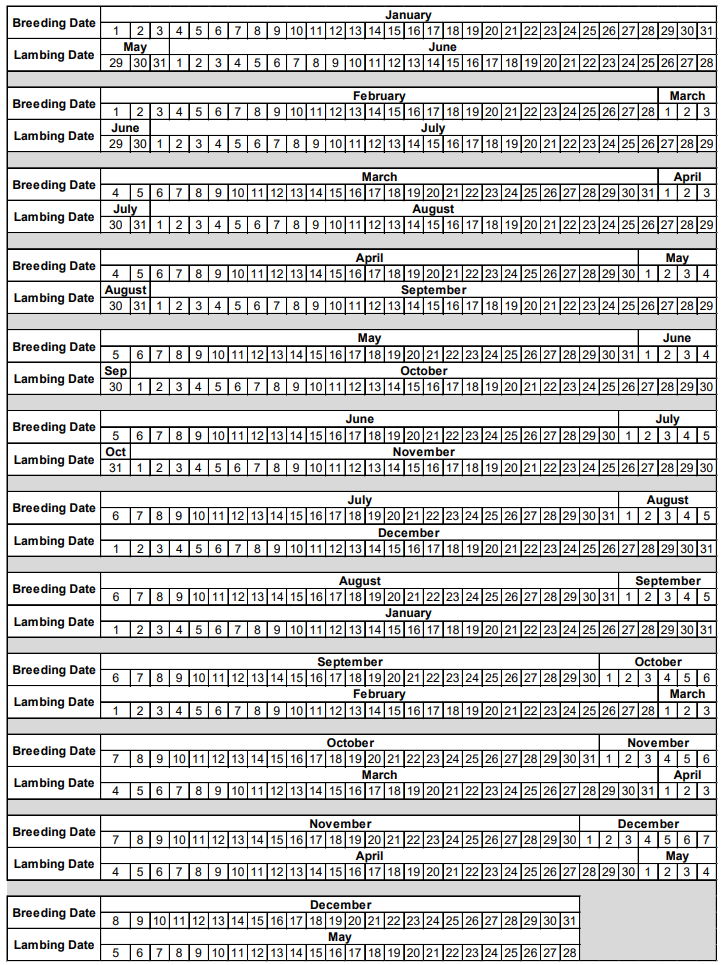
Selecting a ram turnout date is a key management decision that determines the timing for the entire production year or season. Using projected lambing dates (based on a ~148-day gestation), work backward to align breeding, lambing and peak lactation with forage availability and environmental conditions. This approach helps ensure nutritional demands are met during the most critical production stages, supporting ewe condition, lamb survival and overall system efficiency.
The duration of sheep breeding seasons directly influences sire demand, lambing distribution and uniformity of lamb crops. In most production systems, it is recommended to confine sheep breeding seasons to two to three estrous cycles (~35 to 51 days). Shorter breeding periods support centralized lambing windows when ram power is adequate. In general, reproductively sound rams can service up to three to five ewes per day; however, this capacity is highly variable and influenced by factors such as sire age, nutritional status, libido, breeding season (fall or spring), pasture or pen size, terrain, distance to water and the proportion of females in estrus at a given time.
Recommended Coverage Ratios for Rams for a 45- to 60-day Breeding Season
| Species | Maturity | Breeding Season | Ewe Synchronization | Coverage Ratio (Ram : Ewe) |
|---|---|---|---|---|
| Ovine | Mature Ram (>1 year) | Fall | No | 1:35 - 40 |
| Yes | 1:20 - 25 | |||
| Spring | No | 1:20 | ||
| Yes | 1:15 - 20 | |||
| Ram Lamb (≤1 year) | Fall | No | 1:25 | |
| Yes | 1:10 - 15 | |||
| Spring | No | 1:15 | ||
| Yes | 1:5 - 10 |
When ram power is available, synchronizing ewe estrus can be a valuable tool to further concentrate breeding activity. The use of vasectomized or “teaser” rams to induce the “ram effect” stimulates and synchronizes estrus activity, increases ovulation rates and increases the proportion of ewes that conceive early in the breeding season. Artificial estrous synchronization (e.g., CIDRs, prostaglandins, gonadotropins, etc.) protocols can also be used to precisely control the timing of estrus and further compress the breeding season as labor and management allow.
During the breeding season, tracking ram performance can provide valuable insight into mating activity, sire effectiveness within breeding groups and potential fertility issues. One of the most practical tools for monitoring breeding activity is the use of marking harnesses. These harnesses are fitted to each sire at turnout, and the crayon color is changed every 14 to 17 days. This system allows producers to identify when ewes are bred based on marking color, estimate lambing distribution, and detect females that return to estrus and are remarked. Repeated markings can signal potential fertility concerns in either the female or the servicing sire, enabling more timely management decisions.
- Monitor Body Condition Score and adjust nutritional management as necessary.
- Track and record breeding activity.
- Schedule pregnancy scanning services.