Connecting with industry leaders: What it takes to work in agriculture, according to CHS president and CEO
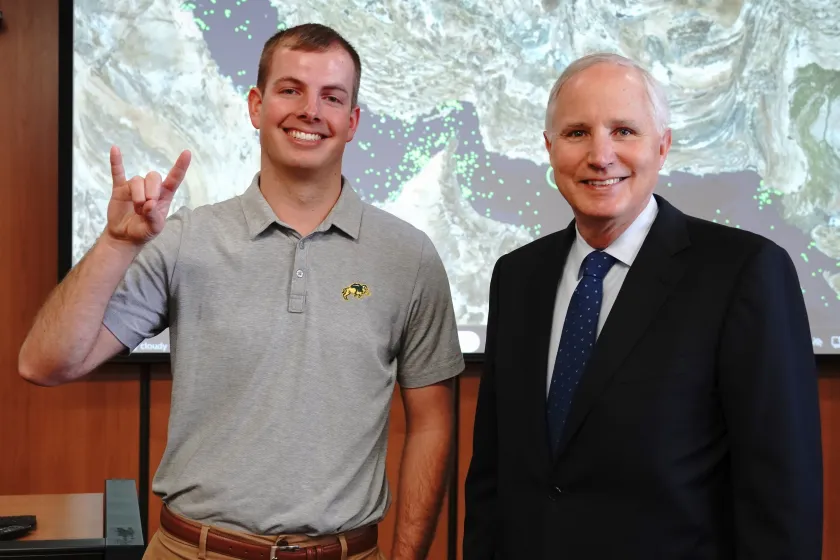
The opportunity to connect with leaders in any area of study is crucial for preparing students for their careers after graduation, and it’s one way North Dakota State University emphasizes bringing classroom learning to the real world.
Will Ellison is a senior studying agricultural economics in NDSU’s College of Agriculture, Food Systems, and Natural Resources. He served as the president of the Agribusiness Club and as the endowment chair of the Blue Key National Honor Society, among many other campus organizations. He was honored as a Top 10 Senior during NDSU Ag Week.
Will grew up on a family farm just outside Mapleton, North Dakota, where he helps raise corn, wheat and soybeans. After graduating in May, he’ll begin a career as a grain originator for CHS — the largest farmer-owned cooperative in the U.S. — in Kindred, North Dakota.
Jay Debertin is the president and CEO of CHS. The company operates across the U.S. and internationally, selling agronomy and energy products and services to farmers to grow crops and maintain their farm operations, and buying crops from farmers and local cooperatives.
Jay joined CHS 42 years ago as an intern and has been president and CEO for almost a decade.
Jay, even though you’ve been a part of this industry for a while, what things are you still curious about?
There’s always going to be something about our industry — particularly in a company like CHS, which moves things around the world — that we ought to know more about. It wasn’t too many years ago when the big question was “How are we going to feed all these people?” Today, that question seems to be almost reversed: “What are we going to do with all this crop?”
That’s just an example of the evolution of what we want to learn. The bad day is when you stop — when you think you have it all figured out — when you don’t want to engage yourself to learn more.
Will, what experiences in NDSU’s ag economics program helped prepare you after graduation?
First and foremost, I think the professors and faculty at NDSU are second to none. Specifically for my career in grain origination, I think about the commodity trading classes with Dr. Bill Wilson. He’s an ag economist in grain and commodity trades, and he’s one of the more notable people in that field. Learning from him about the things that will really matter in my career has been huge.
The student organizations have also been very beneficial. I’ve been lucky to be part of a handful of student organizations and have held quite a few leadership roles. The soft skills I’ve learned are invaluable, especially in the connections I’ve made. I have a feeling that the friends and connections I’ve made here will be beneficial long down the road in the close-knit field of agriculture.
Speaking of connections, Jay, how important has it been for you to make them early on?
Hugely important. This industry is both big and small. It’s small in the sense of the people with whom we do business. Will will be in Kindred, doing business with and improving our service with people who own us. It gets very personal and intimate with those people.
At the same time, we are shipping products to customers around the world. The point is to create a connection, a personal connection, because it’s so important in all product marketing, but particularly those that deal with commodities.
Jay, why is it important for organizations like CHS to stay connected with universities like NDSU?
Again, it comes from a key part of the commodities market. How do we create a difference in an industry where commodities can be substitutable? One of those ways is with the talent we bring in. It’s important that we have talented people who are incredibly bright, driven, curious, and who can collaborate with others and represent the company well.
What we’ve found is that NDSU, time and time again, hits all of those things across the company. I have people on our executive leadership team who come from NDSU. We have people from other fine universities as well, but we definitely see it from NDSU. We look to people such as Dr. Wilson and Dr. Frayne [Olson] to point out talented people within their curricula.
Will, does that sound like you’ll fit in at CHS, among those people?
I’m thankful to be working for a company that values its people — from the farmers who own CHS to its own employees. The people are the most valuable product, after all.
I’m grateful that they’re willing to invest in the universities that play such a big role in agricultural production.
Jay, you started at CHS as an intern. How did that first job out of college prepare you for the career that brought you here today?
It was the ‘80s. I was looking for work. I didn’t exactly know what an intern was. All I knew was that I came to work and did what they told me to do, and I got paid for it. I was an analyst because there was no other title, really.
I look at the people joining the workforce today, and they’re better than I was. I think they ask better questions than I did. The people we’re bringing on today are just better.
Nowadays, CHS has the capability of meeting our employees’ different requests. We have people who like living in small towns and people who like large cities. We have people who live internationally. We meet people where they are and with their lifestyles. If they’re bright and they treat themselves and others with respect, they are welcome to work here just the way they are.
Will, as you leave campus, but take NDSU with you, what advice would you give to students hoping to land a job in agriculture?
Expect to work hard. Make sure you get the little things right. People notice when you work hard and care about the little things. Think, “If I were an employer, would I want myself as an employee?”
Jay’s right about being a continual learner — stay curious. The more you know about something, the less you know. Especially with agriculture, which is an ever-changing industry.
What advice do you have for Will as he enters the workforce, Jay?
Will pointed out exactly what I would say: how you collaborate, your attitude toward your work, how you carry yourself and being somebody others want to work with — these things all matter. Being excellent in your work and being nice to be around is a winning combination.
I will emphasize the importance of constant learning. A college graduate could say, “I’ve spent the last 16 years dealing with school, and I’m tired of learning.” I get it. I was the same way.
So I’ll tell you what, Will. I’ll give you a little break. Then it’s back to work.
That “little break” will be the weekend of graduation, as Will begins his agriculture career the following week.
FOR MORE INFORMATION: https://www.ndsu.edu/programs/undergraduate/agricultural-economics