

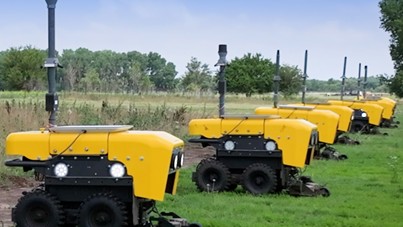
Autonomy in Action: North Dakota Trials at CREC
On a quiet spring morning in 2026, the Carrington Research Extension Center (CREC) will look the same at first: wide fields, crisp air, and the familiar rhythm of a new season beginning. But then something different will move across the residue: not a tractor, not a sprayer, and not a crew. A small autonomous platform will be working its way down the rows with steady purpose, turning a bold idea into something practical you can see with your own eyes.
That’s the heart of NDSU CREC’s collaboration with Greenfield Robotics. Farming in the Northern Plains is facing real pressure, tight labor, short weather windows, herbicide resistance, rising input costs, and increasing expectations to protect soil and water. At the same time, growers are being asked to do more with fewer passes and less disturbance. Autonomy offers a new pathway, but only if it can prove itself in real fields, under North Dakota conditions, where weeds don’t cooperate, and the weather doesn’t wait. That’s exactly why this partnership matters: Greenfield Robotics brings innovative robotic platforms like Grassbot and BOTONY, and CREC brings the research rigor and field-scale realism needed to test what works, what doesn’t, and what it takes to make it farm-ready.
The story starts where every successful crop starts, with a strong foundation. Cover crops such as cereal rye can protect soil, reduce erosion, and improve field resilience. However, they also pose a practical challenge: how do we manage that biomass to support the cash crop while still keeping weeds in check? At CREC, we will explore an exciting approach where Grassbot doesn’t simply terminate cover but helps transform it into an intentional mulch layer. The idea is simple but powerful: create a uniform protective blanket that suppresses early weeds, conserves moisture, and supports planting dry bean and/or soybean with minimal soil disturbance. Instead of multiple heavy passes that disturb soil structure, autonomy may offer a lighter-touch strategy that still delivers strong stand establishment and clean rows.
As the season progresses, the focus shifts from “starting strong” to “staying clean.” One of the most stubborn reminders of why weed control is so difficult is Canada thistle, persistent, aggressive, and capable of regrowing even after significant effort. This collaboration will test a different way of thinking about weed management: not one big intervention, but repeated, precise actions at the right time. Using autonomous, post-plant between-row operations, CREC will examine how the timing of the first deployment based on weed height and the number of deployments across the season can gradually reduce weed pressure without relying on herbicides or tillage. If successful, this would represent a major step forward: a sustainable, repeatable weed-management strategy that protects both the crop and the soil while reducing chemical dependence.
But autonomy isn’t only about controlling weeds; it can also change how we support crop performance. Greenfield’s upward-facing foliar attachment on BOTONY opens the door to a practical opportunity: targeted foliar feeding, applied consistently and flexibly. At CREC, we will demonstrate how autonomous foliar applications can work in both conventional and organic systems, where timing, frequency, and product options can make a measurable difference. The exciting part is not just the application itself, but what autonomy enables: repeated, well-timed passes that are often difficult with traditional equipment because of labor demands, compaction risk, and scheduling constraints. This could be especially valuable in organic fields, where management options are limited, and every advantage matters.
The collaboration also looks beyond a single season toward systems that build resilience over time. CREC will explore autonomous cover-crop interseeding into standing dry bean and/or soybean at different growth stages, using a carefully designed mixture such as cereal rye, winter camelina, and red clover. The goal is to understand when in-season seeding is most successful for emergence, fall ground cover, weed suppression, winter survival, and early spring soil protection. Autonomy makes this approach more realistic because it can operate precisely within established row systems and work within narrow windows, helping integrate cover crops into rotations where timing has traditionally been a barrier. Across all of this work, mulch creation and planting, post-plant weed control, foliar feeding, and in-season cover-crop establishment, the bigger story is about a new management style: small, timely, low-disturbance actions that can be repeated as conditions change. Instead of one-and-done decisions, autonomy allows adaptive strategies that respond to the season while protecting soil and maintaining productivity.
Most importantly, this partnership is designed to deliver more than exciting technology. It’s designed to deliver evidence, confidence, and practical guidance. CREC will serve as the proving ground where farmers, students, engineers, and extension educators can see what autonomous farming looks like up close and judge it by the outcomes that matter: weed control, crop performance, soil protection, and operational fit. By the end of 2026, the story won’t just be that robots worked in a field. The story will be that autonomy, tested with agronomy and validated under North Dakota conditions, can become a practical tool to help farms stay profitable, sustainable, and ready for the future.
Rupak Karn, Ph. D.
Rupak.Karn@ndsu.edu
Extension Precision Agriculture Specialist
