

Bridging the gap: strengthening support for North Dakota’s small farms through NDSU Extension
Small farms play an increasingly important role in North Dakota’s agricultural landscape, and their impact is only growing. According to the USDA National Agricultural Statistics Service 2022 Census of Agriculture, nearly 2,900 farms in the state operate on 1 to 49 acres. That’s an 8% increase since 2007, signaling a steady rise in interest in small-scale agriculture.
These small farms are more than just a trend. They produce a diverse range of products and contribute to local food systems, community resilience, and rural vitality. From fresh produce to meat and specialty goods, small farms help strengthen local economies and connect communities to their food.
Understanding the Need
Despite their importance, small farms often face challenges that traditional agricultural programs don't fully address. A 2022 NDSU master’s research project highlighted that many small-scale producers need more tailored, practical support to succeed.
The NDSU Extension Small Farms team serves as a gateway to research-based, practical resources designed specifically for small farm owners, gardeners, and local food producers. Their work spans a wide range of topics, including livestock and horticulture, food preservation, value-added products, marketing, and local food systems.
To better serve this growing audience, NDSU Extension set out with three key goals:
- Build a multidisciplinary team of Extension agents and specialists focused on small farm needs
- Create a centralized website with accessible, research-based resources
- Expand outreach efforts to connect Extension professionals, small farm owners, and policymakers
These efforts are grounded in educational programming that meets small farms where they are. Key focus areas include:
- Farm to School
- Field to Fork
- Food Entrepreneurship
- Gardening and Horticulture
- Livestock and Poultry
Making an Impact
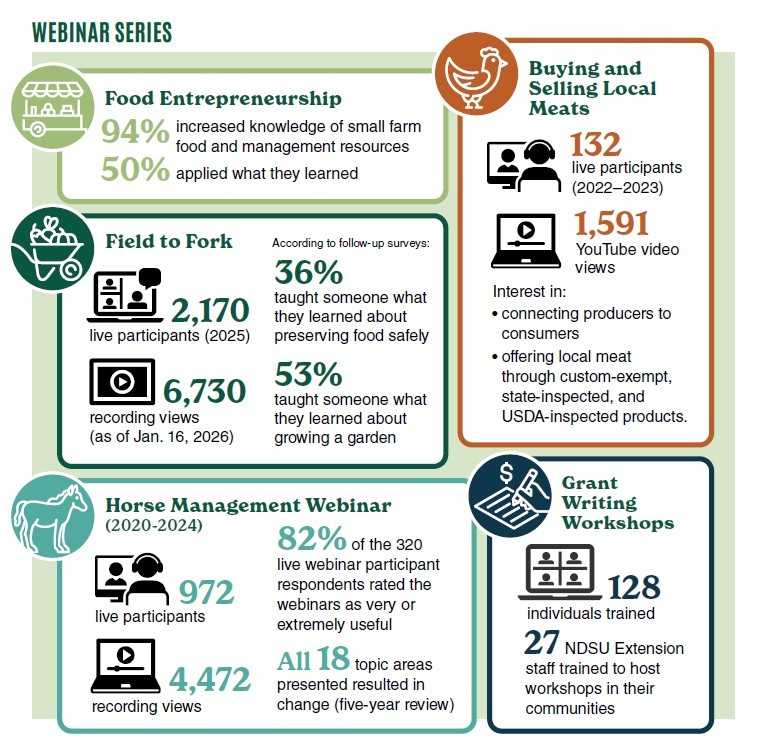
Through these initiatives, NDSU Extension has strengthened its connection with small farm operators across North Dakota. Feedback shows that this audience is engaged and eager to learn. High publication views and strong webinar participation highlight a clear demand for relevant, practical education tailored to small-scale producers (Figure 1).
Some of the publications include:
- Beginners Guide to Raising Chickens
- Food Safety Best Practices for Local Food Entrepreneurs
- Guide for Buying and Selling Local Food
- SNAP at Farmers Markets
Looking Ahead
NDSU Extension is focused on continuing the conversation by bringing together small farm operators, educators, researchers, and policymakers to explore how Extension can evolve to better support small farms.
So far in 2026, we have been or will be present at:
- NDSU Extension Spring Professional Development Conference: April 7-9
- National Rural Grocery Summit: May 5-7
- Prairie Roots Homesteading Summit: May 15-16
While still evolving, we invite you to check out our newly created website, which hosts specific information for small farm operations in North Dakota. You will find the site here: www.ag.ndsu.edu/smallfarms.
If you have specific small farm questions, please reach out to your local NDSU Extension agent found here: https://www.ndsu.edu/agriculture/extension/extension-county-offices.
Mary Keena
Mary.Keena@ndsu.edu
Extension Specialist / Livestock Environmental Management
Team members include: Julie Garden-Robinson, Professor and Food and Nutrition Specialist; Penny Nester, Bowman County Extension agent; Jan Stankiewicz, Community Health and Nutrition Specialist and Tribal Liaison; Travis Hoffman, Associate Professor and Extension Sheep Specialist, Paige Brummund, Ward County Extension agent, Josh Becker, Logan County Extension agent; Lindy Berg, Conservation Leadership and Planning Extension Program Coordinator; Julianne Racine, LaMoure County Extension agent, Sarah Bedgar, McLean County Extension agent; Ryan Odenbach, McKenzie County Extension agent; and Stacy Wang, Social Media Specialist.
