

Calibrate the Spreader!
Manure is often viewed as something producers need to “deal with,” but it is also a valuable nutrient resource. When manure is managed and applied correctly, it can support crop growth and reduce fertilizer costs. When it is applied unevenly or at the wrong rate, however, those same nutrients can quickly become an environmental concern. That’s why manure spreader uniformity—and taking the time to calibrate equipment—matters.
Manure contains nitrogen, phosphorus, potassium, and other nutrients that crops can use. If plants don’t capture those nutrients, they don’t just disappear. They can move with runoff water, leach into groundwater, or build up in soil over time. Improper manure storage and land application have been linked to water contamination and harmful algal blooms, underscoring the importance of good management practices.
Manure stockpiling is common and often necessary, but it comes with important guidelines. In North Dakota, short-term manure stockpile locations may not be used for more than nine months, and the same location cannot be reused year after year. Manure stored longer than nine months must be placed in a permanent stockpile location, which often requires soil investigation and regulatory oversight.
Where manure is stockpiled is just as important as how long it is stored. Sandy soils allow nutrients such as nitrate to move quickly toward groundwater, while loamy and clay soils slow that movement and help retain nutrients in the soil profile. Stockpiles should not be located in gravel pits, near streams or lakes, within floodplains, or within required setback distances from water supply wells. These considerations apply not only to manure, but also to compost and livestock mortality disposal sites.
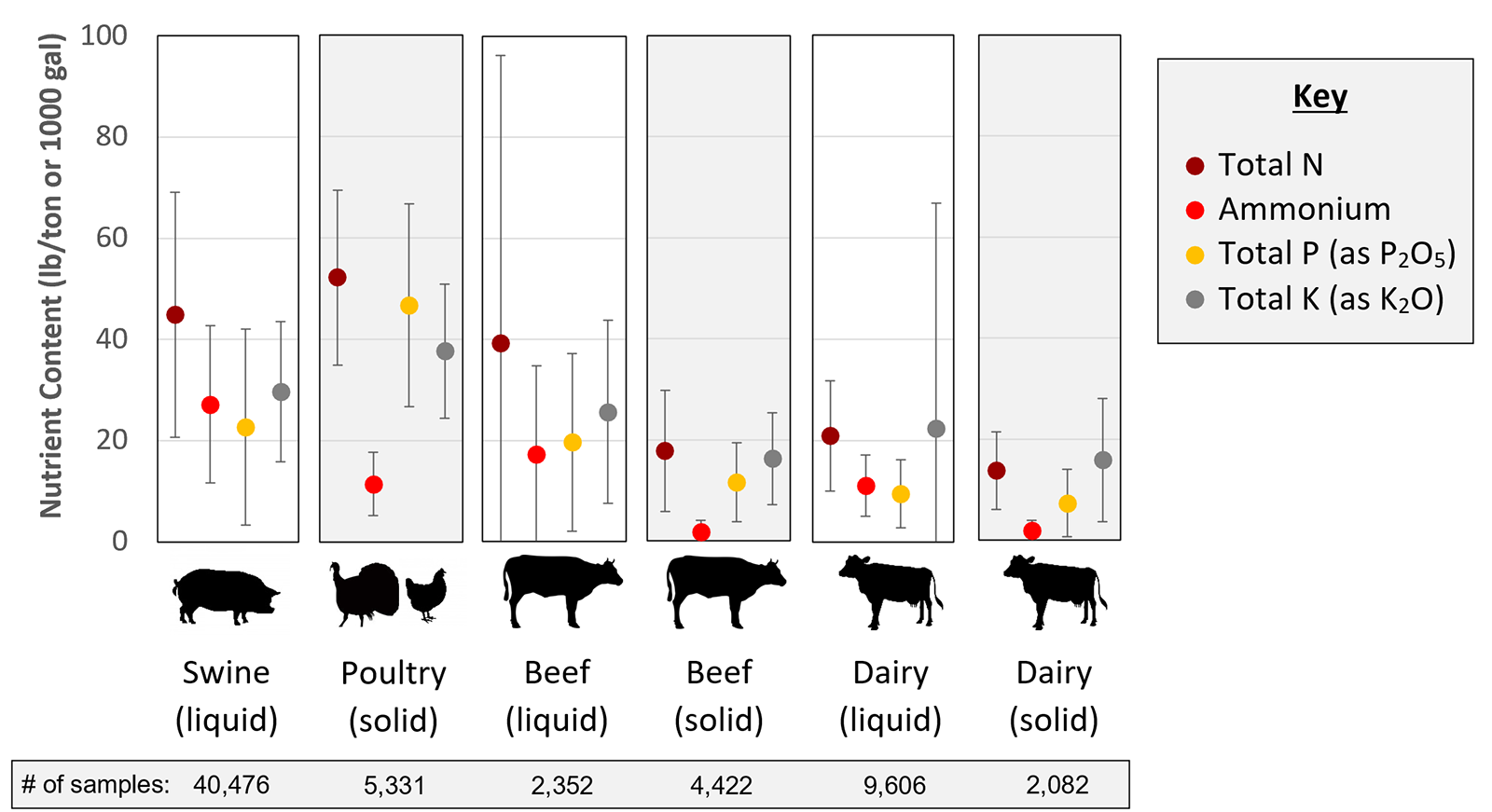
Solid raw manure is not necessarily a consistent product. Nutrient content can vary widely (Nutrient Characteristics of Solid Beef Manure in North Dakota) depending on animal species and digestive system (ruminant, monogastric, or hindgut fermenter), diet changes, and physiological stage—for example, a maintenance horse versus a gestating cow. This natural variability makes it even more important to pay attention to the nutrient content of manure (Solid Manure Sampling for Nutrient Management Planning) and how manure is applied in the field.
Application method and equipment setup also influence how evenly nutrients are delivered. Manure spreaders are calibrated to ensure a consistent amount of manure is applied across a field. Without calibration, it’s easy to over- or under-apply nutrients. Over-application increases environmental risk and wastes nutrients that could have been used elsewhere. Under-application can lead to yield reductions and nutrient deficiencies. In both cases, uneven application reduces nutrient use efficiency and profitability.
Calibrating a manure spreader helps applicators determine application rate, identify effective swath width, and improve overall uniformity of manure distribution. Most solid manure spreaders apply manure in a triangular pattern, with the highest application rate near the spreader path and decreasing farther away. Narrowing the distance between passes often results in a more uniform application across the field.
Uneven spread patterns are often linked to equipment or operational issues, including:
- debris caught in beaters
- broken floor chains
- damaged spinners
- incorrect PTO speed
- inconsistent ground speed
- improper lane spacing
Regular inspection and equipment maintenance can address many of these issues before manure is applied.
Long story short…Manure spreader calibration reduces the potential for nutrient losses that can affect surface and groundwater quality. It also improves nutrient use efficiency and helps maximize the value of manure as a crop input. Taking time to calibrate equipment is a practical step that benefits both the operation and the environment.
Mary Keena
Mary.Keena@ndsu.edu
Extension Livestock Environmental Management Specialist
