

End of season weed management
Howdy! I hope you all stay safe during the upcoming harvest season. Let’s focus on two related weed topics, perimeter weed management and fall weed management.
Perimeter Weed Management
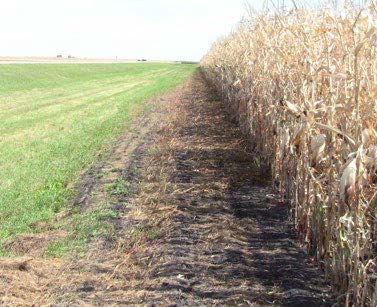
Please take time now to mow all weeds close to standing crops, along the outside field margin (as seen in the photo), to ensure weeds don’t enter the combine. Mow interior field areas that aren’t supporting crops, too, to reduce the number of viable weed seeds that enter your combine. The goal is to stop the spread of weeds within your fields. Even consider mowing the crop inside the field margins when there are more weeds than crop plants.
Unless an even flat fan nozzle was placed on the outside end of your spray boom, a reduced rate of herbicide was applied to the weeds on the outside field perimeter. Reduced rates of herbicide obviously select weeds having herbicide resistance.
When resistant weeds are moved farther into the field by the combine, you allow more resistant weeds in your field, and when resistant weeds produce seed they creep farther into the field each time the same herbicides are applied. Stop the spread!
Fall Weed Management
All cool-season perennial, biennial, and winter annual weeds (those surviving freezing temperatures) are best controlled with a fall herbicide application after a freeze or after mid-October, which ever comes first. Preferably after a freeze, but the current forecast looks like it will not freeze again until mid-October, and we all know the weather could get too cold to spray as we approach November.
Some cool-season perennials, particularly Canada thistle, absinth wormwood, perennial sowthistle, dandelion, and foxtail barley, are best controlled with fall herbicide applications.
- For Canada thistle and foxtail barley, it is best to apply glyphosate alone as other herbicides may antagonize glyphosate. The minimum glyphosate rate applied to Canada thistle and foxtail barley and absinth wormwood should be 1.125 and 1.5 pounds acid equivalent per acre, respectively. If 2,4-D, dicamba, or Valor are applied with glyphosate, the glyphosate rate for Canada thistle and foxtail barley should be increased by 0.5 pound acid equivalent per acre due to antagonism.
- For best dandelion control apply a combination of glyphosate at 1.125 pounds acid equivalent per acre plus 2,4-D ester at 0.75 pounds acid equivalent per acre.
- When applying glyphosate add spray grade ammonium sulfate at 17 pounds per 100 gallon of spray mixture plus a nonionic surfactant at 0.125 %v/v for full adjuvant loaded glyphosate formulations and 0.5 %v/v for partial adjuvant loaded glyphosate formulations.
- For best perennial weed control, plants must be at some minimum height such as 8 inches for Canada thistle, absinth wormwood, and perennial sowthistle and likely 6 inches for foxtail barley.
- To control winter annual weeds such as common chickweed, shepherd’s-purse, field pennycress, and fairy candelabra, apply glyphosate at 1.0 pound acid equivalent per acre.
- To control horseweed (marestail), apply glyphosate at 1.125 pounds acid equivalent per acre plus 2,4-D ester at 0.75 pounds acid equivalent per acre.
- In fields having dense populations of wild oat resistant to Groups 1 and 2 herbicides being planted in 2026 to chick peas or lentils (only 3.25 fluid ounces per acre), non-GMO soybean, and hard red spring wheat, apply Zidua at 4.0 fluid ounces per acre in the fall after soil temperatures consistently stay below 50 degrees F, but prior to frozen soils. This will provide the best early season wild oat control and assist in reducing early season kochia populations. However, applying this rate of Zidua in the fall will preclude the use of Zidua in the spring to control Groups 1 and 2 resistant green foxtail, later emerging kochia, and waterhemp in these crops.
- For fields having dense kochia populations and a few other weed species, apply Valor at 4.0 fluid ounces per acre, and if wild oat is present add Zidua at 4.0 fluid ounces per acre for the best early season wild oat and kochia control, as long as the kochia population is not resistant to Valor. Even for Valor, the soil temperature must consistently stay below 50 degrees F.
When determining which herbicide or herbicides to apply to a field in the fall, target the weed spec(ies) most prevalent and/or most difficult to control. Patience is a virtue when applying fall herbicides due to what is needed for the targeted species.
Please reach out to me to discuss the particulars of your situation.
Jeff Stachler, Ph. D., CCA
Jeff.Stachler@ndsu.edu
Extension Cropping Systems Specialist
