

Field pea variety selection as a tool for Aphanomyces root rot management
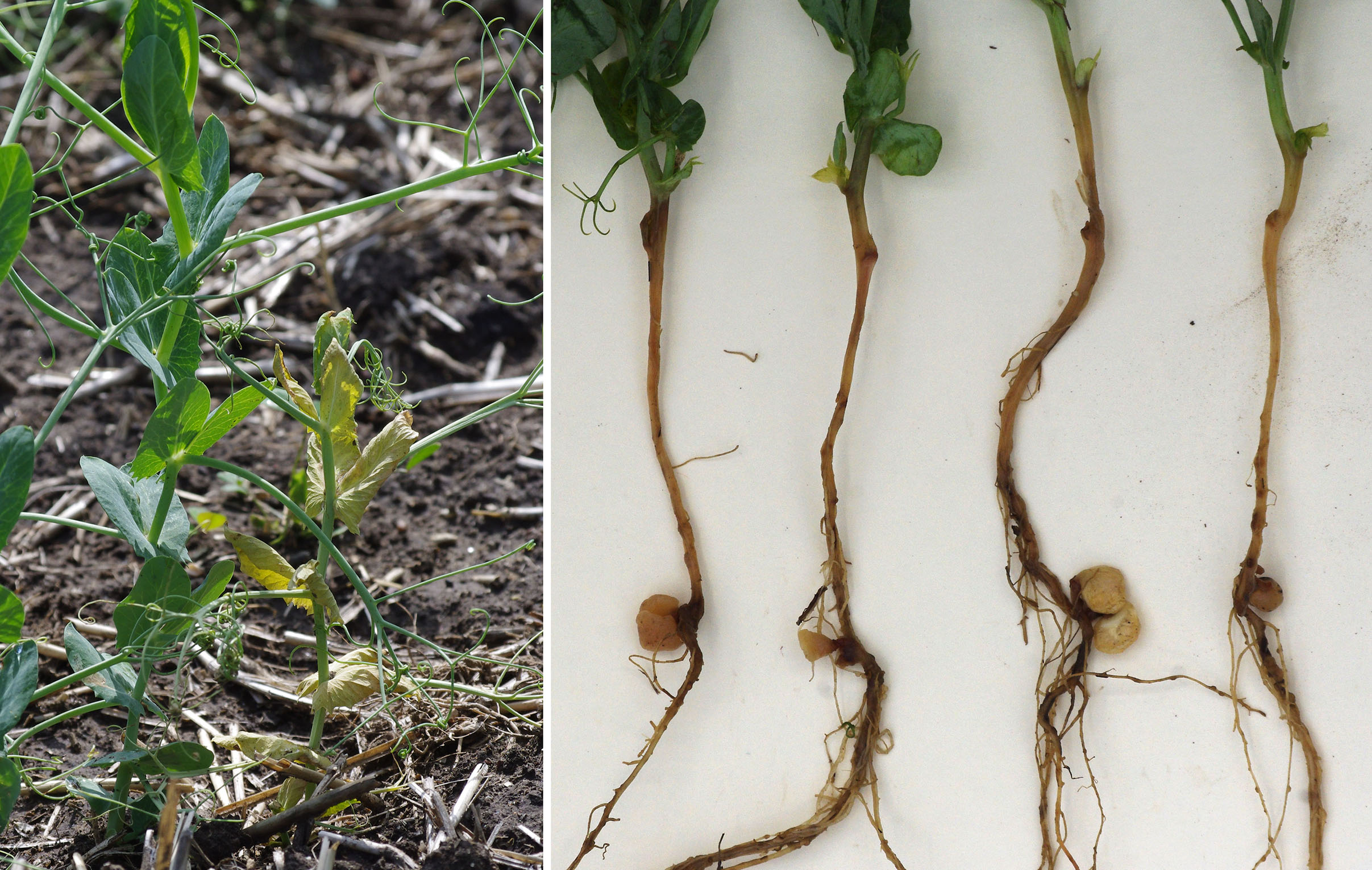
Aphanomyces root rot is a soil-borne disease of field peas that causes sharp reductions in field pea vigor, causes premature plant mortality, and results in severe yield losses, and the management tools recommended for Aphanomyces root rot – extended crop rotation and planting early into cool soils (Aphanomyces root rot is favored by warm soils) – only provide partial disease management. Even with the combined use of extended crop rotation and early planting, severe losses to Aphanomyces root rot are often observed.
Recent findings by the plant pathology research program at the Carrington Research Extension Center indicate that Aphanomyces root rot management can be sharply improved with field pea variety selection. Field pea varieties have long been known to exhibit some degree of differences in their ability to tolerate Aphanomyces root rot, but these differences were assumed to be sufficiently small as to be insignificant for commercial production. Unlike disease resistance, disease tolerance is not associated with reduced disease severity. Disease-tolerant varieties exhibit similar disease severity as less-tolerant varieties but exhibit some degree of higher vigor and yield under disease pressure.
Research findings from field trials conducted in 2023, 2024 and 2025 conducted by the Carrington Research Extension Center in Carrington (all three years) and at on-farm locations (2025) indicate that commercial field pea varieties exhibit much greater differences in tolerance to Aphanomyces than previously believed.
Across multi-location field studies conducted by the Carrington Research Extension Center under elevated Aphanomyces pressure, field pea varieties can be described as exhibiting four different levels of tolerance to Aphanomyces:
- Strong tolerance: varieties that have performed well under severe Aphanomyces pressure even when planting was delayed beyond optimal soil temperatures and that consistently exhibited high yields under Aphanomyces pressure irrespective of environment. Across field studies conducted in 2025, one variety (out of 13 evaluated in multi-location studies) was identified that fit this category.
- Above-average tolerance: varieties that have exhibited high yields under severe Aphanomyces pressure when planted into cool soils in certain environments. These varieties had to carry other agronomic traits that were well-suited for that environment in order to perform well. Across field studies conducted in 2025, three varieties (out of 13 evaluated) were identified that fit this category.
- Average tolerance: varieties that have exhibited high yields under moderate Aphanomyces pressure when planted in conjunction with other Aphanomyces management tools (crop rotation, planting to cool soils) and if the variety carried other agronomic traits that are well-suited for that environment. Across field studies conducted in 2025, one variety was identified that fit this category.
- Poor tolerance: varieties that have consistently exhibited low to very low yields under Aphanomyces pressure irrespective of environment, soil temperatures at planting, and crop rotation interval. Across field studies conducted in 2025, three varieties were identified that fit this category.
In field trials conducted in Carrington and at on-farm locations, the combined use of field pea variety selection and planting into cool soils (average 42-50°F at seeding depth in the first 7 days after planting) consistently facilitated strong field pea yields and agronomic performance under Aphanomyces root rot pressure. Extended crop rotation intervals provided additional latitude on variety selection, but even when crop rotation intervals were tight, acceptable field pea yields were observed with appropriate variety selection. Research was done with traditional small-plot studies (10 ft x 30 ft plots) and with large-plot studies (35 ft x 150 ft plots). Consistent results were observed irrespective of plot sizes.
Follow-up research in Carrington and at on-farm sites is planned for 2026 to confirm these results and to screen additional field pea varieties for tolerance to Aphanomyces. A research update with results from the 2025 field season will be posted to the NDSU Carrington Research Extension Center website in mid- to late March.
Michael Wunsch. Ph. D.
Michael.Wunsch@ndsu.edu
Plant Pathologist
