

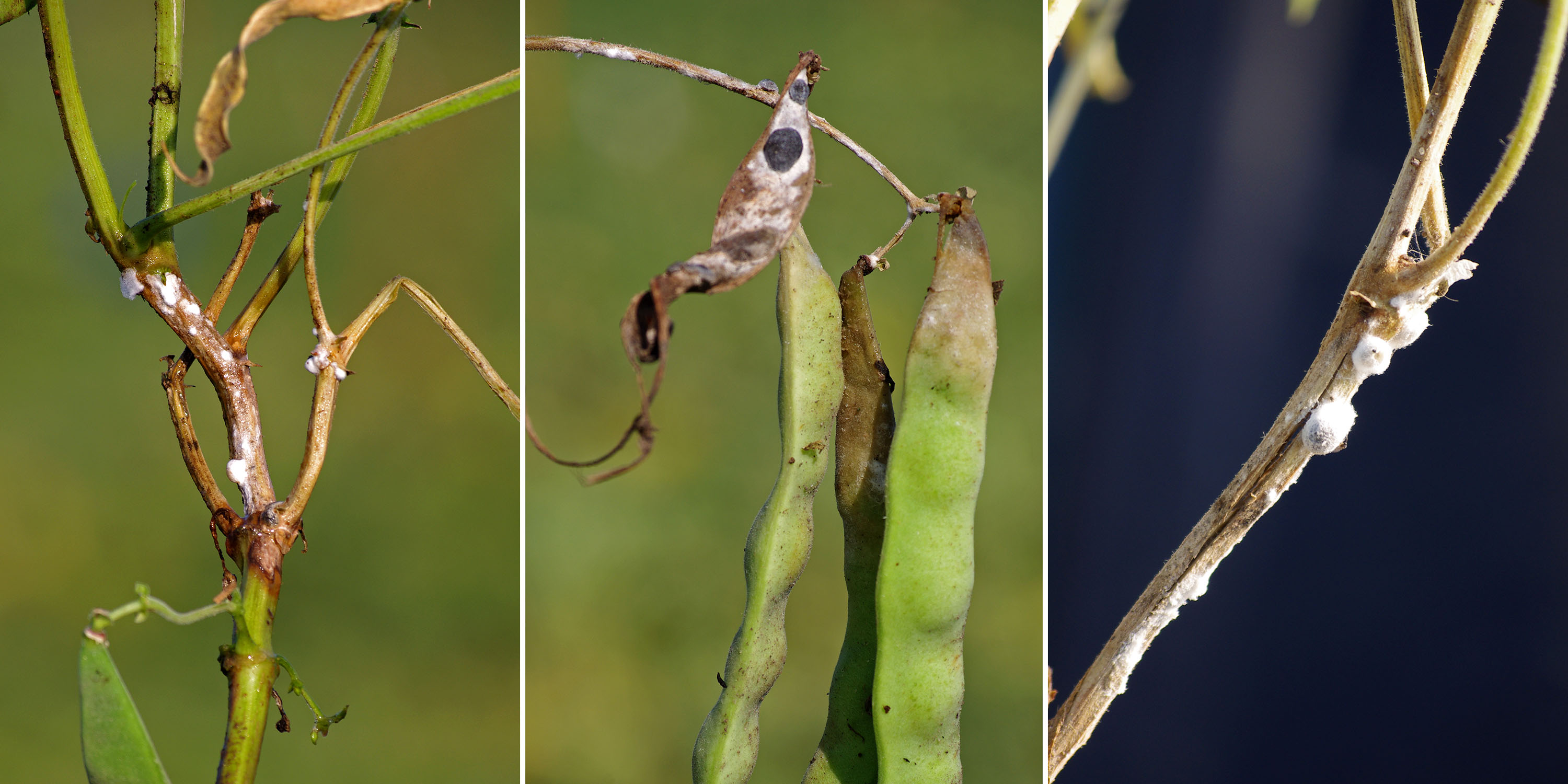
Optimizing fungicide application timing for improved management of white mold in dry beans
When conditions favor white mold as dry beans enter bloom, multi-year fungicide application timing research conducted in Carrington and Oakes, ND indicates that fungicide applications targeting white mold should be made on the basis of the percent of plants with initial pin-shaped pods.
- PINTO BEANS: When conditions favored white mold as pinto beans entered bloom, fungicide efficacy was optimized with (1) a single application made at 60-80% of plants with initial pin-pods irrespective of canopy closure or (2) the first application of a two-application sequence at 10-20% of plants with initial pods if canopy was closed 50-80% of plants with initial pods if canopy was open.
- BLACK BEANS: When conditions favored white mold as black beans entered bloom, a single fungicide application only provided satisfactory white mold management in 1 of 6 studies. In that study, applying at 90-100% of plants with pin-pods was optimal. A two-application fungicide program was optimized in black beans by applying the first application at 1-30% of plants with initial pods.
- NAVY BEANS: When conditions favored white mold as navy beans entered bloom, a single fungicide application only provided satisfactory white mold management in 3 of 6 studies. In those studies, applying at 65-95% of plants with pin-pods was optimal. A two-application fungicide program was optimized in navy beans by applying the first application at 3-20% or 20-50% of plants with initial pods, depending on daytime high temperatures.
- KIDNEY BEANS: When conditions favored white mold as pinto beans entered bloom, fungicide efficacy was optimized with (1) a single application made at approx. 80% of plants with initial pin-pods irrespective of canopy closure or (2) the first application of a two-application sequence at approx. 20% of plants with initial pods.
When applying a single or two sequential fungicide applications targeting white mold, a sharp penalty was observed to applying fungicides too early or too late. Applying too early confers a sharp penalty because dry beans grow vigorously during early bloom, and new growth is not protected by the fungicide. Applying too late confers a sharp penalty because fungicides confer a maximum of 0 to 24 hours of curative activity, depending on the fungicide, with any curative activity limited to the initial 24 hours of microscopic growth of the fungus within the plant (not visible to the human eye).
Unfavorable weather conditions or variability in dry bean development across a field can make it difficult to apply fungicides at the optimal growth stage for white mold. Preliminary findings from the 2024 season suggest that a three-application fungicide program targeting white mold may sharply improve white mold management in dry beans while reducing the penalty to applying fungicides too early, thereby providing additional latitude to properly time fungicide applications. In pinto beans, three fungicide applications approximately 10 days apart optimized white mold management. In kidney beans, three fungicide applications 7 days apart optimized white mold management. Follow-up research optimizing fungicide timing relative the number of applications and the interval between applications in dry beans is in progress in 2025.
Data and accompanying explanatory YouTube videos summarizing results from the dry bean white mold management research conducted by the NDSU Carrington Research Extension Center are available online at https://www.ndsu.edu/agriculture/ag-hub/research-extension-centers-recs/carrington-rec/research/plant-pathology or by searching online for ‘NDSU Carrington plant pathology’.
Michael Wunsch, Ph. D.
Michael.Wunsch@ndsu.edu
Research Plant Pathologist
