

Potential Impacts of a Russia-Ukraine Conflict on Grain Prices
By Frayne Olson, NDSU Extension crop economist/marketing specialist for Agriculture By the Numbers, February 2022
Growing political tensions between the Russian Federation, Ukraine and the North Atlantic Treaty Organization (NATO) are raising concerns for global agricultural and energy markets.
Russia is the world’s largest natural gas and wheat exporter, second-largest crude oil and sunflower exporter, and third-largest barley exporter. Ukraine is the world’s largest sunflower exporter, second-largest barley, third-largest wheat and fourth-largest corn exporter. The greatest concern is that increased political pressure will lead to military action resulting in supply chain disruptions or economic sanctions.
No one can predict the future or anticipate all the potential implications of the escalating situation. However, it is important to understand the structure of Russian and Ukrainian grain exports, and how shifting conditions might impact grain flows and prices.
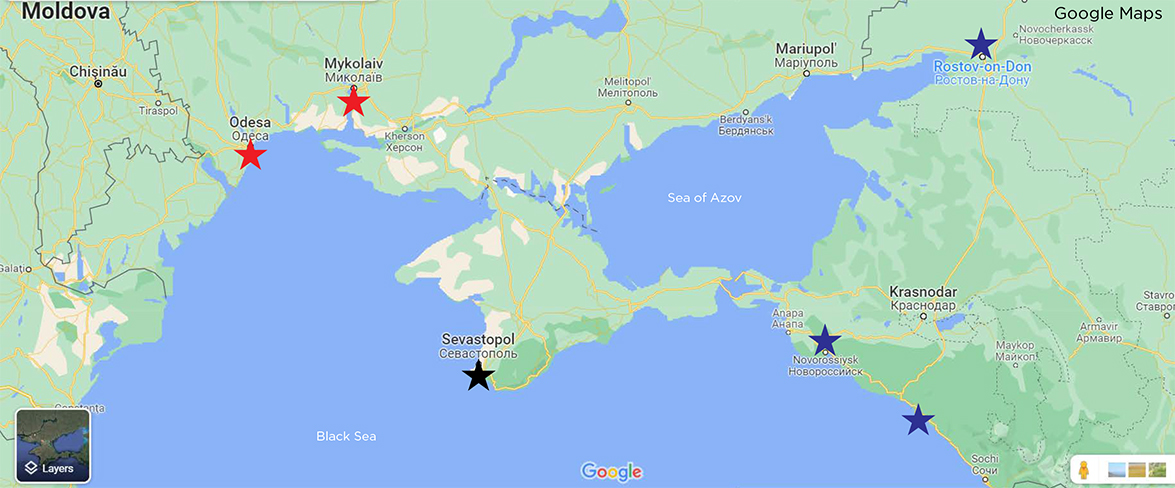
Figure 1 shows the major Ukrainian and Russian grain export locations in the Black Sea region. The two Ukrainian export locations are Odesa and Mykolaiv, identified with red stars. The Russian locations of Novorossiysk, Rostov-on-Don and Tuapse are identified by blue stars.
Figure 1 – Major grain export locations in Ukraine and Russia
Wheat is a major export for both Russia and Ukraine. While both countries produce a range of wheat classes, the majority of their exports would be classified as hard red winter wheat using the U.S. grading system. The five largest wheat buyers from Russia are Egypt, Turkey, Bangladesh, Azerbaijan and Sudan, listed from highest to lowest. The five largest wheat buyers from Ukraine are Egypt, Indonesia, Bangladesh, Pakistan and Turkey. While the specific transportation systems for these exports could not be determined, it is likely the majority of Russian and Ukrainian wheat is shipped by ocean vessels through the Black Sea.
The Sevastopol Naval Base, labeled with a black star in Figure 1, is the site of the Russian Black Sea Fleet and is located in the disputed Crimean Peninsula. In addition, the Strait of Istanbul, or Bosporus, Turkey, is currently the only way ships can move between the Black Sea and the Mediterranean Sea to reach most export destinations.
If there are economic sanctions imposed on Russia or Ukraine, it is likely that grain flows from the Black Sea region will continue. The unknown is whether the trade volumes will be impacted. However, if military actions occur, there is a high probability that grain flows using ocean vessels will be significantly reduced or halted. The location of the Sevastopol Naval Base and the ability to blockade the Strait of Istanbul makes it easy to restrict or halt commercial ship movements.
A similar situation exists for Ukraine’s corn exports. The top five buyers of Ukrainian corn are China, Netherlands, Egypt, Spain and Turkey, listed from highest to lowest. While some of these corn exports might be delivered by railroad, the cost would be significantly higher than by ocean vessel. If economic sanctions are imposed, corn shipments could continue, but if military actions occur shipments will likely be significantly impacted.
Any interference with wheat or corn shipments from Ukraine or Russia will increase global corn and wheat prices. The amount of the price increase will be heavily impacted by the level of trade disruptions and the length of those disruptions. The more the trade flows are limited and the longer these limitations are in place, the more global prices will increase.
It is also unclear whether limited Black Sea wheat or corn shipments will increase U.S. wheat or corn export sales. Many of the countries buying wheat from Russia and Ukraine are very price-sensitive and may look to other wheat suppliers like the European Union, Australia or Argentina for lower-priced winter wheat. The U.S. may be able to increase corn exports because U.S. corn is typically very competitively priced with Brazilian and Argentine corn. Brazil and Argentina are the second and third largest corn exporters, respectively, behind the U.S., which is the largest global corn exporter.
If there are economic sanctions or military actions resulting from the Russia, Ukraine and NATO tensions, there is a high probability crude oil and natural gas prices will increase. We have already seen a risk premium entering the global crude oil and natural gas markets. This could lead to higher U.S. gasoline, diesel fuel, natural gas and fertilizer prices, especially if trade disruptions last many months. Higher energy prices could increase U.S. inflation rates and likely increase the cost of production for farmers and ranchers.
As noted at the beginning of this article, no one can predict the future. However, understanding the potential implications of escalating political tensions in the Black Sea can help farm and ranch managers adjust to the changing economic conditions more rapidly
