

Production Costs are Pressing Issues in 2022
By Bryon Parman, NDSU Extension agricultural finance specialist for Agriculture By the Numbers, February 2022
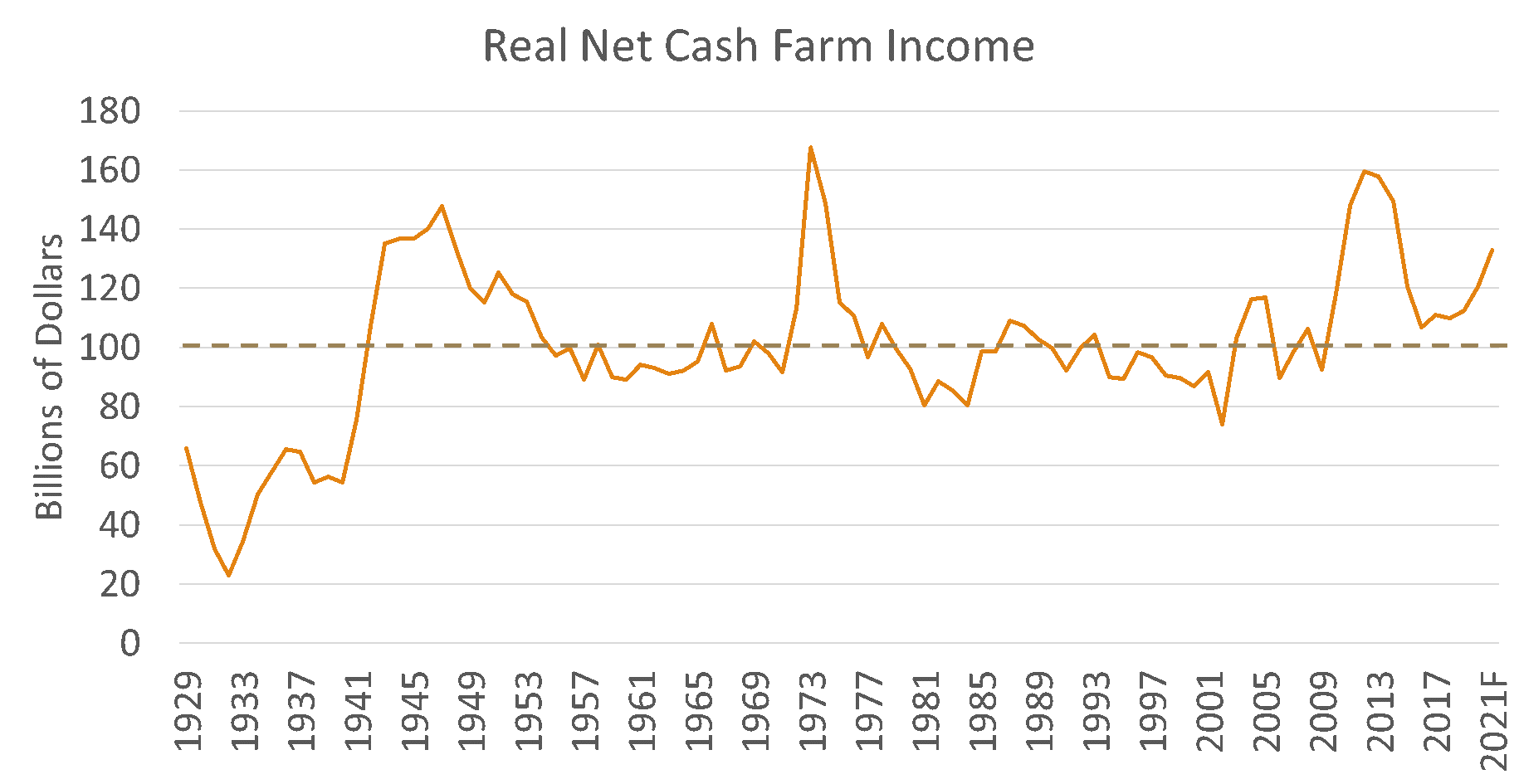
The U.S. Department of Agriculture (USDA) is projecting that the inflation-adjusted “real” net cash farm income for 2021 will be the highest in nearly seven years (Figure 1) and well above the long-run average. Though the data for 2021 will not be made official for a few months, it appears that the income projections for the first time in several years were strong due to higher commodity prices and adequate yields.
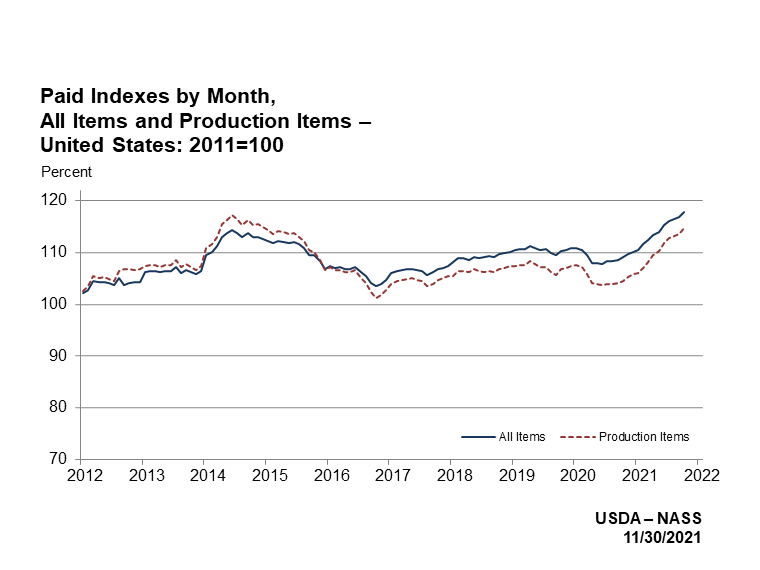
However, while yields and commodity prices are always of concern to farmers, this year’s pressing issue is production costs. Prices for most major crops and livestock prices remain strong. Dealing with the uncertainty of weather is a reality every year, but farmers may be facing record high costs to produce most major crops. Figure 2 shows the farmer price index from the USDA through November of 2021.
As of now, the index for all items will be the highest on record, tightening margins for 2022. One of the biggest drivers of the rise in overall production costs are fertilizer prices. As of the time of this writing, the national average price for anhydrous ammonia was $1,492 per ton with urea averaging $910 per ton, potash averaging $814, with monoammonium phosphate (MAP) and diammonium phosphate DAP averaging $936 and $877 per ton, respectively. For nitrogen fertilizers and potash prices have increased more than 100% compared to a year ago while phosphorus prices (MAP and DAP) are closer to 80% higher than a year ago.
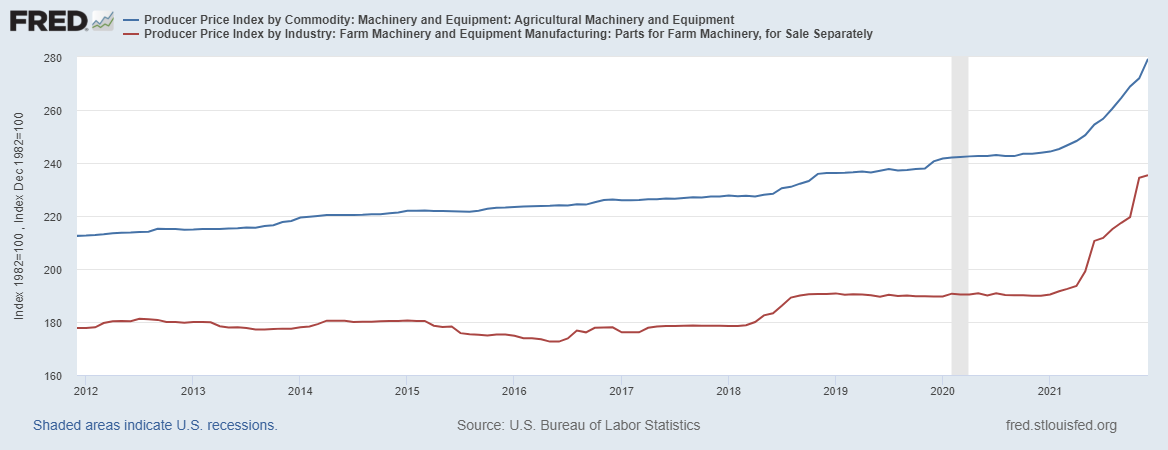
Equipment prices also are higher for both new and used equipment as well as repair parts. Figure 3 from the St. Louis Federal Reserve shows the farmer price index for new farm machinery as well as parts sold separately. The index for both has increased remarkably from a year ago putting further pressure on the cost of production. Additionally, there have been many reports of parts shortages and backorders for key components such that new equipment buyers are on waiting lists for many months for some self-propelled equipment items.
The high costs are not only of concern to farmers, but also retailers selling those products. Agribusiness retailers are put in a tough spot with fertilizer prices at record highs across the country. Retailers want to ensure that they have purchased enough to fill spring planting needs for their customers for the coming season. However, with the high costs wholesale, they run the risk of purchasing high priced fertilizer, and if prices fall, selling it at a loss. As high as prices are right now, even a 5% decline would lead to a large nominal loss per ton which could be financially costly and possibly catastrophic for local retailers. Farmers do have some opportunity to protect themselves to a degree by contracting some of 2022’s crop locking in prices while they remain elevated. This ensures that famers do not pay high production costs in the spring with the possibility of falling commodity prices in the fall. Additionally, soil testing this year will be important making sure no more fertilizer is applied than necessary.
