

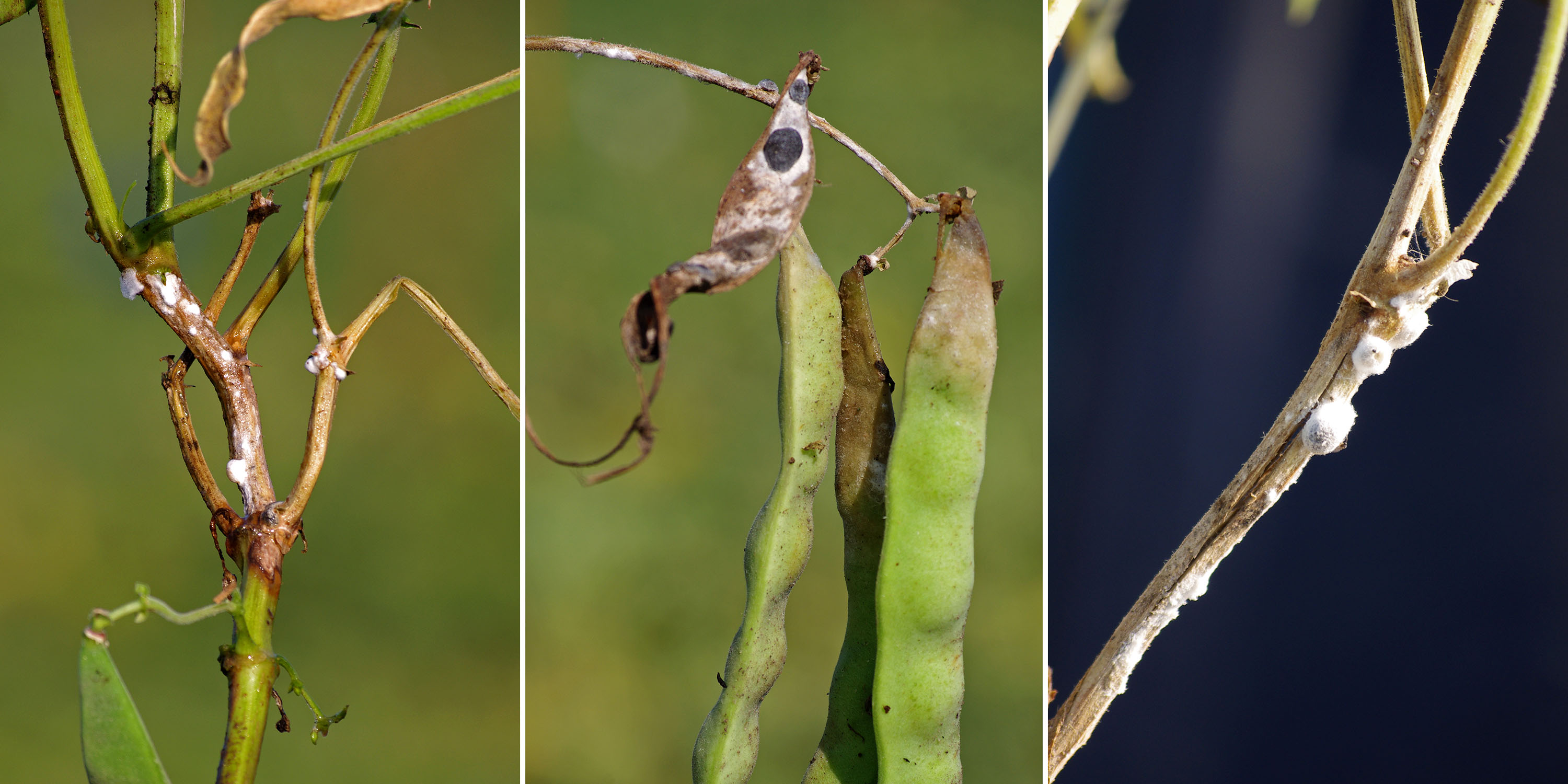
Updated recommendations for optimizing fungicide application timing for white mold in pinto beans
Recent findings from large tractor-applied field studies testing fungicide application timing, interval and frequency for white mold management in pinto and kidney beans have provided new insights on improving white mold management in dry beans.
- When conditions favor white mold as dry beans enter bloom, the optimal application timing of fungicides targeting white mold changes with the number of applications being made. In research studies conducted utilizing supplemental irrigation to create conditions favoring white mold as dry beans enter bloom, white mold management in pinto and kidney beans was optimized with a single fungicide application by delaying the application until 70-100% of plants had initial pin-pods. Two-application fungicide programs were optimized by applying the first application a few days earlier: 20-40% of plants with initial pin-pods in kidney beans, 10-20% of plants with initial pods in pinto beans with a closed canopy (which increases disease risk), and 40-85% of plants had initial pin-pods in pinto beans with an open canopy. Three-application fungicide programs were optimized by applying the first application at early bloom when 0-5% of plants had initial pin-pods. An explanation of why the application timing changes with the number of applications is provided below.
- The optimal application interval (number of days between applications) changes with the number of applications being made, severity of white mold pressure, and maturity length of the dry bean variety. In pinto beans, three-application fungicide programs were optimized when applications were made approximately 7 or 10 days apart, and two-application fungicide programs were optimized when applications were made approximately 10 or 12 days apart, depending on white mold risk. The tighter application interval was optimal when white mold risk was highest. In kidney beans, three-application fungicide programs were consistently optimized when applications were made approximately 7 days apart, and two-application fungicide programs were optimized when applications were made approximately 7 or 10 days apart, depending on white mold risk. Just as in pinto beans, the tighter application interval was optimal was white mold risk was highest.
- White mold management (disease control, yield) improves as the number of fungicide applications increases. Realizing the full gain from an additional fungicide application requires adjustments in application timing and application interval. Three-application fungicide programs were most effective when the first application was made at initial bloom and 0-5% of plants had initial pin-pods and when the interval between applications was tight (7 days in kidney beans; 7-10 days, depending on disease risk, in pinto beans).
- Rotating fungicide chemistries in two- and three-application fungicide programs improves white mold management. When including Topsin/generic or ProPulse in a fungicide program targeting white mold, field testing conducted on pinto and kidney beans in 2025 and prior testing suggests that the efficacy of Topsin is sharply increased as the application rate increases from 30 to 40 fl oz/ac and that ProPulse is most effective when it is applied first (and other products applied second and/or third) in a fungicide rotation program.
Fungicide applications only protect the canopy that is present at the time of the application. Fungicides applied to foliar tissues do not translocate into new growth and do not protect the new growth that occurs after the fungicide is applied. Most fungicides have ability to cure existing infections, and those with some degree of curative activity can generally only stop an infection within 24 hours of the pathogen penetrating the plant (when infections are at a microscopic level and disease is not yet present).
If you are making a single fungicide application, there is a tradeoff: Do you protect against a few early infections or do you delay the application such that more of the canopy is protected as the dry beans enter full bloom? Susceptibility to white mold is highest at full bloom. The data from our field studies show that the yield loss conferred by allowing some early infections is lower than the yield loss associated with leaving a significant proportion of the canopy unprotected (due to new growth) as the dry beans enter full bloom.
When you are making two fungicide applications, the second fungicide application will protect new growth, which means that now you can afford to protect the crop against early white mold infections. However, applying too early still carries a penalty for the same reason: The new growth that occurs between the first and second applications is unprotected until the second application is made.
With a three-application program, fungicide applications #2 and #3 protect the new growth, and our data show that the fungicide program is optimized by applying the first fungicide at early bloom just as the plants first become susceptible to white mold (<5% of plants with initial pin-pods). In a three-application program, you can afford to protect against the earliest infections because you are making subsequent applications on a relatively tight interval to protect the new growth.
When conditions do not favor white mold until full bloom or early pod-fill, applications should be delayed until conditions favor white mold. Foliar fungicide applications only protect the canopy to which they are applied, not the new growth, and applying fungicides before there is any significant risk of pathogen infection will result in a significant portion of the canopy being unprotected when conditions become favorable for disease.
Neither ND Agricultural Experiment Station nor NDSU Extension endorse commercial products or companies even though references may be made to brand names, trademarks or service names.
Michael Wunsch, Ph. D.
Michael.Wunsch@ndsu.edu
Research Plant Pathologist
