2025: Evaluation of Seed Treatments to Manage Purple Stem Caused by Root Rot Complex of Canola in Field Conditions
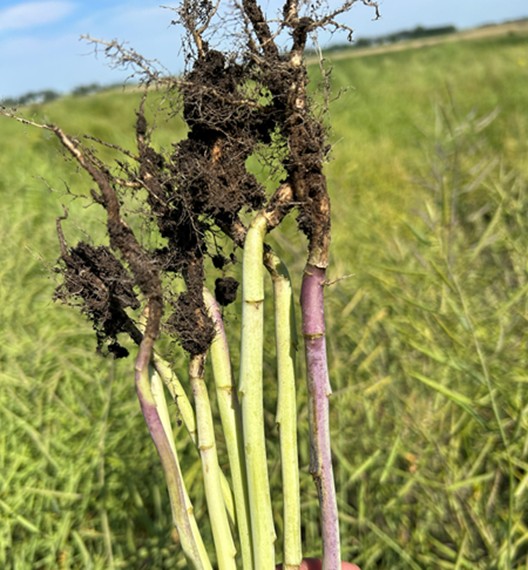
(Research Report, Langdon REC, December 2025)Purple Stem: Purpling in canola, commonly regarded as a clear indicator of phosphorus deficiency, actually reflects a complex response to multiple stresses, particularly those caused by nutrient imbalances (e.g., sulfur or boron deficiency), herbicide carryover injury, or root rot pathogens. In affected areas, chlorophyll production is inhibited, which reveals the underlying purple pigment. Plants frequently exhibit constriction at the soil surface, with stems appearing scabbed due to damage. In some cases, purple plants are severed near the soil surface, leaving only the stems protruding. Recently, the adoption of shorter canola cropping rotations in North Dakota has increased both the intensity and incidence of purpling.
Objective: This study aims to evaluate the effectiveness of seed treatments and soil amendments in managing purple stem disease in canola caused by fungal pathogens.
Methodology: A research trial was conducted at the Langdon Research Extension Center to evaluate the effectiveness of seed treatments for managing root-rot and soil-borne disease complexes in canola. The trial was planted on May 29, 2025, with most seed treatments (Table 1) applied to the canola cultivar ‘InVigor L233P’ one week prior to planting. Beet lime was incorporated immediately prior to planting, and boron was administered as a foliar spray at the 4-leaf stage. Efficacy was determined by comparing treated seeds with non-treated controls. A randomized complete block design with four replications was used to ensure experimental rigor. The trial adhered to state-recommended protocols for land preparation, fertilization, seeding rate, and weed and insect management. Each plot measured 5 feet in width and 16 feet in length. Incidence and severity of the root rot complex were recorded 15 days after planting. To evaluate late infections of soil-borne diseases, twenty-five canola stubbles per plot were rated on a 0-100 scale after swathing on August 5. Data were analyzed using analysis of variance with complete block, balanced orthogonal designs generated by Genovix version II software.
Results: In our trial, purpling (purple discoloration on stems, see Figure 1) was observed due to the presence of major pathogens, including Fusarium spp. (the fungus responsible for root rot) and the second by Verticillium longisporum (a fungus that causes Verticillium stripe disease), as confirmed by morphological observations during the late infection stage. The evaluated seed treatments had no significant differences in managing purple stem incidence. Likewise, no significant differences were detected in plant stand, vigor, yield, or test weight between the treatments and the non-treated check (Table 1). The treatments Rancona summit, followed by Boron foliar treatment, produced the highest yield, while Intego Solo exhibited the lowest.
Table 1: Effects of fungicide seed treatments on purple stem incidence, plant stand, plant vigor, yield, and test weight.
Purple Stem | Yield | Test Weight | |||
|---|---|---|---|---|---|
| Treatments | % Incidence | Plant Stand/A | Plant Vigor | (lbs/A) | (lbs/bu) |
| Trifloxystrobin | 15 | 144,827 | 9 | 2217 | 51 |
| Saltro | 15 | 163,184 | 8 | 2176 | 52 |
| Boron | 12 | 143,183 | 8 | 2318 | 52 |
| Evergol Energy | 11 | 151,829 | 8 | 2197 | 52 |
| Myclobutalinil | 21 | 149,541 | 8 | 2258 | 51 |
| Trunemco | 13 | 126,766 | 8 | 2261 | 52 |
| Ilevo | 19 | 123,453 | 8 | 2228 | 51 |
| Intego Solo | 13 | 131,949 | 8 | 2156 | 52 |
| Rancona summit | 18 | 138,425 | 8 | 2324 | 51 |
| Beet lime | 18 | 139,927 | 8 | 2206 | 51 |
| Non-Treated | 20 | 146,076 | 8 | 2199 | 51 |
Mean | 16 | 141,742 | 8 | 2231 | 51 |
CV % | 53 | 12 | 12 | 7 | 1 |
LSD | NS | NS | NS | NS | NS |
P-Value (0.05) | NS | NS | NS | NS | NS |
NS: Non-significant differences were observed at P-Value < 0.05.
Figure 1: Incidence of purple stem in the research trial at the Langdon Research Extension Center