

2025: What is the Worth of an Inch of Topsoil
(Research Report, Langdon REC, December 2025)Topsoil, also known as the A-horizon, is the most fertile and biologically active layer of the soil. This is the layer where farmers plant seeds, and it supports the crops that feed the world. Soils are typically composed of layers, known as horizons. O-horizon is the layer that has undecomposed organic material; mostly found in forest soils, A-horizon is known as topsoil and is rich in dark organic matter and nutrients, E-horizon is called the zone of leaching (rarely found in cultivated soils and mostly found in older well-developed soils of woodland) and is lighter in color compared to A-horizon, B-horizon is the subsoil layer that is very light in color and has low fertility and microbial activity compared to A-horizon, C-horizon (parent material) is the transitioning layer between B and C-horizons and R-horizon is the bedrock that releases material to the C-horizon after weathering (Figure 1). It is important to note that not all soils contain all these layers. Depending upon the location and soil type, a typically cultivated agriculture soil most probably will have A, B, C and R horizons.
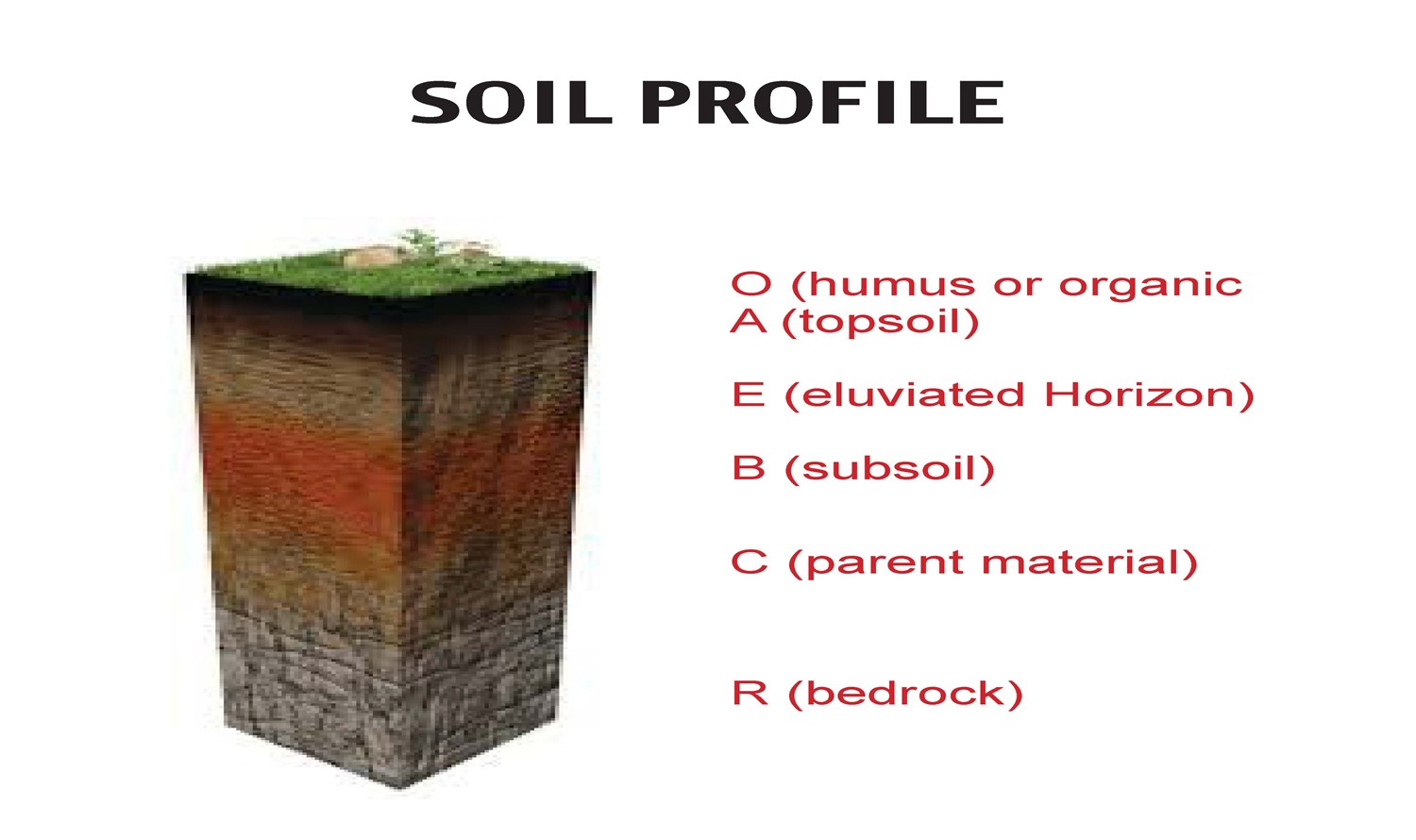
Figure 1. A soil profile showing typical soil layers or horizons that may or may not be present in all soils.
Topsoil is the most valuable soil layer, and it must be protected from erosion. Soil erosion (loss of soil material and nutrients) can happen due to the actions of wind, water, and tillage operations. Tillage can not only cause erosion, but it can enhance the extent of wind and water related erosion as it loosens the soil. Soil erosion not only occurs during the growing-season (Figure 2 and 3) but it can also happen in the winter (Figure 4).
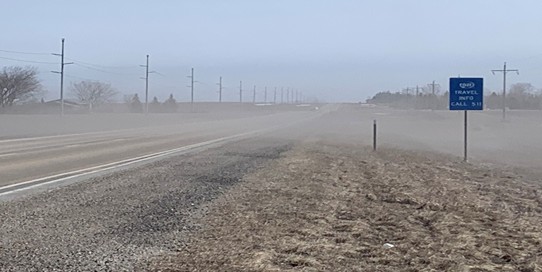
Figure 2. Topsoil blowing a mile east of Langdon along Highway-5, ND on March 25, 2024.
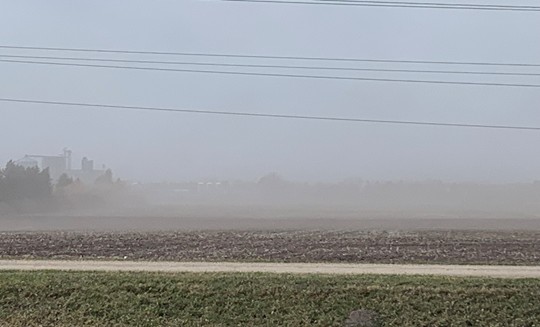
Figure 3. Topsoil blowing a mile and a quarter southeast of Langdon on April 25, 2024.
When topsoil remains on agricultural land, it supports optimal crop and forage production. However, erosion can cause topsoil to accumulate in roadside ditches, leading to water pollution for both humans and livestock consumption. This loss also results in additional costs for farmers, ranchers, and land owners, who must invest in nutrient replacement. This erosion is frequently observed in road-side ditches adjacent to fields tilled in the fall.
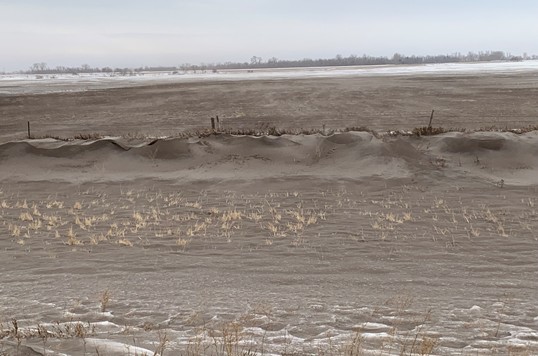
Figure 4. A roadside ditch full of topsoil from the adjoining field that was tilled in the fall. Picture taken on December 19, 2021 5-6 miles west of Grand Forks, ND along Highway-2.
This raises an important question: What is the value of losing an inch of topsoil based on replacing the lost crop nutrients and organic matter? Assigning a dollar value to the qualitative benefits of topsoil, such as microbial activity is very difficult. However, we can estimate the financial cost of replacing nutrients and organic matter lost through erosion using available data.
To study this issue, Grand Forks County Agriculture and Natural Resource (ANR) Extension agent Isaac Cuchna collected a 0–6-inch deep sample of eroded topsoil from a roadside ditch adjoining a tilled field in the winter of 2024-25 between Crookston, MN and Grand Forks, ND. This soil sample was sent to a Soil Testing Laboratory for comprehensive fertility analysis and results are presented in Table 1. Results of the sample collected from the lost topsoil showed appreciable quantities of essential plant nutrients and significant amounts of soil organic matter. It is particularly important to note that nutrients can be replaced by applying commercial fertilizers, but increasing or rebuilding soil organic matter may take a long time despite adopting best management practices.
The estimated cost to replace the nitrogen (NO3-N and NH4-N), phosphorus (P), potash (K), sulphate-sulfur and iron present in the lost six-inches of soil through commercial fertilizers, came to $2541.22 or $423.54 per inch of lost topsoil. Replacement options for other nutrients were not available from the local Langdon supplier.
Soil Properties and Units | Level of Soil Properties |
|---|---|
pH | 7.4 |
CEC (meq/100 g of soil) | 34.3 |
NO3-N (ppm) | 70 |
NH4-N (ppm) | 11.4 |
P (ppm) | 35 |
K (ppm) | 525 |
Ca (ppm) | 193.2 |
Mg (ppm) | 44.95 |
Sulfate-Sulfur (ppm) | 36.11 |
Chloride (ppm) | 84.78 |
Copper (ppm) | 1.8 |
Iron (ppm) | 11 |
Manganese (ppm) | 9 |
Organic Matter (%) | 5.7 |
Table 1: Soil analysis results of the 0-6-inch deep lost topsoil for key soil properties and levels.
For calculating the cost of soil organic matter for nutrient losses, a reference from the Building Soils for Better Crops, Ecological Management for Healthy Soils, Fourth Edition, SARE Handbook 10 by Fred Magdoff and Harold Van Es was used. According to this source, each one percent of soil organic matter contains 1000 pounds of nitrogen, 100 pounds of phosphorus, 100 pounds of potash and 100 pounds of sulfate-sulfur. Based on the 5.7% organic matter level of the lost 0-6-inch topsoil in the roadside ditch, it will cost $4141.73 to replace the lost referenced nutrients through commercial fertilizers. That will be $690.28 for every inch of topsoil. When combining the cost of direct nutrient loss and nutrient loss due to organic matter loss, the total replacement cost is $1113.82 for every inch of lost topsoil or $6682.95 for the 0-6-inch layer of lost topsoil (Table 2).
Nutrient Loss Type | For 0-6-inch Depth ($) | For Every Inch ($) |
|---|---|---|
Direct Nutrient Loss | 2541.22 | 423.53 |
Nutrient Loss due to losing Organic Matter | 4141.73 | 690.28 |
Total | 6682.95 | 1113.81 |
Table 2. The dollar amounts for replacing direct nutrient loss and by losing soil organic matter for 0-6-inch soil depth and for every inch of topsoil.
According to a long-term study by the NDSU Carrington Research Extension Center, consistent applications of livestock manure resulted in a one-percent increase in soil organic matter over 27 years. Since livestock manure is the best and quickest way to increase soil organic matter, it means that despite best management practices, it will take 153.9 years to replace the lost 5.7% soil organic matter. Based on the 2025 life expectancy of 77.6 years for an average North Dakotan, it will roughly take two lifetimes (1.98 exactly) to rebuild 5.7% organic matter.
