

Effects of Sprayer Travel Speed on Weed Control Applying Liberty Ultra
(Research Report, Carrington REC, December 2025)Field observations have been made in which kochia plants are dead on one side and not the other. The theory behind the lack of control is that sprayer travel speed is too fast. With partial funding from the North Dakota Soybean Council, a sprayer travel speed trial using a pulse width modulation sprayer was established in 2025 at the Carrington Research Extension Center (CREC).
Liberty Ultra has limited translocation in plants and when applied, it is best treated as a contact herbicide. Field observations have been made in which kochia plants are dead on one side and not the other. The theory behind the lack of control is that sprayer travel speed is too fast. With partial funding from the North Dakota Soybean Council, a sprayer travel speed trial using a pulse width modulation sprayer was established in 2025 at the Carrington Research Extension Center (CREC).
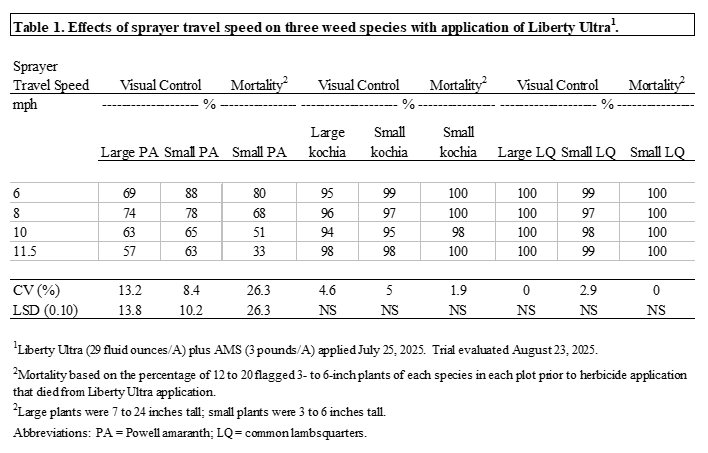
The sprayer travel speed trial was tilled May 28, 2025, and planted May 30, 2025, with an E3 soybean variety. Treatments included four sprayer travel speeds of 6, 8, 10, and 11.5 miles per hour. Plot size was 11 feet wide by 25 feet in length with treatments replicated five times. Due to seedbed and rainfall issues, few Powell amaranth, kochia, common lambsquarters, and annual grass species emerged initially, however, after significant rainfall, a second flush of Powell amaranth, kochia, and common lambsquarters emerged, but at a low density. Due to the low plant density, 12 to 20 individual plants of 3 to 6-inch kochia, common lambsquarters, and Powell amaranth were flagged prior to herbicide application to calculate plant mortality and separate the early emerging and taller (7 to 24 inches) plants from the later emerging (3 to 6 inch) plants allowing for more accurate visual control evaluations.
Liberty Ultra (29 fluid ounce per acre) plus ammonium sulfate (AMS) (3 pounds per acre) was applied July 24, 2025, at a spray volume of 20 gallons per acre using Wilger nozzles. The soil surface was moist to wet at the time of herbicide application. Visual control of the early emerged weeds (grasses, Powell amaranth, kochia, and common lambsquarters) and visual control and plant mortality of the late emerging flagged plants (Powell amaranth, kochia, and common lambsquarters) was evaluated 16 and 30 days after herbicide application. Based upon the similarity of three of the five replications having a significant density of early emerging weeds causing a difference in spray coverage of the smaller plants, only these three replications were used to analyze the data.
Sprayer travel speeds had no negative impact on control of small or large kochia and common lambsquarters plants with Liberty Ultra. Visual control and mortality of small Powell amaranth plants was maximized at sprayer travel speeds of 6 and 8 miles per hour compared to sprayer travel speeds of 10 and 11.5 miles per hour. Visual control of large Powell amaranth plants was best at a sprayer travel speed of 8 miles per hour. Unfortunately, this one-year trial demonstrates Liberty Ultra does not completely control Powell amaranth regardless of plant height. The best visual Powell amaranth control was only 88% at a 6 miles per hour sprayer travel speed. The taller the Powell amaranth, the poorer the visual control with maximum control reaching only 74% with Liberty Ultra at a sprayer travel speed of 8 miles per hour. More research needs to be conducted to better understand Powell amaranth control with Liberty.
This research was partially funded by the North Dakota Soybean Council.
