NDSU Histology Lab gleans beauty from the beasts
By Darla White
Administrative Secretary
Studying tissues and organs is one part of the research aspect of animal science. While this can be complicated and challenging, it can also be something you might not expect: gorgeous.
Yet that is often the result when samples go through the process at the NDSU Histology Lab.
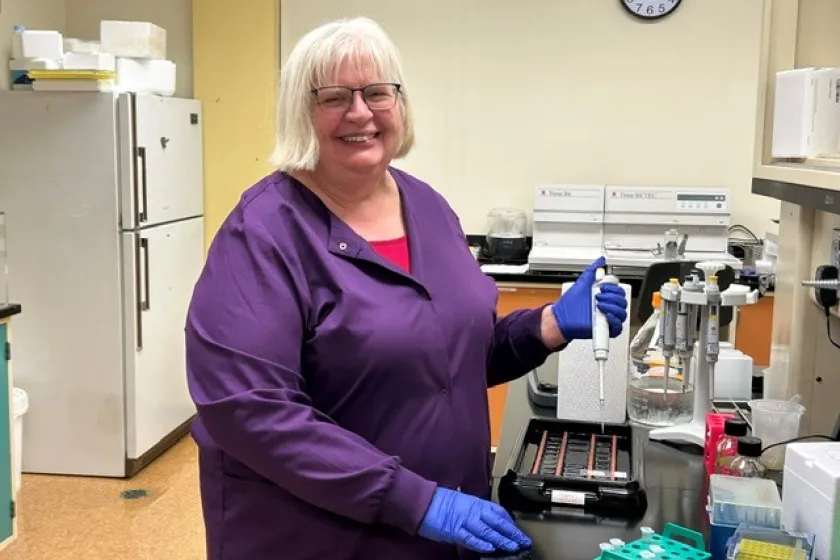
Histology is the study of the cell structure of tissues through sectioning and staining samples. Basically, using various machines and processors, lab manager Ginny Montgomery transforms a physical sample into colorful slides that can be examined under a microscope. “I call it coloring for adults,” she says.
Graduate student Jennifer Hurlbert has been working in the histology lab with some muscle samples collected from her beef bull project. She is working on determining the effects of maternal nutrition during the second trimester of pregnancy on skeletal muscle development in the offspring developed as breeding bulls.
Jennifer and Ginny used a trichrome stain on samples of muscle collected from the longissimus dorsi, which allows them to characterize and quantify the size and number of the muscle fibers (red) and quantify collagen content (blue) within the sample.
This information will help determine if prenatal nutrition altered how many muscle fibers were established in the calf as a fetus and if that translated to greater skeletal muscle growth postnatally. So the slides are not just colorful but consequential.
Ginny started at the NDSU Histology Lab in 2023 after nearly 20 years as a histologist. “No one knows about histology,” Ginny says. In fact, she went through her entire college career never learning anything about it. An example helps most people: “A biopsy at the hospital, that’s histology.”
She enjoys working with the researchers in the department and across the university. The Histology Lab is a core facility, so anybody at NDSU can use it. Besides the Animal Sciences Department, programs that often use the lab include Plant Sciences, Pharmacy, Cereal Science and Biology.
Undergraduate students sometimes work in the lab, often through the Duncan Scholars Program. The program is offered by the College of Ag and provides funding to students taking on significant research responsibilities under faculty mentorship. The students are a great addition, Ginny says, and at the very least, this keeps them from repeating her fate of never hearing about histology in college. They also learn valuable lab skills that they take with them into future careers.
No matter how many slides she creates, Ginny never gets bored. “Histology is always about learning more because you never know everything,” she says. “I always learn something.”