
Title

Flax Production for Oil and Seed in North Dakota

(A1038, Revised September 2026)
Summary

A general publication on flax production and pest management in North Dakota.

Other Authors

Greg Endres, NDSU Extension cropping systems specialist - emeritus

Ana Carcedo, NDSU Extension broadleaf crop agronomist

Sam Markell, NDSU Extension plant pathologist

Ken Hellevang, NDSU Extension ag engineer - emeritus

Availability
Availability:
Web only
Publication Sections

History and Use

Flax (Linum usitatissimum) production has a long history. Flax remnants were found in Stone Age dwellings in Switzerland, and ancient Egyptians made fine linens from flax fiber. Flax production moved west across the northern U.S. and Canada during the 1800s.

As settlers moved west, flax was among the first crops produced. North Dakota farmers have grown flax since prairie sod was broken.

Producers grow two types of flax: seed flax for the oil and nutritional value of its seed, and fiber flax for the fiber in its stem.

Today, producers in the upper Midwest and the Prairie Provinces of Canada primarily grow seed flax. North Dakota is the leading producer of flax in the U.S. Flax is grown as a low-input crop, with good returns on investment, and as a rotational crop.

Flax seed is crushed to produce linseed oil and linseed meal. Linseed oil has many industrial uses, including oil-based paints and linoleum flooring, as well as livestock feed.

Interest in healthful diets for humans and animals is increasing the demand for flax seed.

Human consumption of flax seed is beneficial because of its high dietary fiber, omega-3 oils and anticarcinogenic lignans. Some consumers use flax seed oil as a vegetable oil. Whole, or more often ground, flax seed is consumed mostly in bakery products.

Flax seed and meal can be included in diets for livestock (swine, chickens and horses) and pets.

While fiber flax used to be an important crop in the U.S., almost none is grown commercially now. Fiber flax production dropped dramatically during the 19th century as cotton replaced flax as the country’s dominant plant fiber. Some fiber flax is still grown in Canada. Fiber in seed flax stems can be used to make fine paper and linen.

Growth and Development

Flax is an annual plant with a single main stem. At low plant populations, it is common to see branching at the base of the main stem, similar to tillers in a cereal grain. The stems terminate in a multibranched inflorescence that bears blue (or, rarely, white) flowers. Flax grows to a height of 20 to 30 inches.

The plant has a taproot that may penetrate to 40 inches if growing conditions are favorable. It requires a 50-day vegetative period, a 20- to 25-day flowering period and an extra 25 to 30 days to reach maturity. In years with adequate moisture and wet fall conditions, the maturation period may extend until a hard frost kills the crop, with new flowers continuing to emerge until then.

Flax is a self-pollinating crop. Seed is produced in a boll or capsule. A complete boll can have 10 seeds, but most bolls will have fewer, averaging around six seeds. Heat stress during flowering may reduce the pollen viability and pollination, which results in a reduced number of seeds per boll and/or fewer bolls per plant.

Seeds can be brown or yellow (golden). Producers growing yellow flax varieties must take care to avoid contaminating their harvest with brown flax.

The presence of off-color seeds in a flax sample can result in steep discounts if marketed as human food.

The seed is covered with a mucilaginous coating. This coating becomes sticky when wet. During a wet harvest, this coating may discolor, giving the seed a weathered appearance and a reduced test weight. Wet flax is very difficult to thresh and can clog combines.

Growing Flax

Flax can be grown on most soils in North Dakota. However, poorly drained soils, soils subject to drought and erosion, and soils high in soluble salts should be avoided. Flax fits well in a rotation with small-grain crops.

For optimum yield and disease control, do not plant flax more often than once in three years in any rotation. Also, avoid planting flax after potatoes, canola and sugarbeets.

Select a flax variety adapted to your area. Agronomic and seed yield, and quality performance can be obtained in NDSU Extension publication A1105, “North Dakota Flax Variety Trial Results and Selection Guide,” (https://www.ndsu.edu/agriculture/ag-hub/ag-topics/crop-production/crops/flax) available on the NDSU Extension website or at Extension offices.

Consider planting certified seed because it is tested to ensure minimal weed content, high genetic purity and good seed viability. Certified seed consistently yields more than bin-run seed. All recent varieties have an adequate oil yield and oil quality (iodine number) to meet industry specifications.

Treating flax seed with fungicide is recommended. Seed treatment reduces seed decay and seedling blights and can increase stand significantly. A thicker and more uniform stand produces higher yields.

Yellow-seeded flax varieties are more susceptible to seed decay than brown varieties. Treated seed stored for long periods needs to be retested for germination before use.

Fertilizing Flax

Use soil testing as a guide for applying fertilizer.

A maximum of 80 pounds per acre of nitrogen (soil plus N fertilizer) should be present in a conventionally tilled field and 50 pounds per acre of N in a long-term no-till field. Nitrogen should be limited to these levels to avoid excessive vegetative growth and lodging (Table 1).

If the environment is favorable for higher yields, a higher N release from organic matter will provide the additional N needed in most situations.

Phosphorus application is generally not recommended for flax production. Research data suggested flax showed no yield response to added phosphorus fertilizer. Phosphorus can be applied to flax to maintain soil levels needed for more responsive crops such as wheat or corn; however, no increase in flax yield should be expected regardless of the soil test level.

Table 1. Nitrogen and potassium nutrient recommendations for flax.
Soil Test Potassium, ppm
Soil N plus fertilizer N required1VL 0-40L 41-80M 81-120H 121-160VH 161+
lb/acre (top 2 feet)K2O2 lb/acre
80775432100

Nitrogen recommendation = 80 pounds of nitrogen (N) per acre minus STN minus PCC.

STN is soil test nitrate nitrogen sampled to 2 feet in depth.

PCC is previous crop nitrogen credit (40 pounds of N per acre if the previous crop was an annual legume).

1 - N is limited to 80 pounds per acre for flax grown with conventional tillage and 50 pounds per acre for flax grown in a long-term no-till field.

Zinc deficiency may occur on flax in North Dakota, so information on zinc levels should be requested when soil testing. If soil zinc levels (DTPA extract) are less than 1 part per million (ppm), zinc application is recommended before or at seeding.

Recommendation details for fertilizer use in flax are in NDSU Extension publication SF717, “Fertilizing Flax.” (https://www.ndsu.edu/agriculture/extension/publications/fertilizing-flax-0)
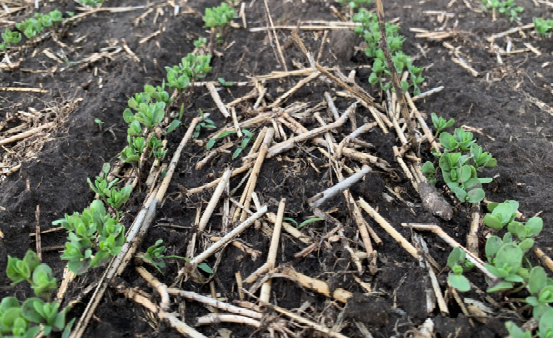
Green rows of seedling flax with emerging true leaves growing in a field.
Photo Credit:
NDSU photo
Desirable stand of seedling flax with emerging true leaves.

Seeding Flax

Flax should be seeded into firm, moist soil. A well-prepared, firm seedbed will ensure seeding at the proper depth. This, in turn, will result in uniform germination and rapid, even emergence. Recommended planting depth is 0.75 to 1.5 inches.

Avoid deep seeding because delayed emergence weakens seedlings, which are more likely to die. Also, flax seedlings are less able to force their way through a soil crust when seeded deeply.

Flax can be grown successfully in no-till systems and does well when seeded into high-residue conditions as long as seeding depth is maintained.

When using preplant-incorporated herbicides, shallow planting is a must to reduce stress on emerging flax seedlings.

A stand of 70 plants per square foot is desired. However, if uniform, stands of 30 to 40 plants per square foot may provide a satisfactory yield. As stands drop below 30 plants per square foot, weed competition and delayed maturity are potential problems.

Seeding rates of 25 to 45 pounds per acre are common. In general, use lower rates (25 to 35 pounds) in western North Dakota and higher rates (35 to 45 pounds) in the east. Seed size varies among varieties, which should also be considered. Yellow-seeded varieties may require higher seeding rates because of lower seedling vigor. If untreated seed is used, then higher seeding rates are recommended.

Early seeded flax generally produces the highest yields, as flax is a cool-season crop.

Frost seldom kills flax seedlings. Seedling plants just emerging (breaking ground) are the most susceptible to injury, but can withstand temperatures down to 28 degrees Fahrenheit for a few hours. After the seedlings have a second leaf, they can withstand temperatures in the low 20 degrees range.

Delayed sowing may aid in weed control, but it almost always results in lower yields. A lack of uniform maturity and ripening is a problem in late-seeded fields, so additional management at harvest often is needed.

Pests

Weed Control

Flax is less competitive with weeds than small grain and should be grown on relatively clean fields. Control weeds following the harvest of the preceding crop. Postharvest tillage of small-grain stubble will prevent weed seed production, suppress perennial weeds and encourage annual weed seed germination prior to freeze-up.

In no-till production, fall weed control in the season prior to planting flax is key. A late fall application that controls emerged winter annuals and provides soil residual activity helps ensure optimal conditions for flax establishment.

Delayed flax seeding with tillage prior to seeding will control wild oats and reduce infestations of other early germinating weeds.

Spring soil-applied herbicides reduce weed emergence and minimize early weed competition, thereby maximizing flax yields.

POST herbicides applied to small weeds and flax soon after weed emergence usually give better control and allow more time for the flax to recover from possible herbicide injury than when the weeds and flax are larger. POST weed control options in flax include bromoxynil, MCPA, Curtail M (or generic clopyralid) and Stinger HL.

Grass Weed Control

Assure II/Targa, Poast and clethodim are all grass-controlling herbicides labeled for use in flax. See individual labels for mixing guidelines when used in combination with broadleaf herbicides.

Preharvest Weed Control

For preharvest herbicides, selection should be based on the crop’s intended use and weed-control needs.

Desiccants labeled for use in flax in North Dakota include glyphosate, Defol 5, Reviton, Sharpen, Valor SX and Valor EZ. Do not apply glyphosate or Sharpen to flax grown for seed because reduced germination may occur. Pay attention to the required preharvest interval for each product.

For more information on all herbicides labeled for use in flax, refer to NDSU publication W253 “North Dakota Weed Control Guide” (https://www.ndsu.edu/agriculture/extension/publications/north-dakota-weed-control-guide). Always read and follow the label for all pesticides.

Insects

Insect problems and yield loss may occur in any year. Follow a program of timely field monitoring to catch problems early. Know the economic threshold levels for the various insects and apply control measures promptly.

The following insects can be problematic in flax:

Grasshoppers – Grasshoppers can be a problem, especially near or at harvest. Flying adults invade from neighboring fields. Damage is caused by grasshoppers chewing through the succulent portion of the stems below the bolls, which causes the bolls to drop to the ground. Seedling feeding may be a problem in late-seeded fields.

Cutworms and armyworms – Larvae of one or more cutworm species are known to cut and consume seedlings at the soil level. Damage is often severe by the time the infestation is apparent. Armyworm larvae feed on foliage in midseason.

Aster leafhopper – Leafhoppers feed on the plant juices. This insect infects the plant with the aster yellow mycoplasma when feeding. The aster yellow disease is also observed in canola, sunflowers and several broadleaf weeds.

Aphids – Aphid populations can increase rapidly and have been observed on flax. However, most years, their numbers are not high enough to cause economic loss.

Wireworm – This insect, while mostly a pest of cereal grains, occasionally can cause reduced stands in flax.

For information on insect control, consult NDSU publication E1143, “Field Crop Insect Management Guide”
(https://www.ndsu.edu/agriculture/extension/publications/north-dakota-field-crop-insect-management-guide).

Diseases

In the past, disease losses were largely responsible for the perception that flax is a risky crop. In recent years, due to the widespread use of disease-resistant varieties, disease losses have been smaller in flax than in most other annual crops.

To guard against flax diseases, be sure to grow resistant varieties, use seed treatments, plant early, use sound disease-free seed and avoid planting flax after flax in the rotation.

Consult NDSU Extension publication PP622, “North Dakota Field Crop Plant Disease Management Guide.”
(https://www.ndsu.edu/agriculture/extension/publications/north-dakota-field-crop-plant-disease-management-guide)

The diseases most often associated with flax production are:
DiseaseControl Practice
Flax wiltPlant resistant variety
Flax rustPlant resistant variety
PasmoCrop rotation, fungicide application
Aster yellowsearly seeding
Root rots, damping off and seedling blightsclean seed, seed treatment and crop rotation

Heat canker is a physiological reaction of the young seedling to high temperatures at the soil surface. Thin stands on dark soils are most susceptible. If plants are injured when small, the plants fall over and die. When plants are larger, the outer stem tissue responds by producing additional cork tissue at the damage site. This wound tissue is brittle, and plants may break at the soil line from strong wind. Early planting and surface residues help reduce heat canker in most years.

Harvesting and Storage

Flax maturity can be judged by the color of the bolls. Flax should be harvested when 90% of the bolls turn brown. The stems may remain green after the bolls are ready to harvest.

Flax with green stems is the most difficult of all grains to cut. Sharp, well-adjusted cutter bars are essential.

Flax can be straight-combined if maturity is uniform and green weeds are not a problem. If flax is swathed and pickup combined later, a tall stubble (4 to 6 inches) is desirable to hold the swath off the ground and allow for even drying. Using swath rollers can help settle the swaths into the stubble to reduce wind damage and aid pickup combining.
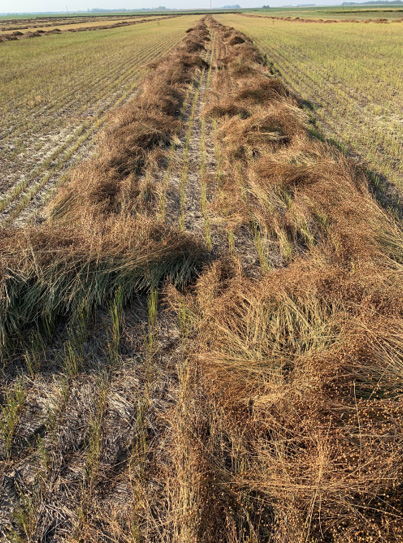
Mature, golden flax swathed into double rows in a field, ready for seed harvest.
Photo Credit:
NDSU photo
Double swathes of flax ready for seed harvest.

Follow manufacturers’ recommendations to reduce seed damage during combining. Some combines have special rollers ahead of the cylinder to fracture the flax boll. The flax seed coat is damaged easily, so proper adjustments are necessary. Yellow-seeded varieties are more susceptible to seed damage because of their thinner seed coat.

Flax seed is safe to store at 10% moisture short term with cool seed temperatures and at 8% long term at warm, 70-degree summer temperatures. Flax needs to be stored at a lower moisture content (7%) at warmer temperatures. Higher moisture will result in heating and mold growth. For an estimated allowable storage time add 6 percentage points to the flax moisture content and use an AST table for cereal grains. For example, 11% moisture flax would be equivalent to 17% wheat.

Drying flax may be required in some years. Natural air drying during October is expected to successfully dry flax to the short-term storage moisture content. A minimum airflow rate and expected drying time is shown in the following table.

Moisture ContentAirflow (cfm/bu)Fan Time (days)
13%1.0033
11%.7537
1.0028

The resistance to airflow is much greater for flax than for wheat. A centrifugal fan will be required, and the depth will need to be limited to about 8 feet. Typically, natural air drying is limited for a flax moisture content of 13% or less. High-temperature drying is an option for drying flax. The resistance to airflow will be high, so the airflow rate and drying time will be lower than those experienced with other crops. Since flax is an oil crop, use care to prevent dryer fires similar to when drying oil sunflower.

Flax seed often comes from the combine with large amounts of green weed seed dockage. A good management practice is to remove green weed seed before storage.

Systematic bin monitoring is recommended. Flax storage should be managed similarly to other grains and oilseeds. The flax should be cooled with aeration for 20 to 30 degrees for winter storage and kept cool (below 40 degrees) as long as possible during spring and summer. Producers must also have tight storage bins, as even small holes or cracks can cause bin leakage.

Enter flax bins with caution. Flax seed in storage flows easily and supports limited weight. Lives have been lost by people falling into seed flax bins and becoming engulfed and dying from suffocation.

Insect pests in stored grain are not usually a problem in short-term storage. If flax seed is stored for a year or more, then monitor for hard-bodied grain weevils.

Seed Flax Straw

Combines should be equipped with straw choppers and spreaders to redistribute the straw evenly. Burning flax residue was once a common practice, but this is no longer recommended. If industrial markets develop for seed flax straw, other methods of collecting straw and transporting it from the field will need to be identified.

Green flax straw may pose a prussic acid problem if used as livestock feed. Use caution in feeding flax straw or grazing, especially immediately after a frost.

References

Growing Flax – Production, Management and Diagnostic Guide. Fifth Edition. Flax Council of Canada.
(https://www.flaxcouncil.ca/agronomy/grower-manual)

This publication was authored by Duane R. Berglund, professor emeritus and former Extension agronomist, and Richard K. Zollinger, professor emeritus and former Extension weed specialist, NDSU, 2007.

NDSU Extension logo