

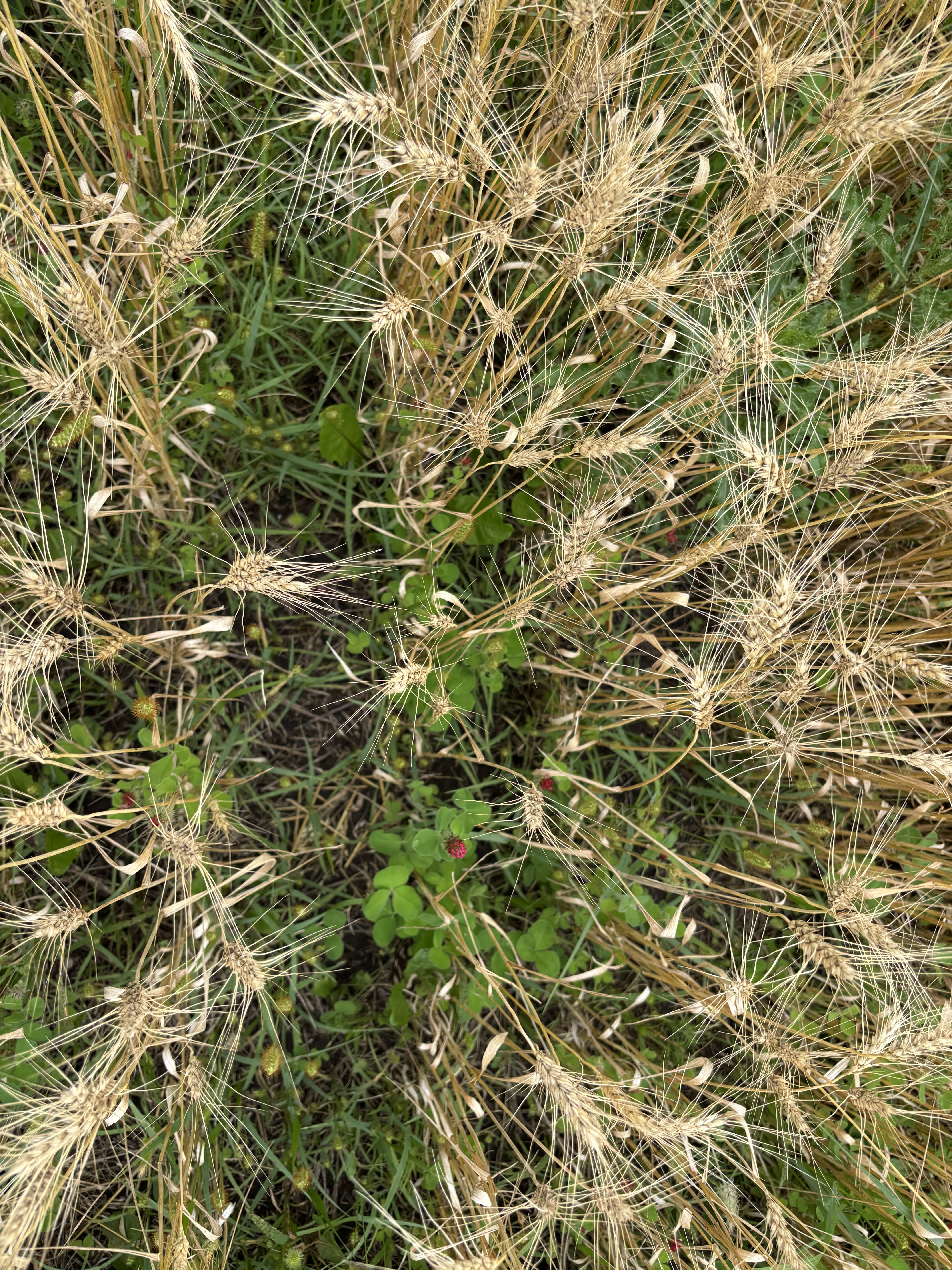
Interseeding legumes with HRSW
Interest in reducing fertilizer inputs has increased greatly in North Dakota over the past few years. The concept of seeding legumes with HRSW is not new: our ancestors seeded sweet clover or possibly alfalfa with wheat prior to the widespread adoption of commercial fertilizers. However, now we have a myriad of interseeding options at our disposal. We screened literature and talked to producers to identify legume species that may fit well in our systems. We included sweet clover in the study as a legume check based on previous research done in the area.
These trials were conducted without additional nitrogen fertilizer so that treatment differences would not be masked by its effect. We will also grow a test crop without fertilizer the following year to determine if there is any impact based on the residual effects of these treatments.
In the first year HRSW was interseeded with legumes and in the second year HRSW alone was planted back as a test crop.
The legumes and HRSW were seeded together at the same depth of no more than half an inch. This is more shallow than a normal HRSW seeding depth and deeper than desired for several of the legumes. Ideally, we would want to plant the HRSW and legumes at their appropriate seeding depths.
These trials were conducted in conventional tillage until 2021 and then in no-till starting in 2022.
Precipitation for the test years was as follows:
- The year 2018 started out dry in April, followed by below average precipitation in May, above average precipitation in June and below normal precipitation the remainder of the growing season but with timely rains.
- 2019 also had below average precipitation in April and May, followed by above average precipitation in June & July.
- 2020 rainfall was well below average for the entire season with the exception of July.
- 2021 also had little significant rainfall after seeding. This lack of rain impacted grain yield and cover crop establishment with no treatments being significantly higher than others.
- In 2022, April and May had rainfall amounts that were well above average, followed by well below normal precipitation the remainder of the growing season.
- In 2023 the precipitation was near normal throughout the growing season.
Below are the combined results of all the trial years.
| First year HRSW seeded with legumes | Test crop the following year | ||||||||
| Treatment | Test Weight (lb/bu) | Protein (%) | Grain Yield (bu/A) | Legume Stand (plants/sqft) | Treatment | Test Weight (lbs/bu) | Protein (%) | Grain Yield (bu/A) | |
| Check | 60.5 | 15.1 | 28.5 | 0.0 | Check | 54.1 | 12.0 | 25.9 | |
| Indian Head black lentil | 60.1 | 15.3 | 27.5 | 7.5 | Indian Head black lentil | 54.9 | 11.3 | 24.0 | |
| Alsike clover | 60.3 | 15.1 | 28.0 | 11.3 | Alsike clover | 54.3 | 11.1 | 19.0 | |
| Balansa clover | 60.2 | 15.2 | 28.9 | 6.1 | Balansa clover | 56.1 | 11.5 | 25.0 | |
| Berseem clover | 60.2 | 15.3 | 30.4 | 12.1 | Berseem clover | 57.3 | 11.3 | 24.3 | |
| Crimson clover | 58.4 | 15.2 | 27.7 | 25.4 | Crimson clover | 56.3 | 11.1 | 22.2 | |
| Hubam clover | 59.5 | 15.4 | 28.6 | 18.2 | Hubam clover | 55.2 | 12.2 | 30.0 | |
| Persian clover | 59.6 | 15.2 | 26.3 | 4.9 | Persian clover | 56.3 | 10.8 | 24.5 | |
| Red clover | 60.0 | 15.1 | 27.9 | 26.3 | Red clover | 56.3 | 11.3 | 23.8 | |
| Subterranean clover | 59.9 | 15.3 | 28.0 | 16.3 | Alsike clover | 54.8 | 11.2 | 24.6 | |
| Sweet clover | 60.0 | 15.3 | 28.9 | 14.3 | Sweet clover | 56.7 | 12.0 | 20.1 | |
| Barrel medic | 60.7 | 15.0 | 27.7 | 19.0 | Barrel medic | 55.5 | 11.5 | 26.1 | |
| Burr medic | 59.9 | 15.3 | 27.9 | 18.6 | Burr medic | 54.5 | 11.2 | 30.0 | |
| Snail medic | 60.0 | 15.0 | 26.9 | 19.7 | Snail medic | 55.7 | 11.4 | 26.5 | |
| Birdsfoot trefoil | 60.3 | 15.3 | 29.9 | 4.4 | Birdsfoot trefoil | 55.3 | 11.7 | 27.1 | |
| Trial Mean | 60.0 | 15.2 | 28.2 | 13.6 | Trial Mean | 55.6 | 11.4 | 24.9 | |
| C.V.% | 5.4 | 4.2 | 18.8 | 57.8 | C.V.% | 5.0 | 11.2 | 31.9 | |
| LSD 5% | NS | NS | NS | 4.3 | LSD 5% | NS | NS | NS | |
In summary, these practices should be utilized in as close-to-clean, weed-free fields as possible to be successful, as your herbicide program may be limited by most of these treatments.
Take-aways:
- It is important to note that none of these treatments had a negative impact on the first-year HRSW production.
- Also, none of these treatments had a statistically significant positive or negative impact on the following years HRSW test crop.
- Crimson clover and red clover had the significantly highest stand establishment.
- Followed by the medics and hubam and subterranean clovers which were significantly higher than the sweet clover check and the remainder of the treatments.
- At this point, it looks like the crimson, red, hubam, and subterranean clovers along with barrel, burr, and snail medics consistently establish adequate stands.
Interpreting data tables can be challenging, but we are familiar with the studies and the data. Please contact me with any questions or to discuss this research in more detail.
Ezra Aberle
Ezra.Aberle@ndsu.edu
Research Agronomy Specialist
Long-Term Cropping Systems Manager
