2025: Evaluation of Seed Treatments to Manage Verticillium Stripe on Canola
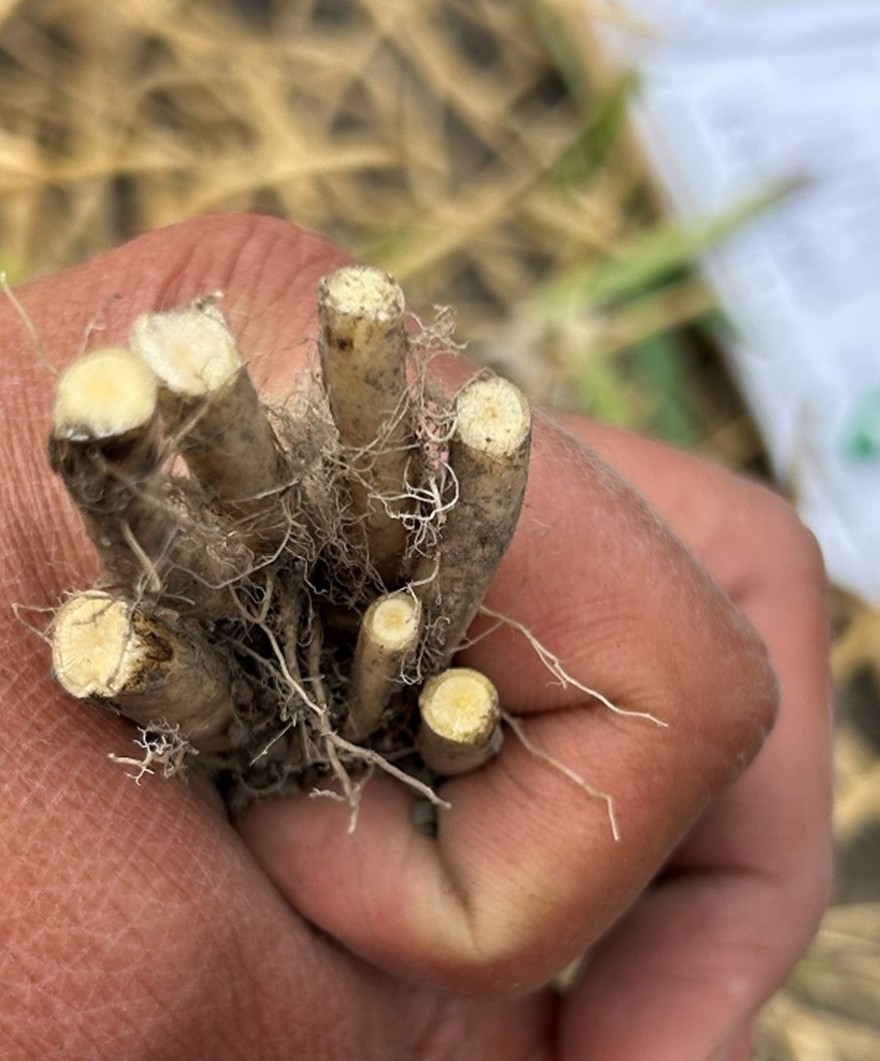
(Research Report, Langdon REC, December 2025)A research trial was conducted at the Langdon Research Extension Center to evaluate the effectiveness of seed treatments for managing Verticillium in canola. The trial began on May 28, 2025, using the canola cultivar ‘InVigor L233P’ and a range of seed treatments, which were compared to non-treated seed. The experimental design was a randomized complete block structure with four replications. State-recommended protocols were followed for land preparation, fertilization, seeding rate, and weed control. Each plot measured 5 feet in width by 16 feet in length. Verticillium inoculum was produced by culturing isolates on wheat spawn in the laboratory in March 2025 and was applied at planting. After swathing, twenty-five canola stubbles per plot were evaluated for Verticillium incidence and severity by observing infection levels on the cross-sections of stems selected for rating (Figure 1). Disease severity was assessed on a 0-100% scale, where 0 indicated no visible disease tissue in the cross-section and 100% indicated dead or fully diseased tissue. The Verticillium mean disease severity index was calculated by multiplying the mean incidence by the percent severity and dividing the product by 100. Data were analyzed using analysis of variance with complete-block and balanced-orthogonal designs generated by Genovix Generation II software.
Table 1: Efficacy of seed treatments on Verticillium stripe incidence, severity, index, plant stand, yield and test weight on canola.
Verticillium Stripe | Yield | Test Weight | ||||
|---|---|---|---|---|---|---|
| Treatments | % Incidence | % Severity | Index | Plant Stand/A | (lbs/a) | (lbs/bu) |
| Trunemco | 21 | 8 | 2 | 127,015 | 2214 | 51 |
| Saltro | 23 | 8 | 2 | 138,803 | 2184 | 51 |
| Evergol Energy | 20 | 5 | 1 | 123,874 | 2185 | 51 |
| Intego Solo | 25 | 7 | 3 | 125,462 | 2257 | 51 |
| Rancona Summit | 14 | 4 | 1 | 127,686 | 2358 | 51 |
| Trilex | 19 | 5 | 1 | 141,979 | 2298 | 51 |
| Mertect | 20 | 5 | 1 | 124,192 | 2209 | 51 |
| Non-Treated | 45 | 20 | 9 | 123,556 | 2106 | 52 |
Mean | 23 | 8 | 2 | 129,071 | 2226 | 51 |
CV % | 44 | 45 | 75 | 18 | 7 | 0.9 |
LSD | 15 | 5 | 3 | NS | NS | NS |
P-Value (0.05%) | 0.0147* | 0.0001* | 0.0001* | NS | NS | NS |
Results: The evaluated seed treatments resulted in significant differences in Verticillium stripe incidence, severity, and index, suggesting that the seed treatments may effectively manage Verticillium stripe. Notably, the Rancona Summit treatment produced the highest yield, while the non-treated control exhibited the lowest yield (Table 1). There were no significant differences detected for plant stand, yield, or test weight.
Figure 1: Verticillium stripe incidence and severity ratings were recorded by making the cross section of the canola stems at the collar region.